

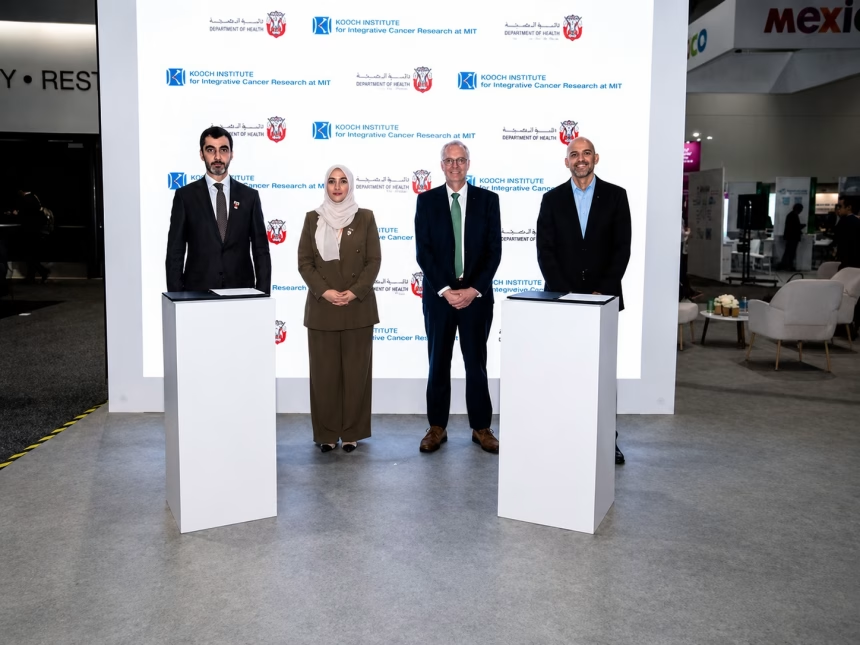

The Department of Health – Abu Dhabi (DoH) and the MIT Koch Institute for Integrative Cancer Research have announced a strategic collaboration to advance AI-enabled oncology research, translational science, and bioconvergence innovation.
The partnership aims to combine the MIT Koch Institute’s research expertise with Abu Dhabi’s life sciences ecosystem to accelerate the translation of scientific discoveries into real-world healthcare solutions.
Aligned with the UAE National Cancer Strategy, the collaboration will focus on developing large-scale clinical trials, translational research, and population-specific cancer studies. It also includes participation in MIT’s Bioconvergence Cancer Alliance and the establishment of shared research databases and biobanks to support oncology research.
H.E. Dr. Noura Khamis Al Ghaithi, Undersecretary of the DoH, said: “We define innovation by the impact it creates at a population-level. Our partnership with the MIT Koch Institute is built on this principle and focuses on building an all-encompassing sustainable ecosystem that empowers knowledge sharing, scientific discovery and applied innovation. Together, we will advance new approaches to cancer research, talent development and bioconvergence innovation while creating new opportunities to build, test and scale solutions that can benefit patients in Abu Dhabi and around the world.”
Click here to join our WhatsApp channel here
Matthew Vander Heiden, MD, PhD, Director, MIT’s Koch Institute for Integrative Cancer Research at MIT notes “We believe addressing complex health challenges requires collaboration across disciplines, sectors, and geographies and are delighted to welcome our new collaborators in Abu Dhabi to the Alliance. We look forward to connecting MIT’s research community with Abu Dhabi’s growing healthcare innovation ecosystem, to exploring together new opportunities in oncology, AI and precision medicine, and ultimately to improving patient outcomes.”
Beyond research, the partnership will also support talent development through physician-scientist fellowships, exchange programmes, and joint learning initiatives. In addition, a bioconvergence incubator will be established to help startups develop innovative healthcare solutions by providing mentorship, expertise, and investment support.
Also read: WHO adds first diagnostic test for Ebola Bundibugyo virus to its Emergency Use Listing