


“I will remember that there is art to medicine as well as science, and that warmth, sympathy, and understanding may outweigh the surgeon’s knife or the chemist’s drug.”
— Modern Hippocratic Oath
Did you ever wonder what the difference is between treating and caring? On the surface, they may appear alike, two words tied to the same noble profession. However, they diverge in subtle yet profound ways. Treating is about applying science to identify a disease, prescribe the right drug, and perform the correct procedure. Caring, on the other hand, reaches beyond that science. It is the way a physician adjusts their tone to be appropriate for each situation, choosing kindness and compassion over judgment and arrogance. It is pulling up a chair instead of standing at the door, remembering that you are meeting someone’s fear, perhaps even their worst nightmare, rather than simply another diagnosis from a textbook. Medicine, then, is not whole unless the art of caring meets the science of treating, together forming inseparable pillars of a doctor’s identity.
Also Read: We Learn, We Teach, We Continue
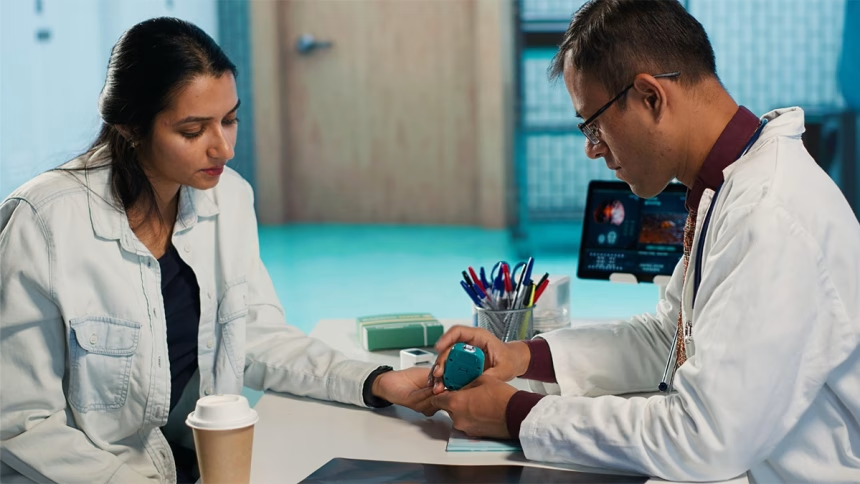
I remember observing two very different encounters with women diagnosed with multiple uterine leiomyomas. In the first, the doctor delivered the diagnosis in a matter-of-fact tone, listing the findings from the ultrasound: variable-sized fibroids scattered across the uterus, some larger, some smaller, explaining the pain, the heaviness, the pressure on the bladder. The doctor briefly outlined the treatment options, recommended surgery, and handed over a prescription to help in the meantime. It was efficient and medically correct. However, the patient sat there silent, her eyes running over the paper with confusion as if it was written in a foreign language. She had not asked a single question, though her eyes revealed a storm of them. She left the room with treatment, but not understanding. She had been treated, but not cared for.
In the second encounter, another woman with the same diagnosis sat across from her doctor, visibly anxious. She carried a heavy burden: she believed she had caused this condition herself. In her words, she had “done something wrong” to reach this stage. Before discussing surgery or medication, the doctor paused, letting her speak. After the patient revealed all her concerns, the doctor gently clarified that leiomyomas are benign smooth muscle tumors of the uterus, influenced by hormonal and genetic factors, not by personal fault or failure. She was not to blame; this is a common condition experienced by many women. The doctor also explained its connection to the pain, pressure, and urinary incontinence she had been experiencing, and reassured her that treatment was available. The doctor still recommended the same surgery that any gynecologist might have, but now it was received with understanding and awareness. The patient left not only with a plan, but with clarity, reassurance, and the comfort of knowing that her fears were heard.
Click here to join our WhatsApp channel here
Reflecting on these two situations, I could not help but wonder if the first patient had carried the same hidden self-blame, unspoken and unanswered. Perhaps all she wanted, like the second patient, was to understand what was happening to her body. The science of treatment was never in question; both received correct medical advice. However, one left feeling alone with her illness, while the other left knowing she was seen and heard as a person. The science may have been the same in both rooms, but the art of caring made all the difference.
As students, we may not yet be prescribing medications or performing surgeries, but we still face the same choice between treating and caring. During ward rounds, it is easy to focus only on reporting lab values, listing differential diagnoses, presenting cases in perfect order, and trying to impress the supervising doctor with all the information we have prepared. That is treating in its clear scientific form. Yet caring can be practiced even then by, for example, pulling the blanket up for a shivering patient, explaining in simple words what is happening, or remembering the name of the person in the bed rather than just the diagnosis on the chart. These gestures do not take away from the science but deepen it. They remind us that medicine is always about the patient, not the condition recorded in their file, but the human being living through it.
I began to realize that the physicians who inspired me most were not just the ones who knew every guideline or ordered the most thorough workup, but those who carried both knowledge and humanity equally. I came to understand that the true art of medicine is not in trying to impress the patient with all the knowledge one possesses or in making a treatment plan seem simple after years of experience. True success is knowing how to support the patient emotionally before addressing their illness clinically, meeting their fears with reassurance, their confusion with clarity, and their vulnerability with respect. For students, this means thinking beyond, “What is the proper order to follow in the management of this condition?” and instead asking, “What does this patient most need from me right now?” Sometimes it will be a specific answer about physiology; other times it will be a kind word that eases their fear. Both are medicine. Both matter.
Remember that as you progress through your training, acquiring theoretical knowledge is only part of becoming a competent physician. Equally important are the skills that allow you to apply that knowledge with empathy, warmth, and understanding. Take the time to listen, be present, offer reassurance, and treat each patient as a whole person with emotions, not just a set of symptoms. These abilities will support your scientific expertise and help you flourish not only as a professional but also as an ethical, humane doctor. In the practice of medicine, it is not only the treatments we deliver but the care we offer that leaves a lasting impact on patients and makes the greatest difference.