


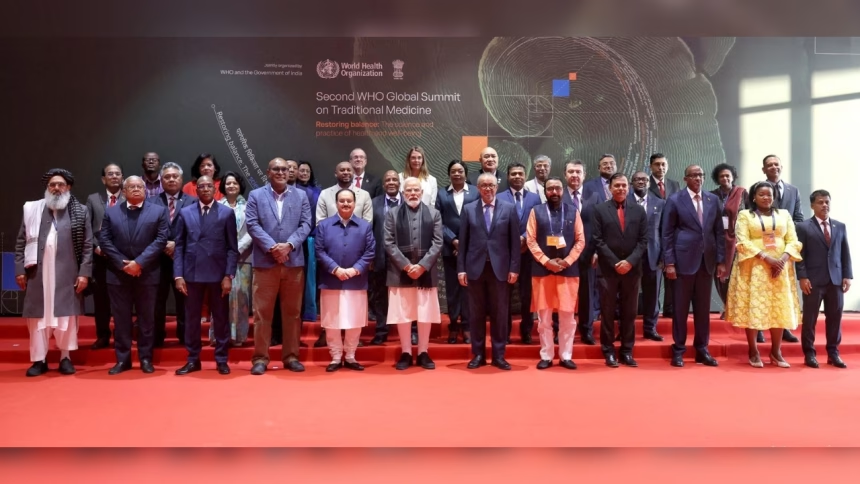
The second WHO Global Summit on Traditional Medicine, co-hosted with the Government of India, concluded in New Delhi, marking a significant moment for global health collaboration. The event attracted more than 16,000 online registrations and brought together 800 in-person participants from over 100 countries, including ministers representing more than 20 nations. Supported by a programme of 160 speakers, the Summit highlighted how traditional medicine can contribute to stronger health systems through safer, evidence-based and affordable care.
Also Read: African Medical Centre of Excellence achieves two landmark successes
The gathering saw ministers, researchers, Indigenous representatives and practitioners unite to advance the WHO Global Traditional Medicine Strategy 2025–2034, with a strong emphasis on implementation rather than discussion alone. During the Summit, WHO launched the Traditional Medicine Global Library, a pioneering digital platform that brings together 1.6 million resources ranging from scientific research to Indigenous knowledge. Equipped with tools such as Evidence Gap Maps and an AI-enabled assistant, TMGL GPT, the platform is expected to enhance access to reliable information and accelerate research efforts globally.
Innovation was a central theme with the introduction of Health & Heritage Innovations, an initiative designed to support novel ideas that connect traditional practices with advanced technologies including artificial intelligence, genomics and digital health. From more than 1,000 submissions, 21 finalists were selected and will take part in a year-long acceleration programme offering technical, regulatory and policy support, alongside access to investors.
Click here to join our WhatsApp channel here
WHO also announced the establishment of the Strategic and Technical Advisory Group on Traditional, Complementary and Integrative Medicine, a new body tasked with guiding the implementation of the Global Strategy. Comprising 19 independent experts, the group will help set research priorities, develop standards and advise on the integration of traditional medicine into national health systems. Its inaugural meeting during the Summit identified key focus areas, including evidence development, protection of traditional knowledge, digital innovation and capacity building.
“Through the Delhi Commitment, countries have agreed not only on why traditional medicine matters but on how to act,” said Dr Tedros Adhanom Ghebreyesus, WHO Director-General. “Traditional medicine can help to address many of the threats to health of our modern world: the growing burden of noncommunicable diseases; inequitable access to health services; and climate change. It can help to support care that is person-centred, culturally grounded, and holistic.”