

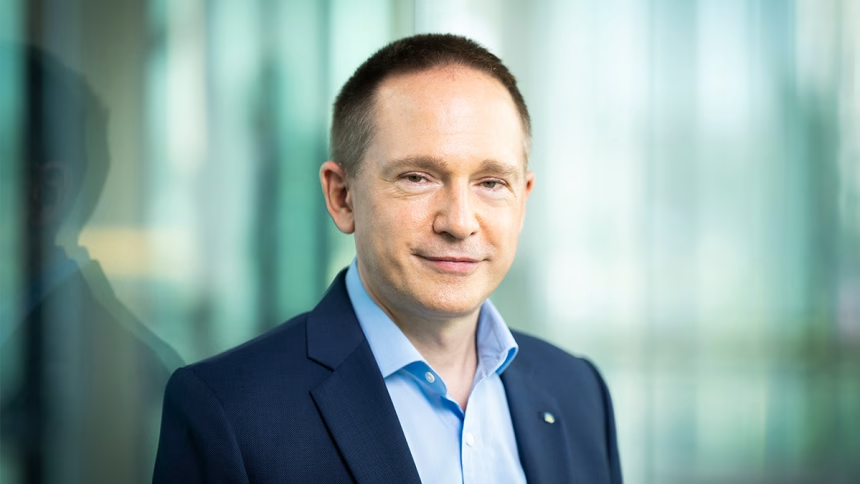

This year’s World Health Summit concluded in Berlin with strong calls for action on peace and health, along with increased investment in women’s health. Each edition of the summit serves as a framework for future healthcare developments. To learn more about the event, emerging healthcare trends, and upcoming World Health Summits, MedEdge MEA conducted a special interview with Carsten Schicker, CEO of the World Health Summit. Among the many insights he shared, one particularly notable response came when he was asked about the one defining shift he predicts in global health by 2035. Discover his answer below.
MedEdge MEA: How do you see the World Health Summit’s role evolving in shaping global health discussions and real-world impact?
Carsten Schicker: The World Health Summit (WHS) is evolving from a high-level convening into a catalyst platform that translates evidence into joint action. In a fragmenting world, our role is to bring science, politics, civil society, and the private sector to one table and convert shared responsibility into concrete partnerships and investments. We curate agendas around key priorities, pandemic and climate resilience, antimicrobial resistance, noncommunicable diseases, and digital transformation, and align leaders and changemakers on implementable pathways. As the leading platform for global health, the WHS will continue to broker cross-sector coalitions and track progress beyond the stage, so discussions result in measurable outcomes and real-world change.
ME: Which global health challenges most urgently need stronger collaboration across sectors and regions?
CS: Four global health challenges stand out;
1. Pandemic and climate resilience – strengthening health security requires coordinated investments and collaboration across health systems, environmental protection, and infrastructure development.
2. Antimicrobial resistance, which requires action from agriculture, pharma, and regulators.
3. The rise of non-communicable diseases (NCDs), where cities, employers, and education systems are as important as clinicians.
4. Digital transformation, which needs interoperable standards, data governance, and equity-by-design.
None of these can be solved by the health sector alone; they demand multilateral collaboration that leverages scientific evidence and mobilizes resources where they have the greatest catalytic effect. The WHS is the platform that brings all these different sectors together to find practicable solutions across regions and sectors.
ME: How is the World Health Summit bringing sustainability and climate resilience into the global health conversation?
CS: We have been placing climate and sustainability as core health issues on our agenda for years. That means integrating strategies for carbon reduction, climate adaptation, and system resilience; connecting health ministries with environment and finance leaders; and highlighting solutions, from climate-smart primary care to resilient supply chains, that reduce emissions, protect communities, and lower long-term costs. The WHS fosters partnerships that align health investments with broader societal resilience and stability, ensuring climate action is recognized as a strategic health investment.
ME: What changes have you introduced to make the Summit more inclusive and ensure its discussions lead to real outcomes?
CS: We have broadened participation across regions and sectors, expanded the voices of youth and people with lived experiences, and anchored our program design in scientific rigor through our WHS Academic Alliance. To make our platform more inclusive, we also hold annual Regional Meetings: in New Delhi in April 2025, we addressed South Asia’s priorities, and in April 2026 we will convene in Nairobi to focus on African perspectives. These meetings ensure local perspectives feed directly into the global debate. To drive outcomes, we design curated sessions with clear deliverables, encourage coalition announcements, and follow up with partners so that discussions translate into real-world impact beyond the annual Summits.
ME: What role does technology play in strengthening global health systems and making care more accessible worldwide?
CS: Technology is a force multiplier when it is rooted in science and best practices, designed for equity, and embedded in system reform. Digital tools can support prevention, extend primary care, improve surveillance, enable supply-chain transparency, and counter misinformation. But technology is not a substitute for governance, financing, and trust. At the WHS, we convene technologists with policymakers, clinicians, patients, and researchers to co-create solutions that interoperate, protect data, and deliver measurable impact, especially for underserved communities. We emphasize digital transformation as part of broader cross-sector strategies that build resilient, people-centered systems.
ME: If you could predict one defining shift in global health by 2035, what would it be and why?
CS: By 2035, the defining shift will be mainstreamed “resilience returns”, where governments and partners treat health spending as a strategic investment that safeguards stability, growth, and peace. Ideally, we will have built stronger, climate-smart primary care systems; sustained pandemic preparedness; and routine co-financing models that blend public, private, and philanthropic capital to reduce future costs. This shift should be driven by better evidence, cross-sector collaboration, and the recognition that health solutions generate positive spillovers for economies, security, and societies at large. The WHS will continue to catalyze this transition by uniting diverse leaders to co-create evidence-based, scalable solutions.