


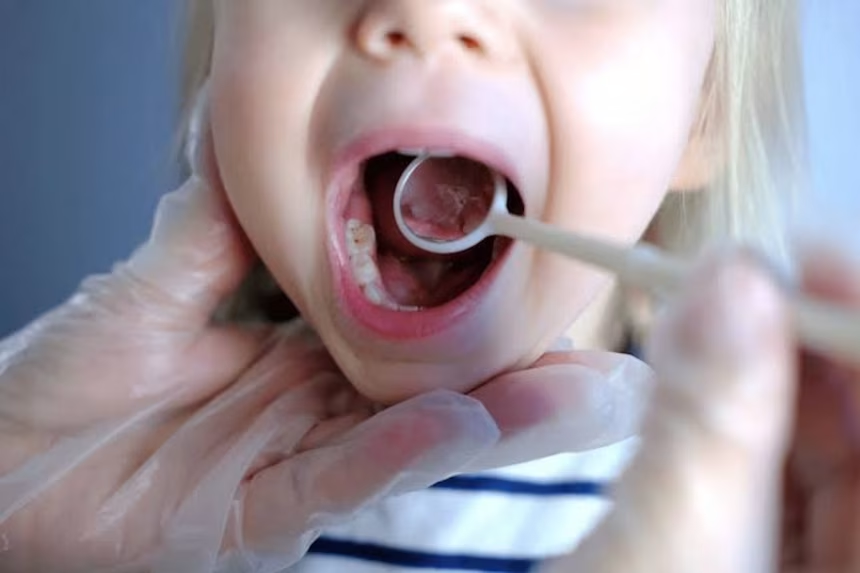

Something I have noticed in my clinic over the past few years stays with me. A child comes in, let us say six or seven years old, and a parent mentions, almost as an afterthought, that their child snores, or sleeps with their mouth open, or always seems tired despite a full night’s rest. I look at how they are sitting. I look at their jaw. Their face is telling me a story that goes far beyond their teeth. What a child’s mouth reveals about their overall health and sleep is something parents rarely expect a dentist to discuss. But it is one of the most important conversations I have.
- Screen time is changing how children breathe, and it shows in their faces
- The pacifier and thumb-sucking question: what the evidence actually says
- Vitamin D deficiency in the Gulf, and why it shows up in your child’s teeth
- Sugar in the Gulf: what dentists are seeing, and what the research confirms
- What I want parents to take away
The mouth is not a separate system. It connects directly to how a child breathes, how they grow, what they eat, and what their body is or is not getting. In the Gulf in particular, I am seeing patterns that are specific to our region, our lifestyle, and our children. Here is what I want every parent to understand.
Screen time is changing how children breathe, and it shows in their faces
This one surprise parents the most. When a child spends prolonged time looking at a screen, a tablet held low, a phone tilted down, their head drops forward, their shoulders round, and their jaw falls open. Breathing through the mouth becomes the default. Do this for a few months and it is a habit. Do it for a few years during a child’s growth period and the consequences become visible
Also read: New Whole-Milk Ready-to-Feed Infant Formula Launches in the US
Mouth-breathing in children is associated with a narrower upper jaw, a longer facial structure, crowded teeth, and even changes in bite development. The American Academy of Pediatric Dentistry recognises airway health as central to paediatric dental assessment, and rightly so. As dentists, we are often the first to spot the signs: the high, narrow palate, the open bite, the forward head posture a child walks in with.
I am not suggesting screens are the enemy. But posture during screen time matters enormously. Screens should be at eye level. Children should be reminded to close their mouths and breathe through their noses. And if your child consistently breathes through their mouth, day or night, please mention it at their next dental visit. It deserves investigation, not just observation.
The pacifier and thumb-sucking question: what the evidence actually says
This is one of the most anxious conversations I have with parents of toddlers. The short answer is: non-nutritive sucking habits, pacifiers, thumbs, fingers, are developmentally normal and not something to panic about in children under two or even three. The AAPD guidance is clear: these habits are common, they provide comfort, and for some children they resolve on their own.
The concern arises when the habit persists beyond the age of three, more so as permanent teeth begin to develop. Prolonged sucking can affect the shape of the palate, the position of front teeth, and the way the upper and lower jaws meet. The longer it continues, the more difficult reversal becomes. But here is the nuance parents often miss: the intensity of the habit matters as much as the duration. A child who passively rests a thumb in their mouth occasionally is very different from one who sucks vigorously for hours a day.
Click here to join our WhatsApp channel here
If your child is under three, it’s okay, we have time. If they are approaching four or five and the habit is still active, it is worth a conversation. There are gentle, effective interventions, and almost none of them involve shame or fear. In my experience, children stop when they feel ready and supported, not pressured, and of course with the right support from the right paediatric dentist.
Vitamin D deficiency in the Gulf, and why it shows up in your child’s teeth
Here is something that surprises almost every Gulf family I tell it to: we live in one of the sunniest regions on earth, and yet vitamin D deficiency is among the highest in the world here. The reason is straightforward: our children spend most of their time indoors, in air-conditioned spaces, away from direct sunlight. Sun avoidance is a rational response to extreme heat, but it carries a cost that few people connect to their children’s dental health.
Vitamin D is essential for calcium absorption, and both are critical for the development of strong tooth enamel and healthy jawbone. When a child’s vitamin D levels are low during the years their teeth are forming, and teeth begin forming well before they erupt, often during pregnancy and early infancy, the enamel that develops can be structurally weak. In the clinic, this presents as chalky white or yellow-brown patches on teeth, increased sensitivity, and a much higher rate of decay even in children who brush regularly and eat relatively well.
I see this regularly. A parent brings in a child with decay that seems disproportionate to their diet and habits, and when we dig deeper, low vitamin D is almost always part of the picture. A simple blood test can confirm levels, and supplementation is often straightforward. Ask your paediatrician. Ask your dentist. This is not a niche concern in the Gulf, it is a mainstream one.
Sugar in the Gulf: what dentists are seeing, and what the research confirms
I want to be careful here, because this is not about judging cultural food practices, it is about specific patterns I see clinically and what the evidence links them to. Sweetened juices, flavoured milk, and sugary snacks are consumed by young children in the Gulf at rates that are among the highest globally. The World Health Organization’s recommended free sugar intake for children is less than ten percent of daily energy, ideally below five percent. Many children in this region consume far beyond that, often beginning in infancy.
What I see as a result is early childhood caries, decay in milk teeth, at a severity that is genuinely distressing. Milk teeth are not throwaway teeth. They hold space for permanent teeth, support speech development, and matter for a child’s comfort, confidence, and nutritional intake. Decay in a two-year-old is not trivial. And the single most consistent factor across the cases I see is prolonged exposure to sugar, particularly in liquid form: the bottle at bedtime, the juice cup that travels everywhere.
Water should be the primary drink for children beyond twelve months. Whole fruit is preferable to juice. Sweetened drinks should be an occasional treat, not a staple. These are not radical recommendations, they are the AAPD guidelines, and they are deeply relevant to what I see in Gulf children every week.
What I want parents to take away
The mouth is a window. When I look at a child’s teeth, jaw, and airway, I am looking at their sleep, their nutrition, their breathing patterns, and their overall development. The four topics I have covered here are not isolated concerns, they are interconnected, and they are all things I can help with when families come in early and come in regularly.
The AAPD recommends a child’s first dental visit by their first birthday or within six months of the first tooth erupting. In the Gulf, we are still some way from that norm. But every year we see children earlier, every conversation we have with parents about breath and diet and habits, is a step in the right direction.
Your child’s mouth is telling you something. It is worth listening to.