

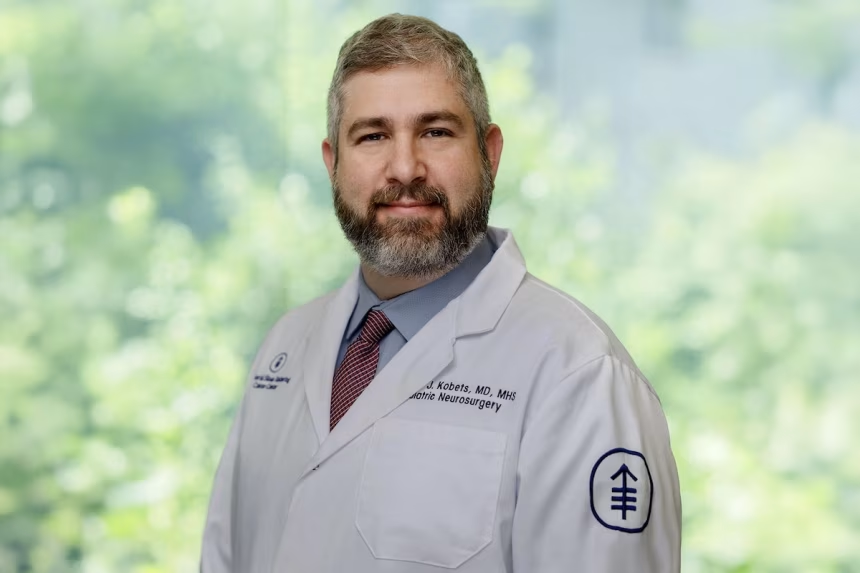

Every year, children across the Gulf are treated for headaches, nausea or clumsy walking, symptoms so ordinary they rarely raise alarm. But sometimes these signs point to something far more serious. In this exclusive conversation, Dr Andrew Kobets, pediatric neurosurgeon at Memorial Sloan Kettering Cancer Center (MSK), explains how minimally invasive techniques, intraoperative MRI and a family-centred approach are transforming outcomes for children facing brain and spine tumors, and when it’s time to seek a specialist opinion.
Can you share what recovery and rehabilitation typically look like for a young patient after a complex brain and spine tumor resection?
There is a significant degree of variability across different tumor types and different patients, and rehabilitation needs vary accordingly. It is important to be at a center focused on post-operative recovery, rehabilitation and longitudinal care, so that the children we treat go on to lead long and strong lives after surgery. Whatever the individual need may be, we have a rehabilitation team with many decades of experience delivering individualized care for every post-operative patient.
Equally important is what we can do in the operating room to give patients the best chance of the strongest long-term rehabilitation outcome. One focus of my practice is minimally invasive surgery, using the smallest possible openings and incisions, so that patients undergo the same procedure through much smaller openings in the skin and bone, sometimes in the skull or spine, allowing for faster and potentially stronger recovery.
A smaller incision means less potential injury to tissue and less discomfort after surgery, allowing patients to recover faster. That is our goal, and whenever the opportunity allows, we take it, to give our patients the longest and strongest life possible after surgery.
Which early signs in children should raise suspicion of a brain or spine tumor, since they are often mistaken for common childhood illness?
This is very true. Many children are seen by gastroenterologists for nausea, by neurologists for headaches, and by orthopaedists or physical therapists for gait instability or difficulty walking. In isolation, any of these symptoms may or may not relate to a problem in the brain or spine.
The key is recognizing patterns, understanding whether multiple issues are occurring together in a way that suggests an underlying brain or spine condition. Headaches that wake a child in the morning, or occur predominantly in the morning, are particularly concerning. Persistent nausea and vomiting might appear to be a gastrointestinal issue in isolation, but combined with other symptoms it forms part of a concerning pattern. Instability or clumsiness while walking is also a significant red flag that can be neurologically based, in either the brain or the spine.
New seizures, weakness, numbness, changes in facial movement, or difficulty swallowing or chewing are all neurobiological functions worth noting when they change. A single episode, such as one headache or one instance of vomiting, is not concerning on its own. But when multiple issues appear together without another identifiable cause, that pattern signals that something may be wrong.
One of the strengths of how we care for patients at MSK is working closely with families. Care decisions are not simply dictated; we collaborate with families to determine the best plan for their child, because families know their children best and are often the first to notice when something has changed. That is the key: recognizing a pattern of difference from the child’s baseline.
This is why communicating closely with families matters. A small change in school performance may not, on its own, indicate a neurological issue, but a clear deterioration over time, without another explanation, is significant. It is the progression of a pattern of neurological symptoms diverging from a child’s baseline that should prompt further evaluation for a possible issue in the brain or spine.
Click here to join our WhatsApp channel here
Brain and spine tumors in children are rare, so most clinicians see very few in their career. What makes these tumors different to treat in children compared to adults?
The key difference between treating children and adults is the longevity of life expected after treatment. We approach a 70-year-old patient very differently from a 7-year-old patient. The expectation of 70, 80 or 90 years of life after treatment shapes every decision, which makes that first decision about the type of surgical intervention or treatment particularly critical. Some treatments carried out may go beyond what a child actually needs, or may be more invasive, or may carry more risk to long-term function than necessary. At MSK, we make full use of all available treatment options from the outset, whether surgical or not.
When a surgical option is appropriate, we consistently choose the approach that is least invasive and least injurious to the surrounding healthy brain tissue. The focus is on the strongest possible long-term recovery and lifespan for that child. Care does not end once the patient leaves the operating room or the hospital; our focus remains on the child’s full life, for as long as possible.
When a doctor suspects a tumor, what tests should come first, and when should they bring the patient to a specialty center?
The starting point is always a thorough neurological examination. We often say that the patient tells us the diagnosis if we evaluate them closely enough. Understanding the specific changes observed in a neurological evaluation helps pinpoint where the problem may lie.
Predominant symptoms such as back pain, leg numbness or weakness, difficulty walking, or loss of bladder or bowel control point toward a possible spinal issue. Cranial symptoms such as headaches and vomiting point toward the brain. A thorough neurological exam and a detailed family history should be the first steps for every patient, as they can reveal a great deal on their own.
Once the likely location is identified, the preferred first study is a contrasted MRI of the brain or spine, using thin-cut sequences between sections. These fine image slices allow subtle abnormalities in brain tissue to be identified. During a contrasted MRI, a dye administered through an IV highlights areas with a rich blood supply. Tumors typically draw additional blood supply from surrounding tissue and appear clearly on a contrasted MRI, making it the preferred initial study for identifying a brain tumor.
Where MRI access is limited, and may take weeks or months to obtain, a CAT scan can be a useful secondary option. It is less specific than an MRI but can still indicate the presence of a mass or something exerting pressure on the brain, more quickly.
What can surgeons do for a child today that was not possible 10 years ago, and which of these advances are only available at high-volume centers?
Experience is the key factor. Today, I can reach any part of a patient’s brain, whether at depth or at the surface, through an incision no larger than 2 cm, using an endoscope to access deep structures and remove tumors through openings far smaller than were possible 10 to 20 years ago.
Also read: Magrabi Health Becomes First Global Ophthalmology Network to Earn SRC Accreditation
Alongside this technology is a decade of accumulated experience in using these tools safely and effectively, which has been one of the major benefits of the past ten years. Navigational tools now allow us to work with millimeter precision, mapping a patient’s face and head to their MRI scan in real time, so that any point on the skull can be matched precisely to an underlying lesion on the scan.
This allows for a highly precise trajectory to the depths of the brain, enabling a biopsy that bypasses critical structures and blood vessels to create the safest possible pathway to reach deep areas of the brain, something that was not achievable a decade or two ago.
At MSK, we also have the ability to perform an intraoperative MRI scan, a capability available at very few centers internationally. This allows us to pause during surgery to obtain an MRI while the patient remains under anesthesia, confirming whether further resection is needed or whether the tumor has been fully removed. This tool is essential for understanding how much tumor, if any, remains.
This capability supports our broader approach: performing the safest possible surgery, and knowing not only when to operate but when to stop. Advances in the molecular understanding of how tumors function have also changed which patients we take to surgery, and which we do not, given the clinical trials, therapeutics and medications now available at MSK that can, in some cases, prevent the need for surgery altogether.
How does MSK work to protect a child’s vision, hormones, cognition, and development?
Patients at MSK benefit from a highly experienced, multidisciplinary team of clinicians rather than the involvement of a single doctor or surgeon, and treatment does not conclude after a single surgery or course of chemotherapy. Patients are cared for by a complete team focused on achieving the best possible outcome for the child.
This is one of MSK’s strongest advantages: a team that provides not only comprehensive care during hospitalization, but lifelong comprehensive care spanning rehabilitation, neuropsychological assessment and post-operative support. This coordinated, multidisciplinary approach allows us to deliver the safest and most definitive treatment, one that accounts for the patient’s entire life, not just the period of hospitalization.
How does shared follow-up with local clinicians work across surveillance imaging, endocrine care and rehabilitation, and why does that follow-up matter years on?
Patients who come to MSK are not intended to replace their local physicians and care teams; the relationship is a collaborative one. We partner with experts and care teams close to the patient’s home, reducing the need for travel and making rehabilitation and long-term post-operative care more accessible closer to home. Establishing a clear channel of communication with local clinicians allows for coordinated endocrinological follow-up and local MRI surveillance.
Once a patient is established at MSK, remote telehealth visits allow us to continue monitoring their progress, confirm they are receiving appropriate local care, and coordinate additional imaging or workups as needed with their local clinicians. This ensures patients can receive the majority of their care locally while benefiting from MSK’s expertise, while also identifying when a patient needs to return to MSK for more specialized treatment, such as a different type of chemotherapy, radiation therapy or surgery.
This is a partnership between MSK, local clinicians and the family, designed to make care as smooth and effective as possible, whether delivered locally or at MSK. The aim is to provide the best possible care for patients wherever they live.
For families and doctors in the Gulf, what should prompt them to seek a specialist opinion, including from abroad?
A specialist opinion is worth seeking when a diagnosis is uncertain or when the tumor is rare enough that a local physician may see very few comparable cases. A center that regularly treats these rarer tumors brings a depth of experience that can meaningfully benefit the patient.
Multiple divergent treatment paths are another reason to seek a second opinion, particularly where a local clinician may be uncertain of the best course, or may not be aware of a specific treatment, clinical trial, or option only available at a center like MSK.
Where there is uncertainty, rarity, or multiple treatment pathways, MSK can help confirm that a proposed treatment strategy is appropriate, or can highlight a treatment option that may not have been previously considered. In some cases, this means supporting the local clinician’s decision-making; in others, it means bringing the patient to MSK for a full evaluation by a dedicated team, to ensure no treatment option has been overlooked.
Ultimately, the goal is to understand when a patient should be seen at MSK directly, with continued care available once they return home, and when MSK’s expertise can instead be brought to the patient and their local clinician. MSK remains committed to ensuring patients have access to the best possible treatment options, wherever they are located.
From minimally invasive endoscopic surgery to intraoperative MRI and real time navigational mapping, Memorial Sloan Kettering continues to set the benchmark for paediatric brain and spine tumour care. For families across the Gulf, this expertise is no longer an ocean away. Through coordinated telehealth follow up and close collaboration with local clinicians, MSK brings world class treatment within reach, without uprooting a child’s care from home. As Dr Andrew Kobets makes it clear, the smallest incision can carry the biggest impact, giving children not just survival, but a strong and lasting life ahead.