


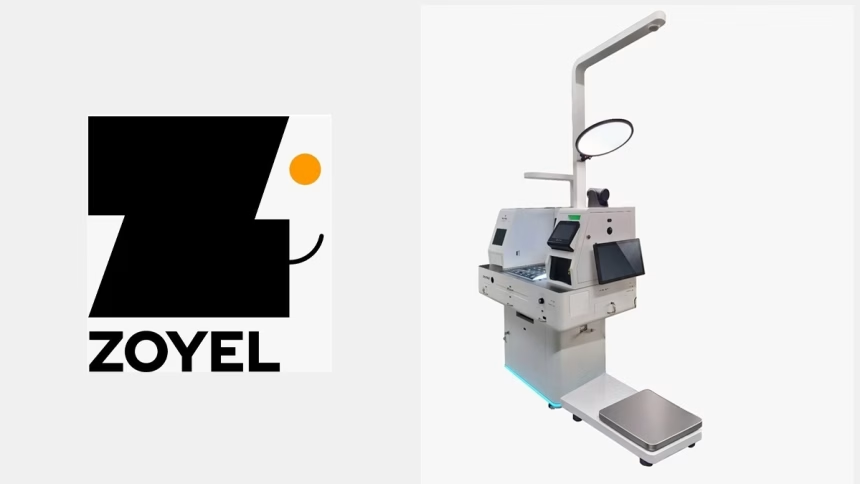

Zoya Technologies has launched the ZoyeMed 3.0 Resilience Edition, a clinical AI terminal designed to deliver a complete medical episode without requiring an internet connection at any point during operation.
The device is intended to address a gap in healthcare delivery during infrastructure disruptions, remote deployments, and grid failures, where cloud-dependent systems typically become inoperable at the moment clinical capacity is most critical.
The terminal runs the company’s Longitudinal Multimodal Model and its Zoyel.health clinical suite entirely on-device, powered by a proprietary edge AI engine called Amygdala. The system can operate indefinitely without network access and supports a full clinical workflow including triage, examination, and prescription support within a 30-minute window and a five-square-metre physical footprint.
Click here to join our WhatsApp channel here
The device integrates more than a dozen diagnostic tools, among them a 12-lead ECG, digital stethoscope, spirometry, dermatoscope, otoscope, fetal Doppler, and a 12-camera telepresence array. It also supports more than 120 point-of-care tests across biochemistry, haematology, and immunoassay analysis. The terminal operates across three clinical modes: physician-led, nurse-managed with remote clinician oversight, and autonomous screening.
Dr. Syed Sabahat Azim said, “Clinical intelligence should remain available to the patient and the clinician regardless of the state of the network around them. We have removed the cloud from the critical path of care – not as a feature, but as the architecture.”
Also read: Abu Dhabi Laboratory Joins WHO Global Network for Measles and Rubella Surveillance
The Resilience Edition is a standalone configuration built on the existing ZoyeMed 3.0 platform, which has been in commercial deployment across multiple regions since 2025. The system is designed as a human-in-the-loop model, with final clinical decisions remaining under the authority of a licensed clinician.
The platform also incorporates an immutable audit trail using hash-chained, append-only records of all clinical actions, a feature the company notes is particularly relevant in environments where connectivity cannot be assumed.