
• Duphat
  • infinia camp
mededge mea logo web MedEdge_Logo_Dark

Public Relations, Top Health Magazine and Healthcare News GCC

  • Newsletters
  • Magazines
  • Subscribe
  • Home
  • News
  • Opinion
  • Interviews
  • Featured
  • Cover Stories
  • Events
  • Health For all
    • Ageing Gracefully
    • Family Health Matters
    • Environment Health
    • Women and Child Health
    • Men’s Health
  • Resource Hub
    • Fresh Perspectives
    • Medical Tourism
    • Medical Education
    • Personnel
    • Research
      • Healthcare Journals & Publishers
    • Healthcare Campaigns
    • Health Tools Hub
    • Dubai Health Centers Directory | Services, Locations & Timings
    • ME Explained
Reading: Uncontrolled high blood pressure puts over a billion people at risk
Share
Notification
  • Duphat
  • infinia camp
mededge mea logo web
  • Magazines
  • Newsletters
  • Profiles
  • Subscribe
Search
  • Home
  • News
  • Opinion
  • Interviews
  • Featured
  • Cover Stories
  • Events
  • Health For all
    • Ageing Gracefully
    • Family Health Matters
    • Environment Health
    • Women and Child Health
    • Men’s Health
  • Resource Hub
    • Fresh Perspectives
    • Medical Tourism
    • Medical Education
    • Personnel
    • Research
    • Healthcare Campaigns
    • Health Tools Hub
    • Dubai Health Centers Directory | Services, Locations & Timings
    • ME Explained
Have an existing account? Sign In
MedEdge MEA > Innovation & Tech > Uncontrolled high blood pressure puts over a billion people at risk
Innovation & Tech

Uncontrolled high blood pressure puts over a billion people at risk

ME Desk
ME Desk
Published: September 24, 2025
Share
5 Min Read
high blood pressure
SHARE

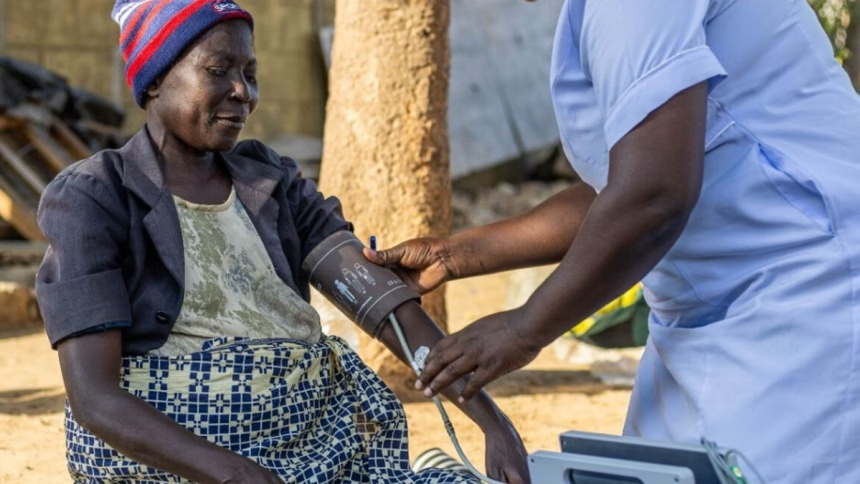
The World Health Organization (WHO) today released its secondย Global hypertension report, showing that 1.4 billion people lived with hypertension in 2024, yet just over one in five have it under control either through medication or addressing modifiable health risks.

Contents
  • Persistent barriers
  • Access to medicines: a cornerstone of progress
  • Country-level progress

The new reportโ€“released at an event co-hosted by WHO, Bloomberg Philanthropies, and Resolve to Save Lives during the 80thย United Nations General Assemblyโ€“also reveals that only 28% of low-income countries report that all WHO-recommended hypertension medicines are generally available in pharmacies or primary care facilities.

Also Read: Abu Dhabi Biobank expands access to cord blood banking services with major NMC Healthcare partnership

Hypertension is a leading cause of heart attack, stroke, chronic kidney disease, and dementia. It is both preventable and treatable โ€“ but without urgent action, millions of people will continue to die prematurely, and countries will face mounting economic losses. From 2011 to 2025, cardiovascular diseasesโ€“including hypertensionโ€“are projected to cost low- and middle-income countries approximately US$ 3.7 trillion, equivalent to around 2% of their combined GDP.

โ€œEvery hour, over 1000 lives are lost to strokes and heart attacks from high blood pressure, and most of these deaths are preventable,โ€ said Dr. Tedros Adhanom Ghebreyesus, WHO Director-General. โ€œCountries have the tools to change this narrative. With political will, ongoing investment, and reforms to embed hypertension control in health services, we can save millions and ensure universal health coverage for all.โ€

โ€œUncontrolled high blood pressure claims more than 10 million lives every year, despite being both preventable and treatable. Countries that integrate hypertension care into universal health coverage and primary care are making real progress, but too many low- and middle-income countries are still left behind,โ€ said Dr Kelly Henning, who leads the Bloomberg Philanthropies Public Health Program. โ€œStrong policies that raise awareness and expand access to treatment are critical to reducing cardiovascular disease and preventable deaths.โ€

Persistent barriers

Analysis of data from 195 countries and territories shows that 99 of them have national hypertension control rates below 20%. The majority of the affected people live in low- and middle-income countries, where health systems face resource constraints.

Click here to join our WhatsApp channel here

The report highlights major gaps in hypertension prevention, diagnosis, treatment, and long-term care. Key barriers include weak health promotion policies (on risk factors such as alcohol, tobacco use, physical inactivity, salt, and trans fats), limited access to validated blood pressure devices, lack of standardized treatment protocols and trained primary care teams, unreliable supply chains and costly medicines, inadequate financial protection for patients, and insufficient information systems to monitor trends.

Access to medicines: a cornerstone of progress

Blood pressure medication is one of the most cost-effective public health tools. Yet only 7 out of 25 (28%) of low-income countries report general availability of all WHO-recommended medicines, compared to 93% of high-income countries. The report explores the barriers and strategies for improving access to hypertension medication through better regulatory systems, pricing and reimbursement, procurement and supply chain management, and improved prescribing and dispensing of these medicines.

โ€œSafe, effective, low-cost medicines to control blood pressure exist, but far too many people canโ€™t get them,โ€ said Dr Tom Frieden, President & CEO, Resolve to Save Lives. โ€œClosing that gap will save lives โ€” and save billions of dollars every year.โ€

Country-level progress

Despite barriers, progress is possible. Bangladesh, the Philippines, and South Korea have made significant progress by integrating hypertension care into universal health coverage (UHC), investing in primary care, and engaging communities:

  • Bangladesh increased hypertension control from 15% to 56% in some regions between 2019-2025 through embedding hypertension treatment services in its essential health service package and strengthening screening and follow-up care.
  • The Philippines has effectively incorporated theย WHOโ€™s HEARTS technical packageย into community-level services nationwide.
  • South Korea has integrated health reforms, including low costs for antihypertensive medications and limiting patient fees, which have resulted in the high rate of blood pressure control nationally: 59% in 2022.

WHO calls on all countries to embed hypertension control in UHC reforms. Implementing the measures recommended in the report could prevent millions of premature deaths and ease the massive social and economic toll of uncontrolled high blood pressure.


Share This Article
Facebook Whatsapp Whatsapp LinkedIn Copy Link
Share
Previous Article Healthcare Disrupters Congress Healthcare Disrupters Congress 2025 highlights advances in precision medicine and genomics
Next Article NMC Healthcare NMC Healthcare acquires Al Ainโ€™s Orthoplus Bone and Joint Center

Recent Posts

  • Leica Biosystems Expands AI Powered Digital Pathology Solution Across EMEA
  • Abu Dhabi Laboratory Joins WHO Global Network for Measles and Rubella Surveillance
  • TASNEEF Signs 10-Year Global Partnership with IFEM to Advance Emergency Care Certification
  • PureHealth Launches SAKINA for Children Across Abu Dhabi
  • WHO Releases First-Ever Guidance to Advance Child-Focused Dengue Treatments
  • duphat
  • MedEdge-Infinia
Two Point Five Logo white
  • About Us
  • Contact Us
  • Medical Disclaimer
  • Privacy Policy
  • Terms and Conditions
  • Cookie Policy (EU)
  • Submit Your Story
  • MediaKit
Reading: Uncontrolled high blood pressure puts over a billion people at risk
Share

Published by Two Point Five Media FZCO

  • About Us
  • Contact Us
  • Medical Disclaimer
  • Privacy Policy
  • Terms and Conditions
  • Cookie Policy (EU)
  • Submit Your Story
  • MediaKit
Reading: Uncontrolled high blood pressure puts over a billion people at risk
Share

Follow US on Social Media

Facebook Instagram Linkedin X-twitter Youtube Whatsapp
Manage Consent
To provide the best experiences, we use technologies like cookies to store and/or access device information. Consenting to these technologies will allow us to process data such as browsing behavior or unique IDs on this site. Not consenting or withdrawing consent, may adversely affect certain features and functions.
Functional Always active
The technical storage or access is strictly necessary for the legitimate purpose of enabling the use of a specific service explicitly requested by the subscriber or user, or for the sole purpose of carrying out the transmission of a communication over an electronic communications network.
Preferences
The technical storage or access is necessary for the legitimate purpose of storing preferences that are not requested by the subscriber or user.
Statistics
The technical storage or access that is used exclusively for statistical purposes. The technical storage or access that is used exclusively for anonymous statistical purposes. Without a subpoena, voluntary compliance on the part of your Internet Service Provider, or additional records from a third party, information stored or retrieved for this purpose alone cannot usually be used to identify you.
Marketing
The technical storage or access is required to create user profiles to send advertising, or to track the user on a website or across several websites for similar marketing purposes.
  • Manage options
  • Manage services
  • Manage {vendor_count} vendors
  • Read more about these purposes
View preferences
  • {title}
  • {title}
  • {title}

WhatsApp us

Logo of Medede mea
Welcome Back!

Sign in to your account

Username or Email Address
Password

Lost your password?