


World Health Organization and Gilead Sciences have renewed their partnership through a new five-year agreement (2026–2030) to support the elimination of visceral leishmaniasis (VL), a life-threatening neglected tropical disease.
Under the agreement, Gilead Sciences will donate 402,941 vials of AmBisome® (liposomal amphotericin B for injection) to treat visceral leishmaniasis and its complications in countries most affected by the disease. The partnership also includes financial support to improve access to diagnosis and treatment, and to scale up WHO-recommended interventions for populations at risk.
Click here to join our WhatsApp channel here
Since 2011, Gilead Sciences has provided more than 1.1 million vials of AmBisome® and over US$18 million for activities, bringing the total to approximately 1.5 million vials and more than US$27 million in financial support with the renewed commitment.
“This agreement underscores the power of strategic partnerships in advancing global health priorities. Through our collaboration with Gilead Sciences, WHO is better equipped to support countries in accelerating the elimination of visceral leishmaniasis as a public health problem,” said Dr Jeremy Farrar, Assistant Director-General, Health Promotion, Disease Prevention and Care, WHO.
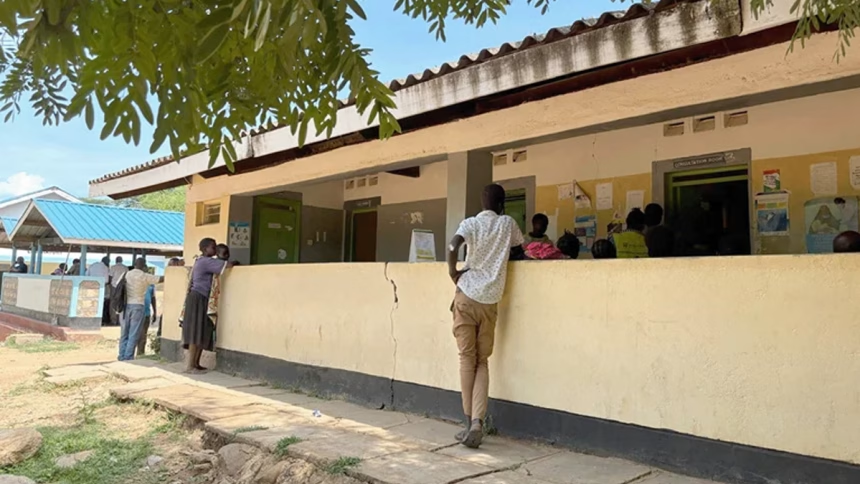
The donated medicines will benefit people in high-burden countries, including Bangladesh, Chad, Djibouti, Ethiopia, Eritrea, India, Kenya, Nepal, Somalia, South Sudan, Sudan, Uganda and Yemen.
“Ending visceral leishmaniasis is within reach because of sustained commitment and investment,” said Daniel O’Day, Chairman and Chief Executive Officer, Gilead Sciences. “With this expanded collaboration and stronger focus on East Africa, we will accelerate progress toward elimination and help more people access the care they need to survive.”
Also read: OCHIN announces 2026 Impact Award winners honoring innovation in community healthcare
Visceral leishmaniasis, also known as kala-azar, is endemic in more than 80 countries and is the most severe form of leishmaniasis. Without timely treatment, it is almost always fatal.
“This renewed agreement reflects both how far we have come and what remains to be done,” said Dr Daniel Ngamije Madandi, Director, Malaria and Neglected Tropical Diseases, WHO. “This collaboration with Gilead Sciences reinforces our support to endemic countries to consolidate gains, reach underserved populations, and accelerate the work toward elimination as a public health problem.”