

• Duphat
  • infinia camp
  • Emirates Digestive Diseases
mededge mea logo web MedEdge_Logo_Dark

Public Relations, Top Health Magazine and Healthcare News GCC

  • Newsletters
  • Magazines
  • Subscribe
  • Home
  • News
  • Opinion
  • Interviews
  • Featured
  • Cover Stories
  • Events
  • Health For all
    • Ageing Gracefully
    • Family Health Matters
    • Environment Health
    • Women and Child Health
    • Men’s Health
  • Resource Hub
    • Fresh Perspectives
    • Medical Tourism
    • Medical Education
    • Personnel
    • Research
      • Healthcare Journals & Publishers
    • Healthcare Campaigns
    • Health Tools Hub
    • Dubai Health Centers Directory | Services, Locations & Timings
    • ME Explained
Reading: The Future of Aesthetic Care in the Age of AI
Share
Notification
  • Duphat
  • infinia camp
  • Emirates Digestive Diseases
mededge mea logo web
  • Magazines
  • Newsletters
  • Profiles
  • Subscribe
Search
  • Home
  • News
  • Opinion
  • Interviews
  • Featured
  • Cover Stories
  • Events
  • Health For all
    • Ageing Gracefully
    • Family Health Matters
    • Environment Health
    • Women and Child Health
    • Men’s Health
  • Resource Hub
    • Fresh Perspectives
    • Medical Tourism
    • Medical Education
    • Personnel
    • Research
    • Healthcare Campaigns
    • Health Tools Hub
    • Dubai Health Centers Directory | Services, Locations & Timings
    • ME Explained
Have an existing account? Sign In
MedEdge MEA > Opinion > The Future of Aesthetic Care in the Age of AI
Opinion

The Future of Aesthetic Care in the Age of AI

Dr Tatjana Pavicic
Dr Tatjana Pavicic
Published: February 25, 2026
Share
5 Min Read
SHARE

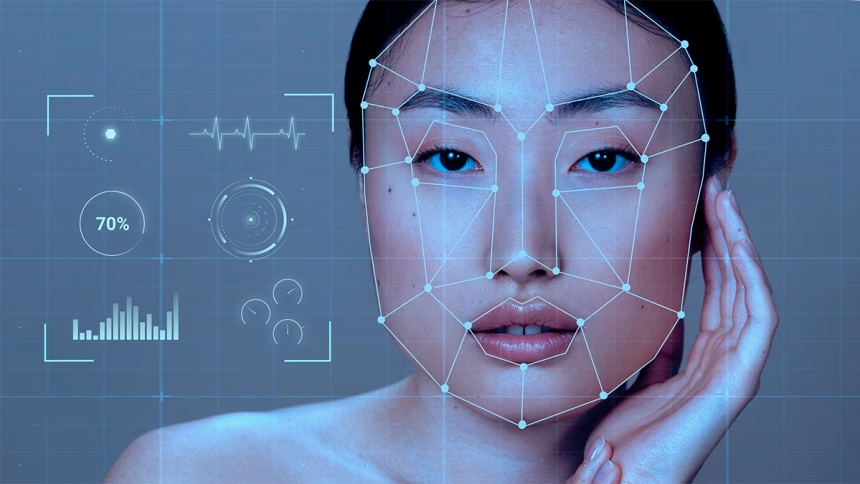
Aesthetic medicine is evolving in ways few could have imagined a decade ago. Where once treatments were guided solely by observation, experience, and the clinicianโ€™s artistic eye, today data-driven technologies are beginning to enhance safety, precision, and personalization. Yet, compared to other medical specialties, aesthetics is still in the early stages of embracing artificial intelligence. Currently, the primary AI tools in clinical use are limited to skin analysis, which quantifies hydration, pigmentation, elasticity, and other surface-level parameters. By providing objective, measurable insights, these systems help clinicians tailor treatments to each patientโ€™s unique needs.

Advances in imaging have expanded what clinicians can see beneath the skin, offering real-time ultrasound visualization of tissue layers during procedures. While this improves safety and precision, it does not yet incorporate AI-driven predictive modeling. The clinicianโ€™s judgment remains central, interpreting the images and deciding how best to deliver treatment. Compared with fields such as radiology, cardiology, and oncology, where AI actively supports diagnostics, pattern recognition, and outcome prediction, aesthetic medicine is still catching up. These disciplines benefit from standardized datasets and decades of imaging infrastructure, allowing algorithms to assist clinical decision-making with high reliability.

China offers an early glimpse into the possibilities of AI adoption. Hospitals there are deploying AI for triage, diagnostics, workflow management, and consultation support, demonstrating how intelligent systems can enhance operational efficiency and clinical accuracy. In aesthetic clinics, AI-powered 3D skin analysis platforms are emerging, combining facial modeling, deep skin condition detection, and data-driven assessment to support clinicians during consultations. This demonstrates how AI can improve precision in evaluation and personalize treatment discussions, laying the foundation for wider clinical adoption worldwide.

Beyond diagnostics, AI promises to transform clinic operations. Automated patient assessment, personalized treatment planning, procedural guidance highlighting critical structures in real time, workflow optimization, and early detection of structural changes will all enhance both safety and efficiency. AI will function not only as a clinical decision-support tool but also as an operational enhancer, allowing clinicians to focus on patient care while leveraging predictive insights.

The next frontier lies in multi-layer anatomical mapping and predictive outcome simulation. When fully developed, AI systems will integrate data on skin, fat, muscle,ligaments, andbone to forecast how treatments will affect appearance and tissue dynamics over time. This capability could revolutionize planning for fillers, neuromodulators, and energy-based devices, enabling personalized interventions with unprecedented precision.

Also read: Can AI-Driven Diets Replace Human Dietary Counselling?

Industry stakeholders are expected to play a significant role in this transformation. By investing in AI-driven imaging, simulation, and predictive analytics, they are driving innovation and establishing standards for safe, evidence-based adoption in clinics. Through clinician training programs, digital platforms, and research-backed AI tools, these brands are equipping practitioners to harness technology effectively. Beyond improving outcomes, they are helping shift the field from reactive correction to preventive, data-informed aesthetics, turning insights into foresight.

Even as AI advances, the artistry of aesthetic medicine remains irreplaceable. Machines can measure, visualize, and predict, but only clinicians can interpret results within the context of proportion, symmetry, and patient goals. Empathy, judgment, and artistic sensibility remain central to the practice. The future of aesthetic care will not be man versus machine, but a partnership where intelligent systems augment human intuition, enabling safer, more precise, and highly personalized interventions. By integrating human judgment with AI, clinicians can deliver care that is both scientifically exact and aesthetically harmonious, defining the next generation of personalized aesthetic medicine.

Disclaimer: The views and opinions expressed in this article are those of the author and do not represent the positions of MedEdge MEA

Click here to join our WhatsApp channel here

Share This Article
Facebook Whatsapp Whatsapp LinkedIn Copy Link
Share
Previous Article Ukraine Health Care Under Intensified Attack in 2025
Next Article Less Invasive, More Precise: The Shift in Colorectal Cancer Care

Recent Posts

  • WHO Reports Rise in Voluntary Blood Donations, Warns of Global Access Gaps
  • Burjeel Cancer Institute Honors 15 Cancer Survivors at โ€˜Circle of Hopeโ€™ Event
  • UAEโ€™s first publicly neurodivergent-owned mental health center launches in Dubai
  • Thumbay Group Breaks Ground on Landmark Research Centre in Ajman
  • Living in the UAE and Worried About Ebola? Here Is What You Need to Know
  • duphat
  • MedEdge-Infinia
Two Point Five Logo white
  • About Us
  • Contact Us
  • Medical Disclaimer
  • Privacy Policy
  • Terms and Conditions
  • Cookie Policy (EU)
  • Submit Your Story
  • MediaKit
Reading: The Future of Aesthetic Care in the Age of AI
Share

Published by Two Point Five Media FZCO

  • About Us
  • Contact Us
  • Medical Disclaimer
  • Privacy Policy
  • Terms and Conditions
  • Cookie Policy (EU)
  • Submit Your Story
  • MediaKit
Reading: The Future of Aesthetic Care in the Age of AI
Share

Follow US on Social Media

Facebook Instagram Linkedin X-twitter Youtube Whatsapp
Manage Consent
To provide the best experiences, we use technologies like cookies to store and/or access device information. Consenting to these technologies will allow us to process data such as browsing behavior or unique IDs on this site. Not consenting or withdrawing consent, may adversely affect certain features and functions.
Functional Always active
The technical storage or access is strictly necessary for the legitimate purpose of enabling the use of a specific service explicitly requested by the subscriber or user, or for the sole purpose of carrying out the transmission of a communication over an electronic communications network.
Preferences
The technical storage or access is necessary for the legitimate purpose of storing preferences that are not requested by the subscriber or user.
Statistics
The technical storage or access that is used exclusively for statistical purposes. The technical storage or access that is used exclusively for anonymous statistical purposes. Without a subpoena, voluntary compliance on the part of your Internet Service Provider, or additional records from a third party, information stored or retrieved for this purpose alone cannot usually be used to identify you.
Marketing
The technical storage or access is required to create user profiles to send advertising, or to track the user on a website or across several websites for similar marketing purposes.
  • Manage options
  • Manage services
  • Manage {vendor_count} vendors
  • Read more about these purposes
View preferences
  • {title}
  • {title}
  • {title}

WhatsApp us

Logo of Medede mea
Welcome Back!

Sign in to your account

Username or Email Address
Password

Lost your password?