

November 2025- At the inaugural edition of Revive ME, today at Beach Rotana Abu Dhabi, global leaders in health, insurance, biotechnology, and clinical innovation came together to discuss how emerging technologies, shifting care models, and new partnerships can shape longevity for all.
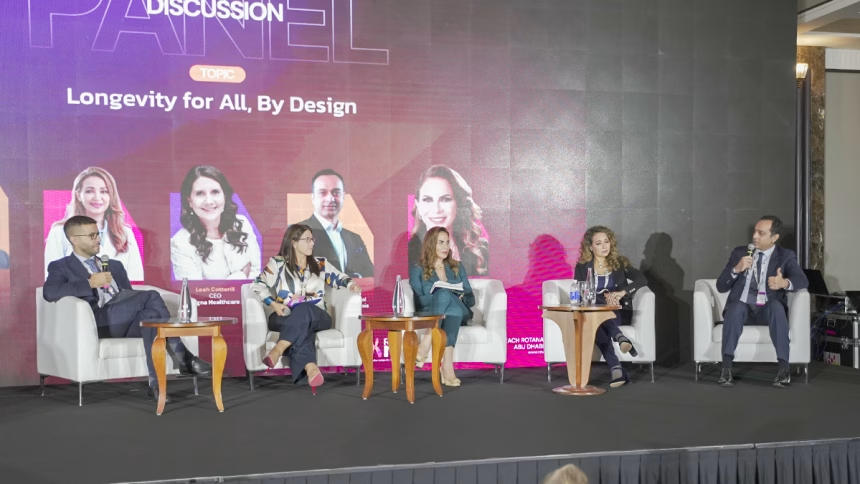
During the morning session on the first day, a panel moderated by Robert Mikhael, Regional Managing Director and Head of Global Emerging Markets at Abbott Laboratories and Vice Chair of AmCham Dubai, explored the topic of “Longevity for All.” The panel featured Farah Hamdan, General Manager for CEE and MEA at Zimmer Biomet; Leah Cotterill, CEO of Cigna Healthcare; Dr. Basmah Alrowaily, Director of the Functional Medicine Department at American Hospital Dubai; and Mohammad AbouBakr, Chair of the AmCham Dubai Pharmea Committee and Regional VP for Middle East, Africa & Russia CIS at AbbVie.
Also Read: NYU Abu Dhabi and PHRMAG partner to foster homegrown innovation and STEM talent in the UAE
Emerging technologies and the innovation gap
Opening the discussion, the moderator asked panelists about the most transformative technologies expected over the next decade. Farah Hamdan noted a “fundamental shift from reactive to predictive healthcare,” driven by AI, advanced wearables, biotechnology, and surgical robotics.
“There is a lot of biotechnology and mechanisms targeting aging, and the shift is clear,” she said. “Companies are moving ahead fast, but from an emerging market lens, our ability to attract this innovation is not at its best.’’
Farah Hamdan stressed that while global innovation is accelerating, the gap between development and adoption in emerging markets “must narrow in the coming period for this region to capitalize on opportunities in the longevity space.”
Insurance priorities shift toward prevention
Speaking on how insurers can support long-term health and longevity, Cigna Healthcare CEO Leah Cotterill said organizations must rethink how they allocate their resources.
“We need to shift from reactive to prevention,” she stated. “If we can channel more dollars toward well care rather than sick care, we will get better outcomes. Insurance must always be there for the worst-case scenario, but investing up front in prevention, immunization, awareness, and lifestyle change slows the steep rise in healthcare costs.”
Leah emphasized personalization as key to encouraging healthier behaviours.
“One size doesn’t fit all,” she said. “Understanding what truly motivates each individual whether physical, mental, emotional, financial, or social, is essential. Technology then helps remove barriers and makes access easier.”
She added that Cigna’s latest International Health Care Study shows mental health ranking as “the top priority for people in the UAE,” signalling a major shift in what drives wellbeing.
Back to basics
From the clinical side, Dr. Basmah Alrowaily underscored the importance of returning to fundamental lifestyle factors, an area she said was historically missing from medical education.
“We were never taught about nutrition, physical activity, sleep, or the basics of health,” she said. “The first step is educating ourselves as clinicians, then empowering patients with knowledge.”
She stressed that small lifestyle interventions remain the most powerful tools for longevity. “If there was one preventive intervention I could put in every patient’s routine tomorrow, it would be exercise,” she explained. “Just 120 minutes a week improves mitochondrial function, reduces cardiovascular risk, reverses insulin resistance, supports sleep, improves mental health, and delays cognitive decline.”
Dr. Basmah added that many patients struggle with simple habits: “I meet people who drink only one 350 ml bottle of water a day. No one sleeping well, moving enough, or eating properly can expect to live well longer.”
Government–industry collaboration
Sharing the industry perspective, Mohammad AbouBakr emphasized that partnerships between governments and pharmaceutical companies must evolve to reflect today’s innovation landscape.
“In the short term, our focus must be on access to innovation. But in the long term, we should be building true research capabilities locally.”
“We are a research-based industry, not a manufacturing-based one,” he argued. “I hope that through collaboration, we can one day see the first healthcare solution or molecule developed in a UAE lab and shared with the world.”
AbouBakr pointed to varying challenges across emerging markets, from limited infrastructure to capability gaps and outdated mindsets rooted in older medical training.
“Priorities, funding, and capabilities differ by country,” he said. “We step in where possible through education, early diagnosis advocacy, and capacity building. But long-term progress depends on mindset shift and sustained investment.”
Longevity transformation
As Revive ME opened its first edition, the panelists agreed that the Middle East stands at a pivotal moment. With accelerating technologies, changing patient expectations, and a government push toward innovation, the foundations for a future-focused longevity ecosystem are taking shape. Yet the path forward requires aligned efforts across industry, government, clinicians, insurers, and individuals.