


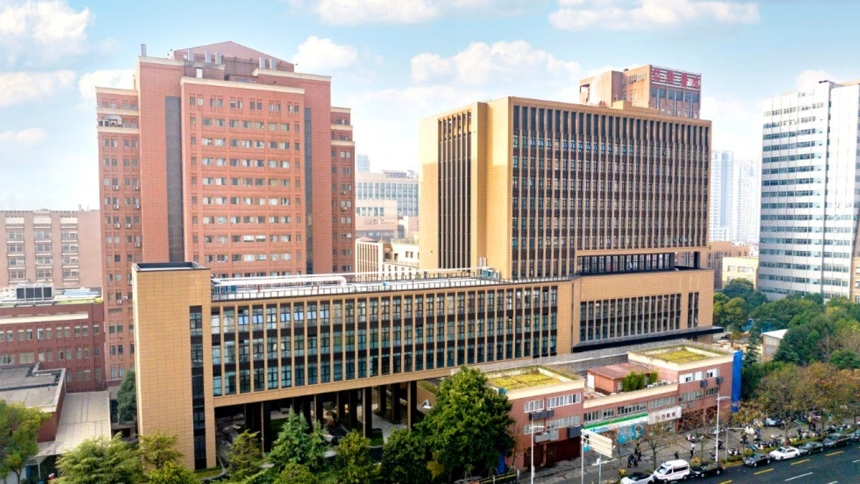
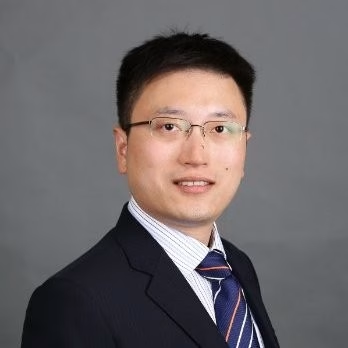
What happens when one of China’s most prestigious hospitals goes fully digital? Prof. Dr. Wang Chun Ming, Director of Smart Hospital Development Department at Renji Hospital, Shanghai Jiao Tong University School of Medicine, has the answer. Speaking exclusively with MedEdge MEA at WHX 2026, Prof. Dr. Wang explains how Renji now treats more than half a million patients online each year, predicts ICU emergencies 30 minutes in advance, and delivers specialist care to patients thousands of miles away. His insights demonstrate that technology and compassionate medicine are not opposites, but powerful partners shaping the future of healthcare.
MedEdge MEA: Could you briefly introduce your institution?
Dr. Wang: As one of China’s leading tertiary general public hospitals, we serve a massive patient base. Last year, we recorded over 7.5 million outpatient and emergency attendances, with over 260,000 inpatients and 130,000 surgeries. 40% of which were day surgeries, where patients check in, undergo surgery, and are discharged the following day. All of this is managed across four campuses in Shanghai with just 3,000 medical beds, reflecting how efficiently we operate.
Like much of Shanghai, we face a rapidly aging population with growing medical demands. A WHO report shared recently projects that by 2050, 36% of the global population will be elderly, a significant challenge for healthcare systems worldwide.
Renji Hospital is home to 13 national key disciplines, representing the highest level of medical excellence in China. Our liver surgery department has performed over 8,000 liver transplantations, including 4,000 living donor procedures. Our gastroenterology department ranks first in China, as does our rheumatology department in outpatient attendance. In urology, our robotic surgery case volume ranks first in the world.
With such high medical demand, we recognized early on the need for a robust digitalized platform powered by AI, one that accelerates efficiency without compromising quality. That vision is what drove us to develop this platform six years ago
ME: At this year’s WHX, what innovative technologies is your institution showcasing?
Dr. Wang: We are showcasing several projects at this event. The first is our integrated digitalized hospital solution, which brings together smart operating theatres, smart ICUs, AI-driven ICUs, smart medical wards, an online hospital, and AI-driven radiotherapy, all functioning as a unified smart hospital ecosystem.
A key feature of this system is how we connect equipment. Previously, we attempted integration at the software level, but differences in databases, data formats, and engineering teams made it costly and inefficient. We now connect all equipment at the fundamental hardware level, centralizing high-quality data that we use to train our AI and the results have been remarkable.
In our smart ICUs, for example, the AI can predict patient deterioration 30 minutes before equipment alarms are triggered. Using multimodal data, the system alerts doctors and nurses through workstations, mobile phones, and smartwatches giving medical staff sufficient time for early intervention. This improves both efficiency and quality of care without requiring additional manpower.
For AI-driven radiotherapy, centralizing data has enabled our AI to generate treatment plans at least four times faster than conventional methods, significantly reducing the workload for our radiotherapists.
Our online hospital now serves over half a million patients annually. Doctors and patients stay connected 24/7, with prescriptions issued online and medications delivered directly to patients’ homes. This high volume of online consultations combined with electronic medical records and prescription data has enabled us to develop what we call ADA (AI Doctor Assistants).
Doctors train their own ADA using their personal consultation data. When applied, ADA makes doctors at least five times more efficient. The system offers three response options: fully agree and send the AI’s response to the patient, partially agree and edit before sending, or guide the ADA to rethink its response, each interaction serving as an additional retraining opportunity at near-zero cost.
One of our cardiologists, for instance, can now see 100 patients online within just three hours, supported by her AI assistant. She spent 10 months training her ADA when it launched last August. Subsequent doctors in our liver surgery and gastroenterology departments trained theirs in six months, and the next 15 doctors did so in just three months, the process is becoming faster and more efficient each time.
Our strategy is clear: AI plus Human Intelligence (HI), working together. AI assistants support doctors; they do not replace them.
Also Read: Can AI-Driven Diets Replace Human Dietary Counselling?
ME: How has your hospital used digital solutions to improve the patient experience, especially for international patients or those seeking cross-border care?
Dr. Wang: This is another exciting area we announced at the event. Our online hospital platform currently has 1,200 registered specialists. Traditionally, consultations were face-to-face within our campus, requiring patients to visit in person. Now, wherever there is internet connectivity, our doctors can see their patients, even while traveling abroad.
Through our new collaboration with a UK-based concierge family medicine platform, we have connected our two systems. International patients traveling to China can now easily access our specialists both online and in person, through a seamless, integrated experience.
For our liver surgery department specifically, we have hosted over 65 patients from Malaysia for living donor liver transplantations, where the donors are typically the patients’ parents. With our integrated online and offline smart hospital platform, we can now provide lifelong follow-up care after patients return home.
The results speak for themselves. When we performed our first international liver transplant case in 2014, patients required approximately three months at our Shanghai hospital, a significant financial and personal burden. Today, that duration has been reduced to just 26 days, a transformation made possible by our digital infrastructure and AI-driven care model.
Our goal is to ensure that quality medical care is not limited by geography. Whether a patient is in Shanghai or overseas, our platform enables continuous, high-quality support throughout their entire healthcare journey.