
• Duphat
  • infinia camp
mededge mea logo web MedEdge_Logo_Dark

Public Relations, Top Health Magazine and Healthcare News GCC

  • Newsletters
  • Magazines
  • Subscribe
  • Home
  • News
  • Opinion
  • Interviews
  • Featured
  • Cover Stories
  • Events
  • Health For all
    • Ageing Gracefully
    • Family Health Matters
    • Environment Health
    • Women and Child Health
    • Men’s Health
  • Resource Hub
    • Fresh Perspectives
    • Medical Tourism
    • Medical Education
    • Personnel
    • Research
      • Healthcare Journals & Publishers
    • Healthcare Campaigns
    • Health Tools Hub
    • Dubai Health Centers Directory | Services, Locations & Timings
    • ME Explained
Reading: Harvard Medical School Study Reveals How Next-Generation Antivirals Target Drug-Resistant Herpes Virus
Share
Notification
  • Duphat
  • infinia camp
mededge mea logo web
  • Magazines
  • Newsletters
  • Profiles
  • Subscribe
Search
  • Home
  • News
  • Opinion
  • Interviews
  • Featured
  • Cover Stories
  • Events
  • Health For all
    • Ageing Gracefully
    • Family Health Matters
    • Environment Health
    • Women and Child Health
    • Men’s Health
  • Resource Hub
    • Fresh Perspectives
    • Medical Tourism
    • Medical Education
    • Personnel
    • Research
    • Healthcare Campaigns
    • Health Tools Hub
    • Dubai Health Centers Directory | Services, Locations & Timings
    • ME Explained
Have an existing account? Sign In
MedEdge MEA > Innovation & Tech > Harvard Medical School Study Reveals How Next-Generation Antivirals Target Drug-Resistant Herpes Virus
Innovation & Tech

Harvard Medical School Study Reveals How Next-Generation Antivirals Target Drug-Resistant Herpes Virus

ME Desk
ME Desk
Published: January 16, 2026
Share
3 Min Read
Harvard Medical School
SHARE

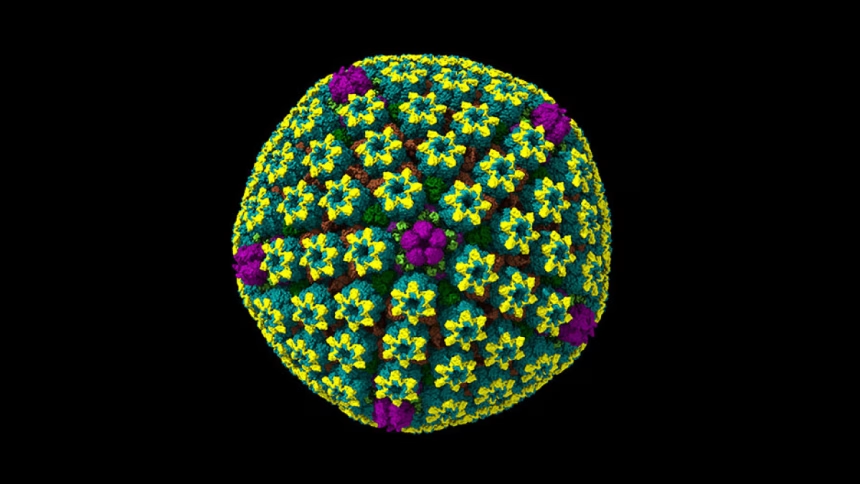
Harvard Medical School researchers have uncovered how a new class of antiviral drugs disables drug-resistant herpes viruses, providing insights that could inform future treatments for HSV and other DNA viruses.

Researchers at Harvard Medical School have identified key mechanisms behind the action of a new class of antiviral drugs, offering fresh insight into how emerging therapies can combat drug-resistant strains of the herpes simplex virus (HSV). The findings enhance scientific understanding of an important treatment approach and open new avenues for addressing herpesviruses and other DNA viruses that replicate within human cells.

Also Read: Global Healthcare Leaders to Gather in Dubai for World Health Expo 2026

The research is particularly significant for immunocompromised patients, who are at increased risk of developing severe HSV infections that no longer respond to standard antivirals due to repeated exposure to the same drug classes. Co-senior author Dr Jonathan Abraham, an infectious disease specialist at Brigham and Womenโ€™s Hospital and associate professor of microbiology at the Blavatnik Institute at HMS, has encountered such cases firsthand, motivating deeper investigation into alternative antiviral strategies.

โ€œAs a clinician, itโ€™s disheartening when medicine can cure a patient of cancer, but the patient requires immunosuppression that leaves them vulnerable to a virus that doesnโ€™t respond to the best drugs we have to treat it,โ€ Abraham said. โ€œAs a researcher, this inspires me to learn as much as I can about how the virus works so that we can continue to find better options for people who are sick with resistant strains of viruses.โ€

While several drugs from this emerging antiviral class are currently undergoing clinical trials in the United States, and one has already received regulatory approval in Japan, their precise mode of action has remained largely unclear. To address this gap, Dr Abraham collaborated with co-senior author Dr Joseph Loparo, professor of biological chemistry and molecular pharmacology at HMS.

Using advanced structural biology and imaging technologies, the research team examined how these drugs bind to and disable a critical viral enzyme essential to the HSV life cycle. Dr Abrahamโ€™s laboratory mapped the structural interactions between the antiviral compounds and the viral protein, while Dr Loparoโ€™s team captured real-time data illustrating how this binding process prevents the enzyme from functioning, effectively halting viral activity.

Click here to join our WhatsApp channel here

โ€œA real strength of this study is the combination of high-resolution, atomistic pictures of the viral proteins bound by the inhibitors and real-time imaging of the viral proteins in action,โ€ Loparo said.

Read More: https://hms.harvard.edu/news/researchers-now-understand-how-new-class-antivirals-works


Share This Article
Facebook Whatsapp Whatsapp LinkedIn Copy Link
Share
Previous Article WHO WHO Regional Director Holds High-Level Talks in Saudi Arabia on Health Security and Equity
Next Article Dr. Nabil Seidah Dr. Nabil Seidah Honoured in Medicine at Great Arab Minds 2025

Recent Posts

  • From market access to national ambition, gulf healthcare is playing a longer game
  • New Push for HIV Innovation and Access Aims to Accelerate Progress Toward 2030 Goals
  • WHO Discusses Digital Health and Humanization of Care at Scientific Conference
  • Rising Ebola Cases Deepen Humanitarian Crisis for Children in DR Congo
  • Burjeel holdings secures dual credit ratings and launches USD 1.5 billion sukuk programme
  • duphat
  • MedEdge-Infinia
Two Point Five Logo white
  • About Us
  • Contact Us
  • Medical Disclaimer
  • Privacy Policy
  • Terms and Conditions
  • Cookie Policy (EU)
  • Submit Your Story
  • MediaKit
Reading: Harvard Medical School Study Reveals How Next-Generation Antivirals Target Drug-Resistant Herpes Virus
Share

Published by Two Point Five Media FZCO

  • About Us
  • Contact Us
  • Medical Disclaimer
  • Privacy Policy
  • Terms and Conditions
  • Cookie Policy (EU)
  • Submit Your Story
  • MediaKit
Reading: Harvard Medical School Study Reveals How Next-Generation Antivirals Target Drug-Resistant Herpes Virus
Share

Follow US on Social Media

Facebook Instagram Linkedin X-twitter Youtube Whatsapp
Manage Consent
To provide the best experiences, we use technologies like cookies to store and/or access device information. Consenting to these technologies will allow us to process data such as browsing behavior or unique IDs on this site. Not consenting or withdrawing consent, may adversely affect certain features and functions.
Functional Always active
The technical storage or access is strictly necessary for the legitimate purpose of enabling the use of a specific service explicitly requested by the subscriber or user, or for the sole purpose of carrying out the transmission of a communication over an electronic communications network.
Preferences
The technical storage or access is necessary for the legitimate purpose of storing preferences that are not requested by the subscriber or user.
Statistics
The technical storage or access that is used exclusively for statistical purposes. The technical storage or access that is used exclusively for anonymous statistical purposes. Without a subpoena, voluntary compliance on the part of your Internet Service Provider, or additional records from a third party, information stored or retrieved for this purpose alone cannot usually be used to identify you.
Marketing
The technical storage or access is required to create user profiles to send advertising, or to track the user on a website or across several websites for similar marketing purposes.
  • Manage options
  • Manage services
  • Manage {vendor_count} vendors
  • Read more about these purposes
View preferences
  • {title}
  • {title}
  • {title}

WhatsApp us

Logo of Medede mea
Welcome Back!

Sign in to your account

Username or Email Address
Password

Lost your password?