
• Duphat
  • infinia camp
mededge mea logo web MedEdge_Logo_Dark

Public Relations, Top Health Magazine and Healthcare News GCC

  • Newsletters
  • Magazines
  • Subscribe
  • Home
  • News
  • Opinion
  • Interviews
  • Featured
  • Cover Stories
  • Events
  • Health For all
    • Ageing Gracefully
    • Family Health Matters
    • Environment Health
    • Women and Child Health
    • Men’s Health
  • Resource Hub
    • Fresh Perspectives
    • Medical Tourism
    • Medical Education
    • Personnel
    • Research
      • Healthcare Journals & Publishers
    • Healthcare Campaigns
    • Health Tools Hub
    • Dubai Health Centers Directory | Services, Locations & Timings
    • ME Explained
Reading: Gaza’s Last Hospitals at Risk: WHO Sounds Alarm on Health System Collapse
Share
Notification
  • Duphat
  • infinia camp
mededge mea logo web
  • Magazines
  • Newsletters
  • Profiles
  • Subscribe
Search
  • Home
  • News
  • Opinion
  • Interviews
  • Featured
  • Cover Stories
  • Events
  • Health For all
    • Ageing Gracefully
    • Family Health Matters
    • Environment Health
    • Women and Child Health
    • Men’s Health
  • Resource Hub
    • Fresh Perspectives
    • Medical Tourism
    • Medical Education
    • Personnel
    • Research
    • Healthcare Campaigns
    • Health Tools Hub
    • Dubai Health Centers Directory | Services, Locations & Timings
    • ME Explained
Have an existing account? Sign In
MedEdge MEA > Humanitarian Aid & Medical Crises > Gaza’s Last Hospitals at Risk: WHO Sounds Alarm on Health System Collapse
Humanitarian Aid & Medical Crises

Gaza’s Last Hospitals at Risk: WHO Sounds Alarm on Health System Collapse

ME Desk
ME Desk
Published: June 11, 2025
Share
3 Min Read
Gaza
SHARE

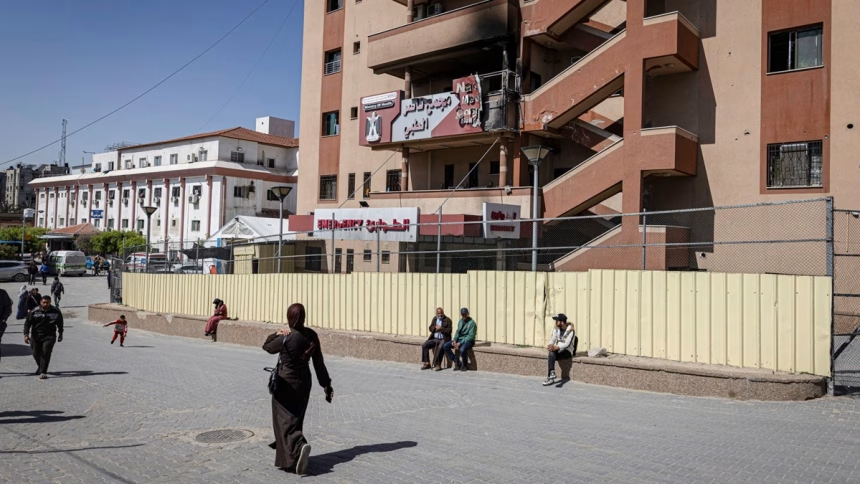
The World Health Organization (WHO) has issued a stark and urgent appeal: protect Nasser Medical Complex and Al-Amal Hospital, two of the last functioning public hospitals in Gaza’s south, before it’s too late. With northern Gaza already devoid of operational hospitals, the burden on these facilities in Khan Younis has become unbearable, as over 2 million people scramble for life-saving care.

Nasser Medical Complex, Gaza’s largest remaining referral hospital, is operating at 180% over capacity. Al-Amal is at its limit. Together, they account for nearly 500 beds—beds that could vanish if access routes remain blocked and vital supplies continue to be denied. The consequences are chilling: a 40% drop in total bed availability since the start of the conflict, with the healthcare system on the brink of collapse.

Also Read : Israel-imposed blockade triggers severe medicine shortages in Gaza, MSF warns

“These hospitals aren’t just buildings,” said a WHO official. “They are the difference between life and death for thousands.”

Patients with crushing injuries, cancer, renal failure, and those in need of blood transfusions or surgery flood these hospitals daily. Staffed by exhausted doctors and nurses, supported by one national and four international emergency medical teams, they continue to serve under harrowing conditions—with critical shortages of medications, supplies, and fuel.

Despite the chaos, no formal evacuation orders have been issued for either hospital. However, Israeli authorities have reportedly informed Gaza’s Ministry of Health that access roads leading to both sites will be blocked, putting incoming patients and humanitarian responders at grave risk.

The WHO has not minced words: “Hospitals must never be militarized or targeted. These attacks must stop. The decimation of Gaza’s healthcare system has gone on for too long.”

The collapse of these two hospitals would mark a devastating blow for the people of Gaza, particularly in Khan Younis, where a large portion of the displaced population now resides. For a mother holding a feverish child, or an elderly patient clinging to life in a dialysis chair, the message is clear: time is running out.

Adding to the gravity of the situation, over 50 trucks carrying WHO medical supplies remain stalled at Al-Arish and in the West Bank, unable to cross into Gaza. Without these supplies, hospital teams are forced to make impossible decisions—who receives care, and who is turned away.

In its appeal, WHO is calling for three immediate actions:

  • Protection of Nasser and Al-Amal hospitals to ensure they remain safe, functional, and accessible.
  • Unhindered humanitarian access, including safe passage for medical supplies and personnel.
  • An immediate and lasting ceasefire, to allow health services to stabilize and resume essential care.


Share This Article
Facebook Whatsapp Whatsapp LinkedIn Copy Link
Share
Previous Article Malaika Mendonca A Conversation with Dr. Malaika Mendonca: A Journey Through ECMO in the UAE | SWAAC ELSO
Next Article Dr. Thomas Rogers Dr. Thomas Rogers Named VP and CMO of Cleveland Clinic Medina Hospital

Recent Posts

  • From market access to national ambition, gulf healthcare is playing a longer game
  • New Push for HIV Innovation and Access Aims to Accelerate Progress Toward 2030 Goals
  • WHO Discusses Digital Health and Humanization of Care at Scientific Conference
  • Rising Ebola Cases Deepen Humanitarian Crisis for Children in DR Congo
  • Burjeel holdings secures dual credit ratings and launches USD 1.5 billion sukuk programme
  • duphat
  • MedEdge-Infinia
Two Point Five Logo white
  • About Us
  • Contact Us
  • Medical Disclaimer
  • Privacy Policy
  • Terms and Conditions
  • Cookie Policy (EU)
  • Submit Your Story
  • MediaKit
Reading: Gaza’s Last Hospitals at Risk: WHO Sounds Alarm on Health System Collapse
Share

Published by Two Point Five Media FZCO

  • About Us
  • Contact Us
  • Medical Disclaimer
  • Privacy Policy
  • Terms and Conditions
  • Cookie Policy (EU)
  • Submit Your Story
  • MediaKit
Reading: Gaza’s Last Hospitals at Risk: WHO Sounds Alarm on Health System Collapse
Share

Follow US on Social Media

Facebook Instagram Linkedin X-twitter Youtube Whatsapp
Manage Consent
To provide the best experiences, we use technologies like cookies to store and/or access device information. Consenting to these technologies will allow us to process data such as browsing behavior or unique IDs on this site. Not consenting or withdrawing consent, may adversely affect certain features and functions.
Functional Always active
The technical storage or access is strictly necessary for the legitimate purpose of enabling the use of a specific service explicitly requested by the subscriber or user, or for the sole purpose of carrying out the transmission of a communication over an electronic communications network.
Preferences
The technical storage or access is necessary for the legitimate purpose of storing preferences that are not requested by the subscriber or user.
Statistics
The technical storage or access that is used exclusively for statistical purposes. The technical storage or access that is used exclusively for anonymous statistical purposes. Without a subpoena, voluntary compliance on the part of your Internet Service Provider, or additional records from a third party, information stored or retrieved for this purpose alone cannot usually be used to identify you.
Marketing
The technical storage or access is required to create user profiles to send advertising, or to track the user on a website or across several websites for similar marketing purposes.
  • Manage options
  • Manage services
  • Manage {vendor_count} vendors
  • Read more about these purposes
View preferences
  • {title}
  • {title}
  • {title}

WhatsApp us

Logo of Medede mea
Welcome Back!

Sign in to your account

Username or Email Address
Password

Lost your password?