


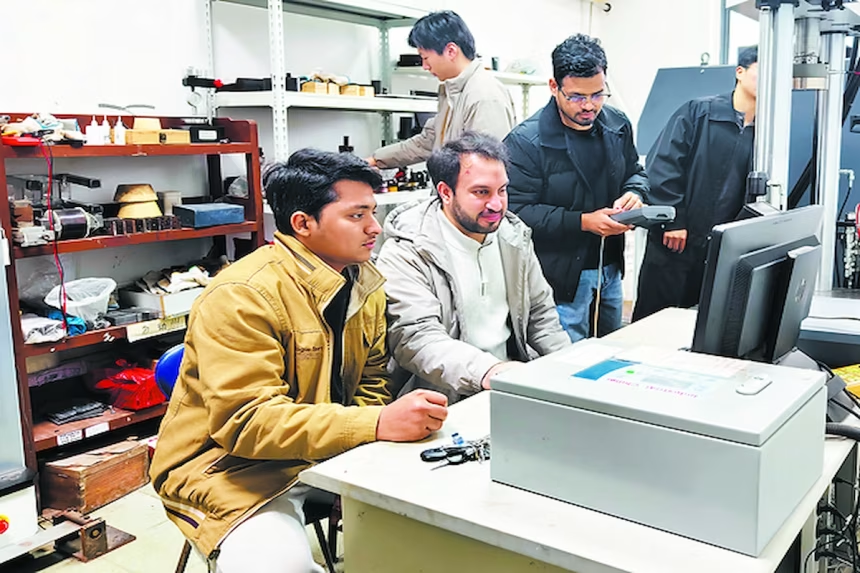

China and Pakistan have strengthened their cooperation in disaster risk reduction through the China-Pakistan Belt and Road Joint Laboratory on Smart Disaster Prevention of Major Infrastructures. The initiative combines China’s expertise in civil engineering and advanced technologies, including artificial intelligence (AI), big data, and smart monitoring, with Pakistan’s engineering and research capabilities to improve disaster prevention, infrastructure resilience, and emergency preparedness.
“The intention behind establishing the joint lab was to better address natural disasters like earthquakes that both China and Pakistan face,” said Professor Xu Zhaodong of Southeast University, noting that both countries are located on the Eurasian Seismic Belt, which accounts for approximately 15% of the world’s earthquakes.
Also read: WHO Launches Global Research Priorities on Climate, Health and Migration
Building on years of bilateral cooperation in earthquake engineering, the initiative will advance joint research, technology transfer, talent development, and the development of seismic resilience and infrastructure safety standards. Researchers are also working to adapt Chinese technologies for major infrastructure projects in Pakistan.
“Since the establishment of the joint lab, the two sides have developed a regular exchange mechanism, leading to deeper cooperation in joint research and development, technology innovation, talent cultivation, and the promotion of practical engineering solutions,” said Chen Zhongfan, Professor at Southeast University.
Guo Tong, Head of the School of Civil Engineering at Southeast University, said the laboratory integrates civil engineering with AI, big data, and information management to create an interdisciplinary research environment while supporting the development of future disaster prevention specialists.
Click here to join our WhatsApp channel here
Khan Muhammad, Counsellor for Scientific and Technological Affairs at the Embassy of Pakistan in China, highlighted the growing need for such collaboration, noting that many Belt and Road Initiative partner countries are vulnerable to earthquakes, typhoons, and other natural hazards, with cumulative economic losses exceeding RMB 1 trillion over the past two decades.
The joint laboratory is expected to strengthen scientific collaboration between China and Pakistan while training the next generation of engineers and researchers, supporting technology transfer, and enhancing disaster preparedness to reduce the impact of future natural hazards.