
• revive me 2026
  • Regenerative Medicine 2026
MedEdge MEA
  • Newsletters
  • Magazines
  • Subscribe
  • Home
  • News
  • Opinion
  • Interviews
  • Featured
  • Cover Stories
  • Events
  • Health For all
    • Ageing Gracefully
    • Family Health Matters
    • Environment Health
    • Women and Child Health
    • Men’s Health
  • Resource Hub
    • Fresh Perspectives
    • Medical Tourism
    • Medical Education
    • Personnel
    • Research
      • Healthcare Journals & Publishers
    • Healthcare Campaigns
    • Health Tools Hub
    • Dubai Health Centers Directory | Services, Locations & Timings
    • ME Explained
    • Video
  • Her Health
Reading: Human Brain and Heart Tissue Models Head to Space to Study Aging and Microgravity
Share
Notification
  • revive me 2026
  • Regenerative Medicine 2026
MedEdge MEA logo full
  • Latest News
  • Events
  • Subscribe
  • Her Health
Search
  • Home
  • News
  • Opinion
  • Interviews
  • Featured
  • Cover Stories
  • Events
  • Health For All
  • Resource Hub
  • Newsletters
  • Magazines
Have an existing account? Sign In

Home - Research - Human Brain and Heart Tissue Models Head to Space to Study Aging and Microgravity

Research

Human Brain and Heart Tissue Models Head to Space to Study Aging and Microgravity

ME Desk
ME Desk
Published: October 21, 2026
Share
4 Min Read
WhatsApp Image 2026 10 21 at 11.13.45 AM
SHARE
google_preferred_source_badge_light_en@2x

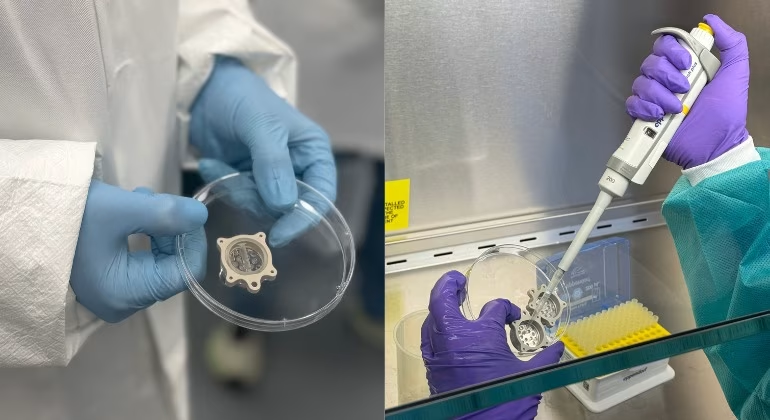
Researchers at the Icahn School of Medicine at Mount Sinai are sending bioengineered human brain and cardiovascular tissue models to the International Space Station aboard the SpaceX CRS-35 mission to investigate how microgravity and increased radiation exposure affect human health and ageing.

The research involves two investigations using organoids and organ-on-chip technology to study changes in brain activity, cardiovascular function and cellular ageing during spaceflight. The findings could help researchers better understand health risks for astronauts and identify potential approaches to protect people from age-related diseases on Earth.

Click here to join our WhatsApp channel here

One project uses miBrain, a human brain tissue model developed from patient-derived stem cells. It contains key brain cell types, including neurons, astrocytes and immune cells, alongside vascular structures. Researchers will examine how brain cell signalling and function respond to spaceflight and investigate how genetic risk factors, including APOE4, may influence neurodegeneration and ageing.

โ€œOur research could establish miBrain as a practical tool for assessing neurological risk before and during spaceflight,โ€ said project leader Joel W. Blanchard, PhD, Associate Professor of Stem Cell Biology and Regenerative Medicine, and Neuroscience, at the Icahn School of Medicine at Mount Sinai. โ€œBy testing how human brain tissue responds to the space environment, we aim to identify biomarkers of injury, determine how genetic risk factors alter susceptibility, and evaluate countermeasures that protect brain health.โ€ย 

The second investigation will use a microfluidic platform called the ยตCVchip, containing beating cardiovascular organoids derived from healthy human stem cells. Automated systems will conduct electrical pacing, pressure testing, microscopic imaging and fluid collection to assess how heart and blood vessel tissues respond to prolonged microgravity exposure.

Also read: Assistive Technology Supports Independence and Vocational Skills in Long-Term Rehabilitation

โ€œWe are incredibly proud that these spaceflight missions have chosen to propel stem cell-derived organoids from the Blanchard, Sachs, and Costa laboratories to the International Space Station,โ€ said Sarah E. Millar, PhD, Dean for Academic and Scientific Affairs and Chair of the Department of Stem Cell Biology and Regenerative Medicine, Icahn School of Medicine at Mount Sinai. โ€œThese projects highlight Mount Sinaiโ€™s growing work in space science and innovation. The results from these experiments will help us better understand the impacts of space travel on brain and heart health, refine how we prepare astronauts for spaceflight, and, potentially, improve care and develop interventions for aging populations across the Mount Sinai Health System and surrounding communities.โ€ย 

โ€œWe are excited about the work from the Department of Surgeryโ€™s Sachs/Costa Laboratory exploring organoid physiology in space,โ€ said Michael L. Marin, MD, Chair of the Department of Surgery, Mount Sinai Health System. โ€œThe data expected from this study will deepen our understanding of how specific tissues respond to altered gravitational forces.โ€

The projects involve Mount Sinai researchers in collaboration with NASA and space technology company Space Tango. The teams aim to identify biological markers of tissue injury, improve understanding of cardiovascular changes and explore potential protective strategies.

The research could advance space medicine while providing insights into neurological and cardiovascular conditions affecting ageing populations on Earth.

Share This Article
Facebook Whatsapp Whatsapp LinkedIn Copy Link
Share
Previous Article WhatsApp Image 2026 10 20 at 2.56.49 PM Surgical Intelligence and AI Innovations to Feature at Abu Dhabi Health Summit
Next Article image 2026 10 21T114425.565 Gene Therapy Enables Thalassemia Patient to Become Independent of Blood Transfusions

Recent Posts

  • Mission-Ready Healthcare Model Supports Over 1.17 Million Visits
  • New Multidisciplinary Healthcare Facility Planned for Bahrain Bay
  • UAE to Prohibit Veterinary Use of Ciprofloxacin from November 2026
  • Gene Therapy Enables Thalassemia Patient to Become Independent of Blood Transfusions
  • Human Brain and Heart Tissue Models Head to Space to Study Aging and Microgravity
Two Point Five Logo white
  • About Us
  • Contact Us
  • Medical Disclaimer
  • Privacy Policy
  • Terms and Conditions
  • Cookie Policy (EU)
  • Submit Your Story
  • MediaKit
Reading: Human Brain and Heart Tissue Models Head to Space to Study Aging and Microgravity
Share

Published by Two Point Five Media FZCO

  • About Us
  • Contact Us
  • Medical Disclaimer
  • Privacy Policy
  • Terms and Conditions
  • Cookie Policy (EU)
  • Submit Your Story
  • MediaKit
Reading: Human Brain and Heart Tissue Models Head to Space to Study Aging and Microgravity
Share

Follow US on Social Media

Facebook Instagram Linkedin X-twitter Youtube Whatsapp
Manage Consent
To provide the best experiences, we use technologies like cookies to store and/or access device information. Consenting to these technologies will allow us to process data such as browsing behavior or unique IDs on this site. Not consenting or withdrawing consent, may adversely affect certain features and functions.
Functional Always active
The technical storage or access is strictly necessary for the legitimate purpose of enabling the use of a specific service explicitly requested by the subscriber or user, or for the sole purpose of carrying out the transmission of a communication over an electronic communications network.
Preferences
The technical storage or access is necessary for the legitimate purpose of storing preferences that are not requested by the subscriber or user.
Statistics
The technical storage or access that is used exclusively for statistical purposes. The technical storage or access that is used exclusively for anonymous statistical purposes. Without a subpoena, voluntary compliance on the part of your Internet Service Provider, or additional records from a third party, information stored or retrieved for this purpose alone cannot usually be used to identify you.
Marketing
The technical storage or access is required to create user profiles to send advertising, or to track the user on a website or across several websites for similar marketing purposes.
  • Manage options
  • Manage services
  • Manage {vendor_count} vendors
  • Read more about these purposes
View preferences
  • {title}
  • {title}
  • {title}

WhatsApp us

Logo of Medede mea
Welcome Back!

Sign in to your account

Username or Email Address
Password

Lost your password?