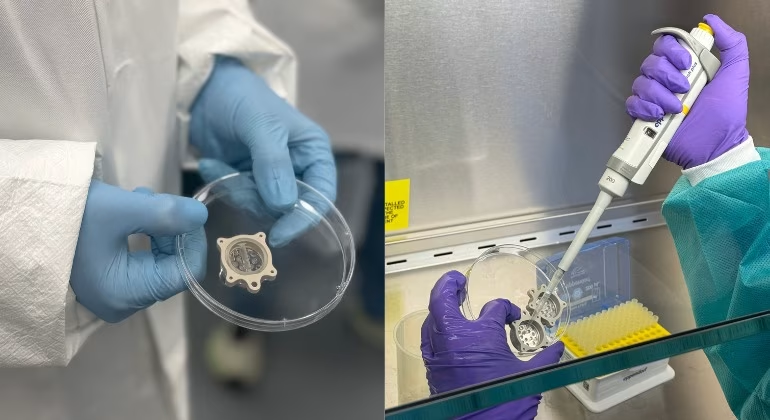

Researchers at the Icahn School of Medicine at Mount Sinai are sending bioengineered human brain and cardiovascular tissue models to the International Space Station aboard the SpaceX CRS-35 mission to investigate how microgravity and increased radiation exposure affect human health and ageing.
The research involves two investigations using organoids and organ-on-chip technology to study changes in brain activity, cardiovascular function and cellular ageing during spaceflight. The findings could help researchers better understand health risks for astronauts and identify potential approaches to protect people from age-related diseases on Earth.
Click here to join our WhatsApp channel here
One project uses miBrain, a human brain tissue model developed from patient-derived stem cells. It contains key brain cell types, including neurons, astrocytes and immune cells, alongside vascular structures. Researchers will examine how brain cell signalling and function respond to spaceflight and investigate how genetic risk factors, including APOE4, may influence neurodegeneration and ageing.
“Our research could establish miBrain as a practical tool for assessing neurological risk before and during spaceflight,” said project leader Joel W. Blanchard, PhD, Associate Professor of Stem Cell Biology and Regenerative Medicine, and Neuroscience, at the Icahn School of Medicine at Mount Sinai. “By testing how human brain tissue responds to the space environment, we aim to identify biomarkers of injury, determine how genetic risk factors alter susceptibility, and evaluate countermeasures that protect brain health.”
The second investigation will use a microfluidic platform called the µCVchip, containing beating cardiovascular organoids derived from healthy human stem cells. Automated systems will conduct electrical pacing, pressure testing, microscopic imaging and fluid collection to assess how heart and blood vessel tissues respond to prolonged microgravity exposure.
Also read: Assistive Technology Supports Independence and Vocational Skills in Long-Term Rehabilitation
“We are incredibly proud that these spaceflight missions have chosen to propel stem cell-derived organoids from the Blanchard, Sachs, and Costa laboratories to the International Space Station,” said Sarah E. Millar, PhD, Dean for Academic and Scientific Affairs and Chair of the Department of Stem Cell Biology and Regenerative Medicine, Icahn School of Medicine at Mount Sinai. “These projects highlight Mount Sinai’s growing work in space science and innovation. The results from these experiments will help us better understand the impacts of space travel on brain and heart health, refine how we prepare astronauts for spaceflight, and, potentially, improve care and develop interventions for aging populations across the Mount Sinai Health System and surrounding communities.”
“We are excited about the work from the Department of Surgery’s Sachs/Costa Laboratory exploring organoid physiology in space,” said Michael L. Marin, MD, Chair of the Department of Surgery, Mount Sinai Health System. “The data expected from this study will deepen our understanding of how specific tissues respond to altered gravitational forces.”
The projects involve Mount Sinai researchers in collaboration with NASA and space technology company Space Tango. The teams aim to identify biological markers of tissue injury, improve understanding of cardiovascular changes and explore potential protective strategies.
The research could advance space medicine while providing insights into neurological and cardiovascular conditions affecting ageing populations on Earth.