

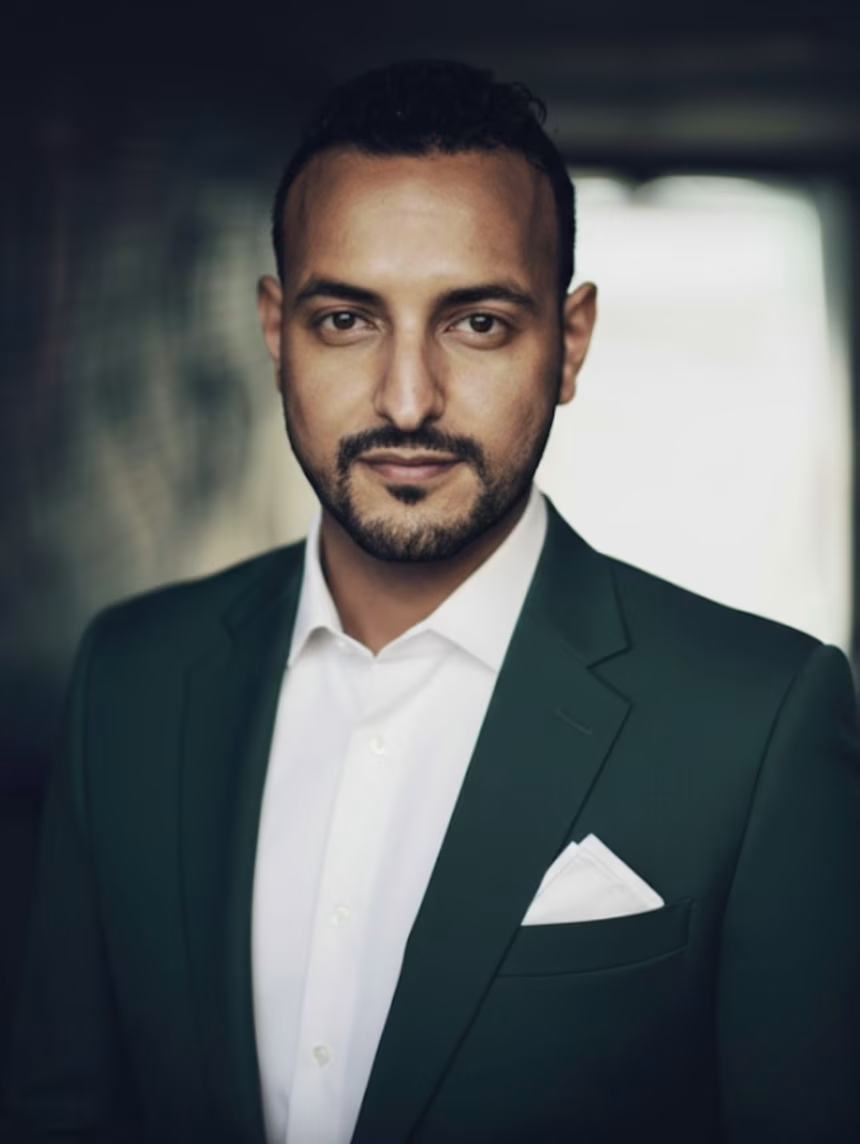

Dr Meshari Alwashmi, CEO and co-founder of Amplifai Health, discusses why the technology is built to sharpen human judgement rather than replace it, how it fills a gap left by conventional sports-tracking tools, and where he sees Thermal Intelligence heading next, from elite sport into everyday preventive health.
1. What drew you personally to thermal imaging, and how would you explain to someone outside medicine what it can tell us about the body?
What drew me to thermal imaging was that it is safe, non-invasive, and still largely underutilized despite its significant potential. Unlike radiology, relatively few specialists are trained to interpret thermal images. Since AI is particularly effective at recognizing and interpreting visual patterns, we saw an opportunity to make thermal imaging more consistent, accessible, and useful. That inspired us to take the initiative and lead the emerging field of Thermal Intelligence.
Think of thermal imaging as a map of the body’s blood flow. Because blood carries heat, an increase or decrease in circulation can create a distinct thermal signature. For example, an area under physical stress may appear warmer than the same area on the opposite side, while reduced circulation may appear cooler. Thermal imaging makes these invisible patterns visible so they can be investigated and tracked over time.
Click here to join our WhatsApp channel here
The important point is that thermal imaging is not about replacing medical diagnosis. It’s about providing another layer of objective physiological information that can support better decisions.
2. How much of what you’re able to detect now would have been invisible or ambiguous to a clinician five or ten years ago?
The thermal patterns were always there, but interpreting them consistently was difficult and often depended on a small number of trained specialists. Today, our technology can automatically identify body regions, quantify temperature differences, and track changes against a person’s own baseline over time. We are not creating a new physiological signal. We are making an existing yet largely invisible signal; measurable, interpretable, and useful.
3. You’ve spent time in clinical applications before moving into athlete performance. What carried over from that experience, and what had to be rethought completely?
What carried over was the scientific discipline: standardized imaging, quality control, anatomical mapping, validation, and using thermal patterns to identify early signs of potential injury or physiological risk. What had to be rethought was the workflow. In clinical care, the focus is often detecting health risks early. In sport, we give an objective signal that supports the practitioner’s assessment; for recovery, readiness and return-to-play. It brings an extra layer of clarity and completes the picture for the decisions your team already makes.
Also read: Moscow Expands AI-Powered Radiology Services Across Russian Regions
4. When you’re building a system that reads physiological signals, how do you draw the line between something clinically meaningful and something that’s just noise, and how do you handle the tension between giving people more data and making sure it actually leads to better decisions rather than more anxiety?
We rely on established scientific guidelines to help separate meaningful signals from normal physiological noise. We look at the magnitude, location, and consistency of a thermal pattern, compare both sides of the body, and track it against the person’s baseline over time. We also continue to learn by associating these signals with symptoms, outcomes, and other physiological data, helping us better understand what each pattern may mean.
More data is not always better. Better interpretation is. We do not want to overwhelm athletes with raw thermal images, numbers, or unnecessary alerts. NUR uses AI to translate complex signals from multiple sources into clear, relevant insights and practical next steps. The goal is to give athletes and their performance teams greater clarity and confidence, not more anxiety.
5. How do you personally think about the role of AI here? Is it there to replace judgement, sharpen it, or something else entirely?
I see AI as a tool to sharpen judgement, not replace it. AI makes this previously specialized technology accessible, understandable, and useful. Advanced computer vision captures noisy thermal images, isolates the relevant signal, segments the body, analyses thermal patterns, and applies statistical methods to assess their significance. Controlled generative AI then translates these complex findings into clear, practical insights. This democratizes thermal imaging by enabling athletes to perform scans themselves while helping them and their performance teams understand the results, interpret them alongside other relevant data, and make informed decisions about what to investigate next.
6. Elite sport already has plenty of tracking technology. What made you confident there was still a real gap worth building for?
Most sports technologies measure what the athlete does, such as speed, distance, workload, force, heart rate, or sleep. Very few show how specific regions of the body are responding. Thermal imaging adds that missing physiological layer by revealing regional patterns, bilateral asymmetry, and changes from the athlete’s own baseline. NUR is also the only self guided thermal imaging system designed for anyone to use without a specialist operating every scan. By bringing these insights together with wearables, force plates, and other tools, NUR gives athletes and performance teams a more complete picture.
7. Working between Saudi Arabia and the US, how different is the appetite for this kind of technology across regions, and looking ahead, where do you personally want to see it applied next?
The appetite is strong in both regions, but adoption happens differently. Saudi Arabia is moving quickly in digital health, preventive care, and sports innovation, with opportunities to deploy technology across larger systems. In the US, adoption is often more decentralized and led by individual teams, clinics, and performance centres. In both markets, people respond to the same value: technology that provides meaningful insight while fitting naturally into their existing workflow.
I want to see this technology move beyond elite sport and become part of everyday preventive health. It has strong potential in physiotherapy, rehabilitation, healthy aging, and personal wellness, helping people understand how their bodies are responding before small issues become serious. Ultimately, I want Thermal Intelligence to become as accessible and familiar as other everyday health monitoring tools.