


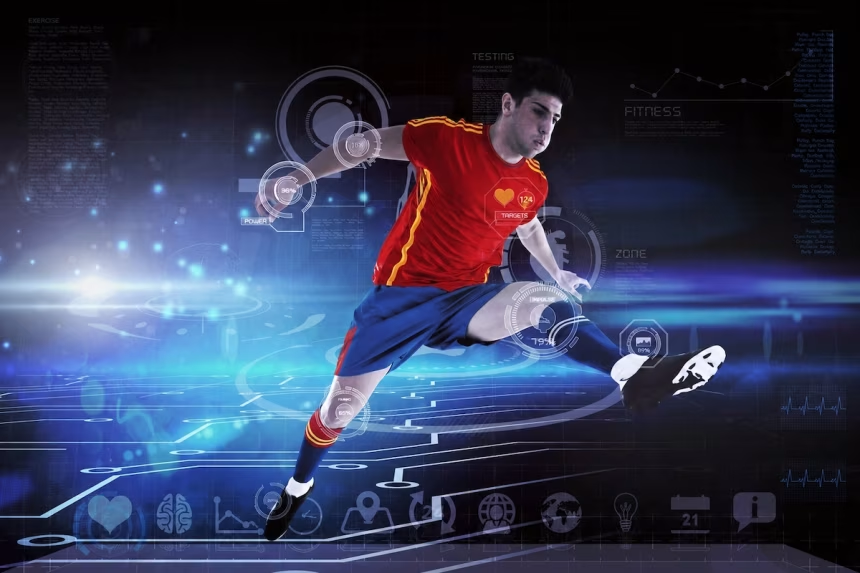

On July 19, 2026, Spain beat Argentina 1-0 in extra time to lift its second FIFA World Cup title, ending Lionel Messi’s last shot at the trophy and capping a tournament in which La Roja conceded just a single goal in eight matches. The headlines went to Ferran Torres’ extra-time winner. But behind that statistic , one goal conceded across an entire World Cup campaign , sits something a healthcare audience will find more interesting than the scoreline: a sports medicine system with real institutions, real clinicians, and real technology behind it.
For a healthcare audience, Spain’s win is less a football story and more a case study in applied sports medicine.
MedEdge Insight: Every healthcare system has strengths and challenges. At MedEdge MEA, we explore global healthcare models not to rank them, but to identify practical lessons that can inspire innovation across the Middle East.
The training ground behind La Roja: Ciudad del Fútbol
Spain’s national team doesn’t prepare in a generic facility , it operates out of Ciudad del Fútbol, the Royal Spanish Football Federation’s (RFEF) purpose-built training complex in Las Rozas, on the outskirts of Madrid. Opened in 2003 at a cost of €46 million, it has served as Spain’s national team headquarters and training base ever since, housing not just pitches but the medical, physiotherapy, and sports science staff who manage the squad through qualification and tournament play.
This matters because it reflects a broader Spanish pattern: elite performance infrastructure isn’t assembled the month before a tournament, it’s a standing institution the federation invests in year-round.
A recognizable name in Spanish sports medicine: Dr. Ramón Cugat
Barcelona is sometimes called the “capital of sports medicine,” and one name is central to that reputation: Dr. Ramón Cugat, Co-Director of Orthopaedic Surgery and Traumatology at Quirónsalud Barcelona Hospital and founder of the Instituto Cugat. Dr. Cugat pioneered arthroscopic knee surgery in Spain, began using growth-factor injections in 2000, and has specialized in stem-cell-based repair of ACL and cartilage injuries since 2013. Over a four-decade career he has treated a roster of elite footballers , including Xavi Hernández, Andrés Iniesta, Carles Puyol, Samuel Eto’o, Cesc Fàbregas, David Villa, and Fernando Torres.
He’s a useful reference point for a clinical audience precisely because his work sits at the intersection this article is about: orthopedic surgery, regenerative medicine, and elite sport, all developed inside Spain’s hospital system rather than a standalone sports facility.
Technology behind the trophy
Modern international squads no longer rely on instinct alone to manage fitness through a month-long tournament , they rely on data. At the 2026 World Cup, twelve nations used GPS performance-tracking vests (from providers such as STATSports) to monitor players’ speed, distance covered, and heart rate in real time, feeding sports scientists and coaches the load data behind substitution and selection decisions.
This is now the standard toolkit across elite football, and Spanish clubs and federations have been early, consistent adopters of it:
- GPS load tracking , monitoring distance, sprint counts, and high-intensity efforts in every training session, not just matches.
- HRV (heart-rate variability) monitoring , an accessible marker of recovery status and accumulated fatigue.
- Sleep analytics , increasingly used to flag players at elevated injury risk before it shows up on the pitch.
- Biomechanical and movement screening , assessing asymmetries and movement patterns linked to non-contact injuries like hamstring strains and ACL tears.
None of these tools are exclusive to Spain. What distinguishes the Spanish system is how early and how thoroughly they’ve been embedded into club academies, not just first-team squads , meaning players arrive at international level already accustomed to being monitored, screened, and managed by data rather than instinct.
Click here to join our WhatsApp channel here
What injuries actually cost , the real La Liga numbers
It’s tempting to claim Spanish clubs simply suffer fewer injuries than their European rivals, but the research doesn’t support a clean comparison , a peer-reviewed analysis found injury incidence across Europe’s top five leagues (La Liga, the Premier League, Serie A, the Bundesliga, and Ligue 1) is not significantly different. What is well documented is the financial weight of injuries within La Liga itself: a PLOS One study of the 2018/19 season found muscle injuries cost La Liga’s 20 clubs a combined €365,811 per month, with hamstring strains alone accounting for roughly €47,388 per month , a real, quantified incentive for the investment Spanish clubs have made in injury prevention and rehabilitation infrastructure.
Why this matters beyond football
The GCC region has invested heavily in elite sport in recent years , football academies, national fitness strategies, and sports medicine centers across the UAE, Saudi Arabia, and Qatar. Spain’s campaign offers a genuine blueprint, not just inspiration. For GCC sports medicine directors and hospital groups building out performance capability, three priorities stand out:
1. Build standing infrastructure, not tournament-cycle projects. Ciudad del Fútbol has operated continuously since 2003. The lesson isn’t the building itself , it’s the principle that medical and performance staff need a permanent institutional home, integrated with the federation year-round, rather than being assembled ahead of a major tournament.
Also read: New Research Highlights Role of Maternal Nutrition in Lifelong Child Health
2. Push sports science down to academy level, not just the first team. Spain’s players arrive at the national team already conditioned by club academies that have embedded GPS tracking, recovery monitoring, and movement screening into daily training for years. For GCC federations expanding youth academies, embedding a sports scientist at every age-group level , not only senior squads , is one of the more cost-effective long-term investments available.
3. Look to Spain’s hospital-based sports medicine expertise, not just its clubs. Centers like Quirónsalud Barcelona and the Instituto Cugat show that Spain’s sports medicine strength runs through its hospital system, not a separate sporting bureaucracy. GCC hospital groups exploring international knowledge-transfer or clinical partnerships have a genuine, credentialed ecosystem to engage with here , one with decades of experience specifically in orthopedic and regenerative treatment of elite athletes.
The takeaway
Spain’s World Cup title will be remembered for a Ferran Torres finish in extra time. But the infrastructure behind it , a permanent national training base, hospital-based sports medicine expertise built over decades, and an early, thorough embrace of performance data , is a genuine case study in applied sports medicine, with direct relevance for hospital groups, sports medicine clinics, and academy programs across the GCC building out their own performance and rehabilitation capabilities.
This article is part of MedEdge MEA’s coverage of global health systems and performance medicine relevant to GCC healthcare leaders.