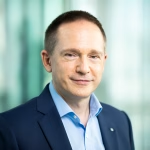


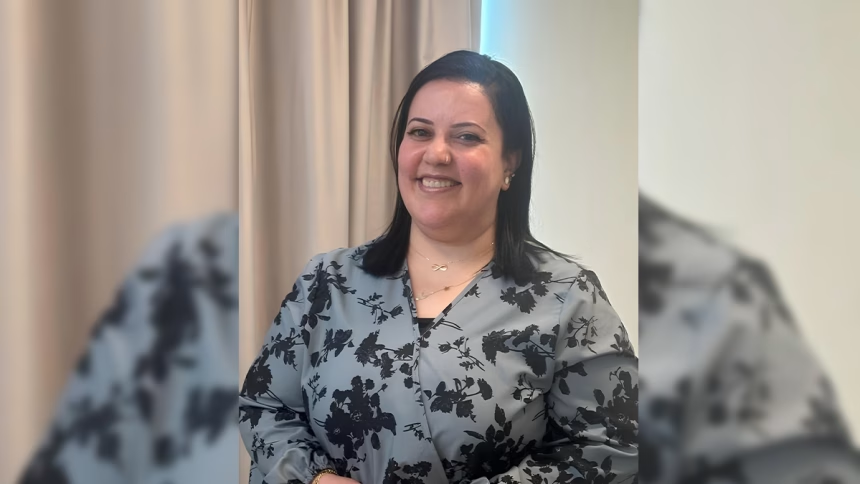
With unfailing control over budget and timelines, transparent collaboration, and consistently high service quality, ScienceSoft has earned the respect of its clients. ScienceSoft, the US-based IT consulting and software development company is expanding its footprint worldwide. In healthcare, ScienceSoft’s growth aligns perfectly with industry expectations. To explore the latest healthcare developments, MedEdge MEA had an exclusive conversation with Hadeel Abu Baker, Senior Healthcare IT Consultant and Business Analyst at ScienceSoft.
MedEdge MEA: What’s your view on AI’s current impact in healthcare IT and its immediate effect on patient care?
Hadeel Abu Baker: Currently, AI is seeing the highest adoption in admin operations: documentation, revenue cycle, and patient communication. These areas face lighter regulations and bring paybacks within months, compared to clinical AI tools.
For instance, RCM vendors report significant gains in processing time and denial reduction through AI-driven coding and eligibility checks. Similarly, patient chatbots and automated outreach in major EHR portals cut no-shows and free 2–3 staff hours per employee daily. The result for patients is shorter waits and higher access to care.
Clinical decision supporting AI is progressing more cautiously. Both in the US and the Gulf, many CDS tools qualify as medical devices, which require multi-step validation, regulatory clearance, and strict data governance. ROI also arrives later because benefits depend on patient outcomes.
ME: How do AI agents enhance patient intake and triage in high-pressure environments?
Hadeel: Studies like OpenAI’s HealthBench show that frontier general LLMs can effectively recognize and escalate emergencies. However, regulations for intake and triage in emergency departments are tighter than in ambulatory care. For example, Abu Dhabi Emergency Department Standard requires a validated triage scale, such as ESI, and assigns triage and clinical responsibility to licensed staff, so AI cannot assign acuity or make clinical calls.
Still, an intake-and-triage AI agent can add real value in a busy ER. A practical Gulf setup might have the agent generate an ISBAR pre-note that enters the triage queue and a clinician prompt requiring ESI and disposition entry before proceeding. This keeps the AI outside the medical screening exam, ESI selection, and disposition steps. Once signed by a clinician, the system locks the triage packet, records an auditable trail, and alerts the charge nurse to any red-flag triggers. For providers, this setup speeds door-to-clinician time during surges, reduces documentation gaps, and strengthens accountability compared to current workflows.
ME: How is ScienceSoft leveraging AI to transform patient intake and triage across global healthcare systems?
Hadeel: ScienceSoft recently designed an intake and triage AI agent with LLM-agnostic architecture. The blueprint suits hospitals and ambulatory centers, with the fastest payback at front desks, ambulatory phone lines, and virtual lobbies. Here’s how it works:
- Patients start intake on their phones or kiosks. The chatbot collects minimum necessary data, confirms insurance in real time, and books appointments. It also spots red-flag symptoms to escalate high-risk cases to medical staff immediately.
- Medical staff receive one clean packet that includes the reason for the visit, a short history, eligibility status, and a booked slot. That cuts repeat interviews, shortens queues, and decreases claims bounce on missing data.
The same architecture pattern also powers another of our recent solutions, an AI voice assistant for patient scheduling and outreach. We’ve found that this kind of assistant can handle about 70% more scheduling requests per hour than a human staff member, and it reduces the booking time per call by roughly 40%.
ME: In what ways is ScienceSoft collaborating with hospitals in the Middle East to improve patient flow and experience?
Hadeel: ScienceSoft works with public and private Gulf hospitals to support national digital transformation initiatives, such as Vision 2030’s Health Sector Transformation Program in Saudi Arabia, which focuses on expanding e-health, prevention, sustainability, and care access. We support those aims by targeting hospital flow bottlenecks with AI solutions.
For example, an AI claims checker can align with NPHIES flags, check eligibility, and find code gaps early to cut denials and protect revenue. An AI call center agent can answer common questions in Arabic and English and book appointments, freeing up staff and reducing wait times.
Since high-quality Arabic clinical corpora for LLM fine-tuning remain limited, we use strong general models with out-of-the-box support for Arabic, its dialects, and Arabizi. As a safety guardrail, the system tracks dialect recognition confidence scores, and when they drop, asks a clarifier question or moves the session to staff.
ME: What major digital trends do you believe will redefine hospital operations and patient engagement in the next decade?
Hadeel: First, AI assistants are becoming standard in EHR platforms. All major EHR vendors already ship agents. Oracle Health shows the pattern with a voice interface inside its EHR and AI assistants that surface clinical context and suggest next steps. Over the next decade, AI agents will draft notes and orders, reconcile meds, prefill prior authorization, predict denials, and run natural-language patient outreach.
Second, care moves outside the hospital. With clearer regulations and payer support, virtual visits and hospital-at-home programs are going to scale up. Remote patient monitoring also grows more capable as devices and AI models improve, so care teams can spot risk early and act before a flare-up. For us, this minimizes waits, follow-up gaps, rural access issues, and avoidable admissions.