


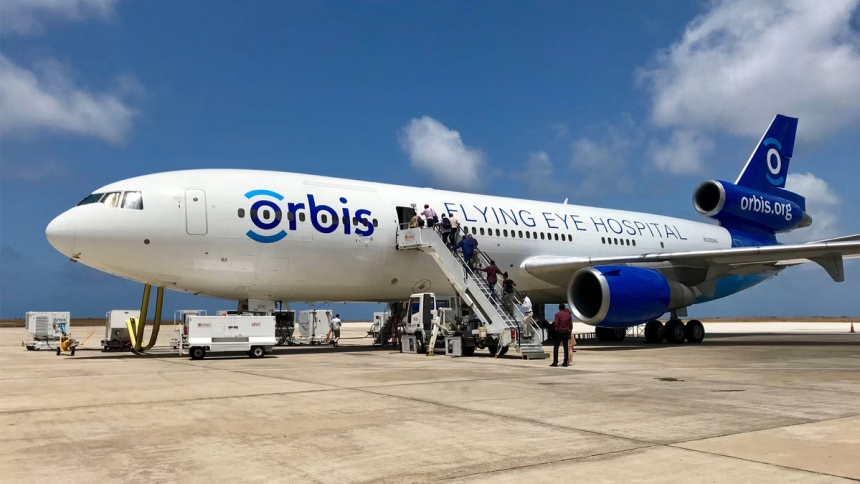

Blindness affects millions worldwide, yet specialists say that nearly 80% of vision loss can be prevented or treated. The Orbis Flying Eye Hospital is an innovative solution to this problem, an actual hospital built inside an airplane traveling the globe to bring eye care and training directly to underserved communities.
What is the Orbis Flying Eye Hospital?
The Orbis Flying Eye Hospital is a fully accredited ophthalmic teaching hospital onboard a specially converted McDonnell Douglas MD-10 aircraft. It serves as both a surgical center and an educational facility, flying to low- and middle-income countries where access to eye care is limited or nonexistent.
Also Read: Can Looking at an Eclipse Damage Your Eyes?
The plane is equipped with operating rooms, examination areas, sterilization facilities, and a classroom with 46 seats. Through advanced 3D cameras and live broadcast systems, surgeons onboard perform eye surgeries which local doctors, nurses, and students can watch in real time. They can even interact via two-way audio-visual systems to ask questions during procedures. This approach allows Orbis to do more than treat patients, it trains local health professionals, enabling them to carry on sight-saving work long after the plane has left.
A brief history
The idea began in 1982, when Orbis International converted a Douglas DC-8 aircraft donated by United Airlines into the first Flying Eye Hospital. Since then, the project has evolved, upgrading to a DC-10 in 1992 and most recently to the current MD-10 donated by FedEx in 2016. Each new plane has improved range, better facilities, and state-of-the-art medical equipment.
Click here to join our WhatsApp channel here
Orbis was the first flying hospital in the world to receive full U.S. hospital accreditation, making it a genuine, mobile medical center with the same standards as land-based hospitals.
What happens inside the plane?
Once on site, the Flying Eye Hospital’s team sets up quickly, the operating rooms can be sterilized and ready for surgery within six to seven hours of landing.
Inside, the plane houses:
- Two fully equipped operating rooms.
- Exam and patient recovery areas.
- A classroom with large 3D screens broadcasting live surgeries.
- Surgical simulators using artificial eyes that allow trainees to practice procedures like cataract removal.
Doctors and nurses onboard, along with volunteer experts from around the world, not only perform surgeries but teach local clinicians hands-on skills and the latest techniques. Through these efforts, Orbis helps build lasting local eye care capacity.
Why this model works
The World Health Organization estimates that over 90% of the world’s blind population lives in low-income countries, often due to a simple lack of access to care and trained specialists. Sending doctors from these regions abroad for training is expensive and takes them away from their communities for long periods.
The Flying Eye Hospital brings the training to them. This “teach a man to fish” approach is sustainable. Instead of creating a temporary clinic, Orbis strengthens a region’s healthcare system for the long term. A doctor who learns advanced surgical techniques can go on to restore the sight of thousands throughout their career.
The plane’s impact is amplified by Orbis’s telemedicine platform, Cybersight, which allows for ongoing remote training and support long after the aircraft has departed for its next mission.
A legacy of sight
Since its first flight in 1982, the program’s impact is undeniable. The Flying Eye Hospital has conducted programs in over 95 countries and trained more than 400,000 healthcare workers. Its legacy is measured not just in the surgeries performed on the plane, but in the millions of procedures performed later by the doctors it trained.
It stands as a powerful example of innovation in global health, a mobile, self-sufficient symbol of hope that continues to prove a simple, powerful idea: sometimes, the best way to help is to come down and show how.