
• Duphat
  • infinia camp
mededge mea logo web MedEdge_Logo_Dark

Public Relations, Top Health Magazine and Healthcare News GCC

  • Newsletters
  • Magazines
  • Subscribe
  • Home
  • News
  • Opinion
  • Interviews
  • Featured
  • Cover Stories
  • Events
  • Health For all
    • Ageing Gracefully
    • Family Health Matters
    • Environment Health
    • Women and Child Health
    • Men’s Health
  • Resource Hub
    • Fresh Perspectives
    • Medical Tourism
    • Medical Education
    • Personnel
    • Research
      • Healthcare Journals & Publishers
    • Healthcare Campaigns
    • Health Tools Hub
    • Dubai Health Centers Directory | Services, Locations & Timings
    • ME Explained
Reading: 1 in 4 people globally still lack access to safe drinking water – WHO, UNICEF
Share
Notification
  • Duphat
  • infinia camp
mededge mea logo web
  • Magazines
  • Newsletters
  • Profiles
  • Subscribe
Search
  • Home
  • News
  • Opinion
  • Interviews
  • Featured
  • Cover Stories
  • Events
  • Health For all
    • Ageing Gracefully
    • Family Health Matters
    • Environment Health
    • Women and Child Health
    • Men’s Health
  • Resource Hub
    • Fresh Perspectives
    • Medical Tourism
    • Medical Education
    • Personnel
    • Research
    • Healthcare Campaigns
    • Health Tools Hub
    • Dubai Health Centers Directory | Services, Locations & Timings
    • ME Explained
Have an existing account? Sign In
MedEdge MEA > Health For All > Public Health > 1 in 4 people globally still lack access to safe drinking water – WHO, UNICEF
Public Health

1 in 4 people globally still lack access to safe drinking water – WHO, UNICEF

ME Desk
ME Desk
Published: August 26, 2025
Share
4 Min Read
safe drinking water
SHARE

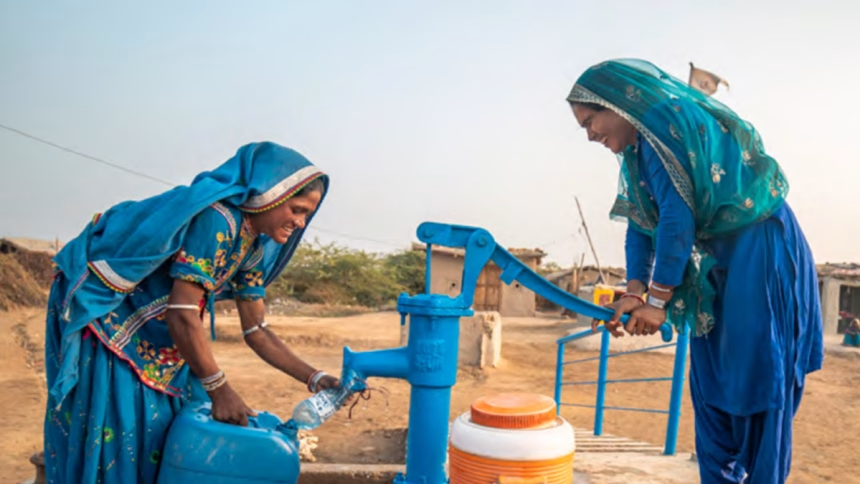
To mark World Water Week 2025, new report highlights persistent inequalities, with vulnerable communities left behind.

Despite progress over the last decade, billions of people around the world still lack access to essential water, sanitation, and hygiene services, putting them at risk of disease and deeper social exclusion.

Also Read: Benefits of Drinking Water: 5 Signs Your Body Is Desperate for Hydration

A new report: Progress on Household Drinking Water and Sanitation 2000–2024: special focus on inequalities –launched by WHO and UNICEF during World Water Week 2025 – reveals that, while some progress has been made, major gaps persist. People living in low-income countries, fragile contexts, rural communities, children, and minority ethnic and indigenous groups face the greatest disparities.

Ten key facts from the report:

  • Despite gains since 2015, 1 in 4 – or 2.1 billion people globally – still lack access to safely managed drinking water*, including 106 million who drink directly from untreated surface sources.
  • 3.4 billion people still lack safely managed sanitation, including 354 million who practice open defecation.
  • 1.7 billion people still lack basic hygiene services at home, including 611 million without access to any facilities.
  • People in least developed countries are more than twice as likely as people in other countries to lack basic drinking water and sanitation services, and more than three times as likely to lack basic hygiene.
  • In fragile contexts, safely managed drinking water coverage is 38 percentage points lower than in other countries, highlighting stark inequalities.
  • While there have been improvements for people living in rural areas, they still lag behind. Safely managed drinking water coverage rose from 50 per cent to 60 per cent between 2015 and 2024, and basic hygiene coverage from 52 per cent to 71 per cent. In contrast, drinking water and hygiene coverage in urban areas has stagnated.
  • Data from 70 countries show that while most women and adolescent girls have menstrual materials and a private place to change, many lack sufficient materials to change as often as needed.
  • Adolescent girls aged 15–19 are less likely than adult women to participate in activities during menstruation, such as school, work and social pastimes.
  • In most countries with available data, women and girls are primarily responsible for water collection, with many in sub-Saharan Africa and Central and Southern Asia spending more than 30 minutes per day collecting water.
  • As we approach the last five years of the Sustainable Development Goals period, achieving the 2030 targets for ending open defecation and universal access to basic water, sanitation and hygiene services will require acceleration, while universal coverage of safely managed services appears increasingly out of reach.

“Water, sanitation and hygiene are not privileges, they are basic human rights,” said Dr Ruediger Krech, Director a.i, Environment, Climate Change and Health, World Health Organization. “We must accelerate action, especially for the most marginalized communities, if we are to keep our promise to reach the Sustainable Development Goals.”

Click here to join our WhatsApp channel here

“When children lack access to safe water, sanitation, and hygiene, their health, education, and futures are put at risk,” said Cecilia Scharp, UNICEF Director of WASH. “These inequalities are especially stark for girls, who often bear the burden of water collection and face additional barriers during menstruation. At the current pace, the promise of safe water and sanitation for every child is slipping further from reach – reminding us that we must act faster and more boldly to reach those who need it most.”
Share This Article
Facebook Whatsapp Whatsapp LinkedIn Copy Link
Share
Previous Article RAK Diabetes Challenge 2025 Ready to lose weight, improve sugar levels and win big? Join RAK Diabetes Challenge 2025
Next Article Dubai Investments Dubai Investments, Through Globalpharma, Signs MoU with Angola’s Ministry of Health

Recent Posts

  • From market access to national ambition, gulf healthcare is playing a longer game
  • New Push for HIV Innovation and Access Aims to Accelerate Progress Toward 2030 Goals
  • WHO Discusses Digital Health and Humanization of Care at Scientific Conference
  • Rising Ebola Cases Deepen Humanitarian Crisis for Children in DR Congo
  • Burjeel holdings secures dual credit ratings and launches USD 1.5 billion sukuk programme
  • duphat
  • MedEdge-Infinia
Two Point Five Logo white
  • About Us
  • Contact Us
  • Medical Disclaimer
  • Privacy Policy
  • Terms and Conditions
  • Cookie Policy (EU)
  • Submit Your Story
  • MediaKit
Reading: 1 in 4 people globally still lack access to safe drinking water – WHO, UNICEF
Share

Published by Two Point Five Media FZCO

  • About Us
  • Contact Us
  • Medical Disclaimer
  • Privacy Policy
  • Terms and Conditions
  • Cookie Policy (EU)
  • Submit Your Story
  • MediaKit
Reading: 1 in 4 people globally still lack access to safe drinking water – WHO, UNICEF
Share

Follow US on Social Media

Facebook Instagram Linkedin X-twitter Youtube Whatsapp
Manage Consent
To provide the best experiences, we use technologies like cookies to store and/or access device information. Consenting to these technologies will allow us to process data such as browsing behavior or unique IDs on this site. Not consenting or withdrawing consent, may adversely affect certain features and functions.
Functional Always active
The technical storage or access is strictly necessary for the legitimate purpose of enabling the use of a specific service explicitly requested by the subscriber or user, or for the sole purpose of carrying out the transmission of a communication over an electronic communications network.
Preferences
The technical storage or access is necessary for the legitimate purpose of storing preferences that are not requested by the subscriber or user.
Statistics
The technical storage or access that is used exclusively for statistical purposes. The technical storage or access that is used exclusively for anonymous statistical purposes. Without a subpoena, voluntary compliance on the part of your Internet Service Provider, or additional records from a third party, information stored or retrieved for this purpose alone cannot usually be used to identify you.
Marketing
The technical storage or access is required to create user profiles to send advertising, or to track the user on a website or across several websites for similar marketing purposes.
  • Manage options
  • Manage services
  • Manage {vendor_count} vendors
  • Read more about these purposes
View preferences
  • {title}
  • {title}
  • {title}

WhatsApp us

Logo of Medede mea
Welcome Back!

Sign in to your account

Username or Email Address
Password

Lost your password?