
• Duphat
  • infinia camp
mededge mea logo web MedEdge_Logo_Dark

Public Relations, Top Health Magazine and Healthcare News GCC

  • Newsletters
  • Magazines
  • Subscribe
  • Home
  • News
  • Opinion
  • Interviews
  • Featured
  • Cover Stories
  • Events
  • Health For all
    • Ageing Gracefully
    • Family Health Matters
    • Environment Health
    • Women and Child Health
    • Men’s Health
  • Resource Hub
    • Fresh Perspectives
    • Medical Tourism
    • Medical Education
    • Personnel
    • Research
      • Healthcare Journals & Publishers
    • Healthcare Campaigns
    • Health Tools Hub
    • Dubai Health Centers Directory | Services, Locations & Timings
    • ME Explained
Reading: WHO issues new guidance on Bundibugyo Virus Disease therapeutic research
Share
Notification
  • Duphat
  • infinia camp
mededge mea logo web
  • Magazines
  • Newsletters
  • Profiles
  • Subscribe
Search
  • Home
  • News
  • Opinion
  • Interviews
  • Featured
  • Cover Stories
  • Events
  • Health For all
    • Ageing Gracefully
    • Family Health Matters
    • Environment Health
    • Women and Child Health
    • Men’s Health
  • Resource Hub
    • Fresh Perspectives
    • Medical Tourism
    • Medical Education
    • Personnel
    • Research
    • Healthcare Campaigns
    • Health Tools Hub
    • Dubai Health Centers Directory | Services, Locations & Timings
    • ME Explained
Have an existing account? Sign In
MedEdge MEA > Research > WHO issues new guidance on Bundibugyo Virus Disease therapeutic research
Research

WHO issues new guidance on Bundibugyo Virus Disease therapeutic research

ME Desk
ME Desk
Published: June 27, 2026
Share
1 Min Read
SHARE

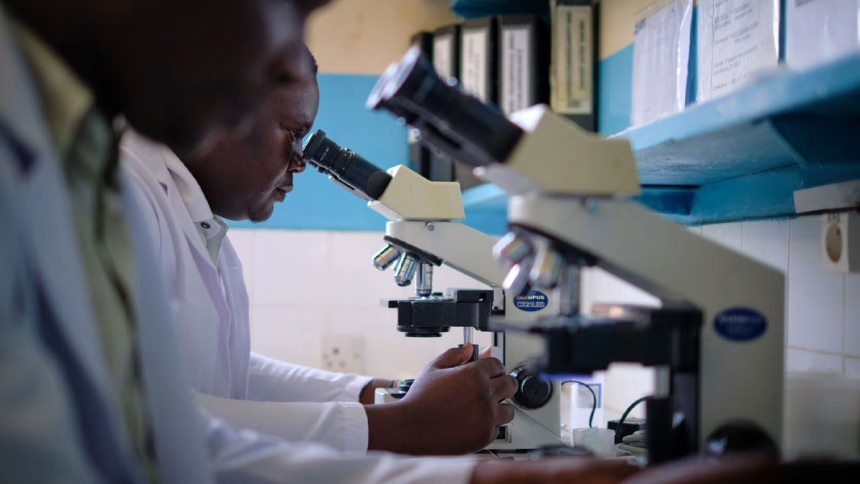
The World Health Organization (WHO) has stated that more scientific evidence is needed before immunomodulators and host-directed therapies can be included in clinical trials for Bundibugyo Virus Disease (BVD). Current knowledge is largely based on research involving the Ebola virus, which is not sufficient to guide treatment decisions for BVD.

WHO’s Technical Advisory Group on Therapeutics Prioritization (TAG-TP) emphasized the need to collect high-quality clinical data from patients infected with the Bundibugyo virus. This includes studying immune responses, viral load, inflammation, organ damage, and blood clotting markers to better understand how the disease progresses.

Click here to join our WhatsApp channel here

The organization warned that some immunomodulatory treatments could be beneficial or harmful depending on the stage of illness, making careful patient selection and timing of treatment essential. WHO also highlighted the importance of generating evidence from animal studies to help identify the most promising therapies for future clinical trials.

The recommendations aim to support the safe development of effective treatments while minimizing risks for patients participating in Bundibugyo virus disease research.

Also read: Regional Hearing Care Gap Demands Stronger Screening and Public Health Support

Share This Article
Facebook Whatsapp Whatsapp LinkedIn Copy Link
Share
Previous Article M42 and HealthPlus Convene Multidisciplinary Forum on Diabetes Technology in Abu Dhabi
Next Article Family Care Authority hosts dialogue on drug prevention ahead of international awareness day

Recent Posts

  • Family Care Authority hosts dialogue on drug prevention ahead of international awareness day
  • WHO issues new guidance on Bundibugyo Virus Disease therapeutic research
  • M42 and HealthPlus Convene Multidisciplinary Forum on Diabetes Technology in Abu Dhabi
  • Department of Health Abu Dhabi and Novartis Forge genomics partnership to advance precision care
  • Abu Dhabi biobank teams up with BioTwin to expand AI precision health capabilities
  • duphat
  • MedEdge-Infinia
  • DUHAPT
Two Point Five Logo white
  • About Us
  • Contact Us
  • Medical Disclaimer
  • Privacy Policy
  • Terms and Conditions
  • Cookie Policy (EU)
  • Submit Your Story
  • MediaKit
Reading: WHO issues new guidance on Bundibugyo Virus Disease therapeutic research
Share

Published by Two Point Five Media FZCO

  • About Us
  • Contact Us
  • Medical Disclaimer
  • Privacy Policy
  • Terms and Conditions
  • Cookie Policy (EU)
  • Submit Your Story
  • MediaKit
Reading: WHO issues new guidance on Bundibugyo Virus Disease therapeutic research
Share

Follow US on Social Media

Facebook Instagram Linkedin X-twitter Youtube Whatsapp
Manage Consent
To provide the best experiences, we use technologies like cookies to store and/or access device information. Consenting to these technologies will allow us to process data such as browsing behavior or unique IDs on this site. Not consenting or withdrawing consent, may adversely affect certain features and functions.
Functional Always active
The technical storage or access is strictly necessary for the legitimate purpose of enabling the use of a specific service explicitly requested by the subscriber or user, or for the sole purpose of carrying out the transmission of a communication over an electronic communications network.
Preferences
The technical storage or access is necessary for the legitimate purpose of storing preferences that are not requested by the subscriber or user.
Statistics
The technical storage or access that is used exclusively for statistical purposes. The technical storage or access that is used exclusively for anonymous statistical purposes. Without a subpoena, voluntary compliance on the part of your Internet Service Provider, or additional records from a third party, information stored or retrieved for this purpose alone cannot usually be used to identify you.
Marketing
The technical storage or access is required to create user profiles to send advertising, or to track the user on a website or across several websites for similar marketing purposes.
  • Manage options
  • Manage services
  • Manage {vendor_count} vendors
  • Read more about these purposes
View preferences
  • {title}
  • {title}
  • {title}

WhatsApp us

Logo of Medede mea
Welcome Back!

Sign in to your account

Username or Email Address
Password

Lost your password?