
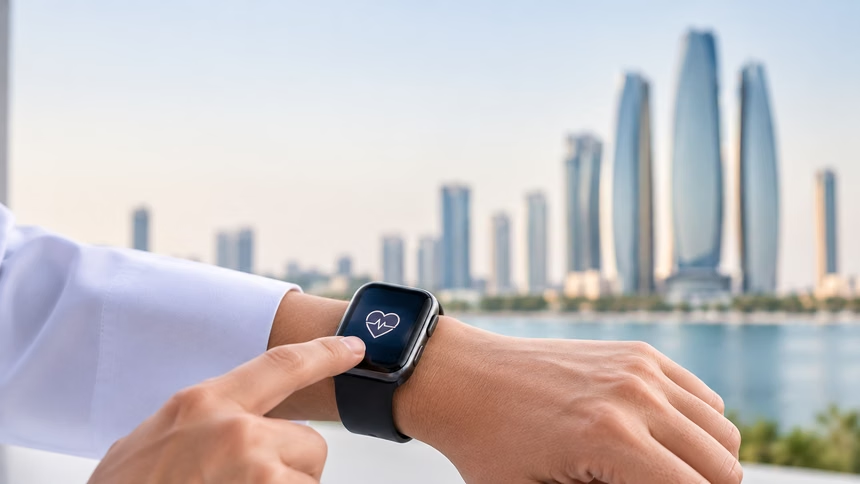

Rohan Sawhney, Partner at Monitor Deloitte in the Middle East, explains how wearables can move healthcare from episodic treatment to continuous prevention. He outlines what is needed for trusted, interoperable data to inform clinical decisions, the barriers to connected care, and the roles of governments, providers and payers.
MedEdge MEA: How can wearables help shift healthcare in the region from treating illness to preventing it?
Rohan Sawhney: Traditionally, individuals engage with healthcare systems only when a health concern has already emerged. The integration of wearables can change the entire individual and provider dynamic by making health status continuously visible. Wearables can surface a deteriorating risk profile early and prompt healthier behaviour. They can also support early intervention, whether that is a nudge, a check-in or a clinical conversation. Ultimately, the shift is from episodic treatment to continuous prevention. However, this hinges on data connecting to trusted health platforms and care pathways.
ME: What needs to happen for wearable data to become useful in everyday clinical decision-making?
RS: Three things. Data must be trustworthy, meaning validated and accurate enough for the decision at hand. It must be interoperable, flowing into the records clinicians already use rather than introducing new platforms. It has to be simplified into meaningful trends and alerts. The goal is beyond just data integration; it is decision integration, which means getting the right information to the right professional at the right time to implement an effective intervention. Clear clinical guidance on interpreting wearable data, and clear governance, matter as well.
Click here to join our WhatsApp channel here
ME: From your experience advising healthcare providers and regulators, where do you see the biggest barriers to connected healthcare?
RS: The first is validation: consumer-grade data is not always clinical-grade, and there is no standard guidance for interpreting it. The second is data privacy and protection: ensuring that personal health information is managed securely, with appropriate safeguards around data storage, access and sharing. The third is integration: too many pilots hand clinicians large volumes of data with no protocol for what to do with it, which turns a promising tool into extra work. Underneath all three sit trust and incentives, because people and providers need a reason to keep engaging.

ME: How can healthcare systems connect wearable data with existing patient records while protecting privacy?
RS: Abu Dhabi already has Malaffi for health records and Sahatna as a front door, and Sahatna combines wearable data with those records to generate a personalised Health Age score. The principles are standardised data formats and secure interfaces, so data joins the longitudinal record. Consent should be centralised and clear, so people understand and can change what they share. Access rights should be defined, with strong cybersecurity and residency safeguards. Finally, privacy has to be designed in from the start, not added later.
Also read: Abu Dhabi DoH and Roche Partner to Advance Diabetic Eye Care
ME: What role should governments, healthcare providers and technology companies play in making connected healthcare work at scale?
RS: Each has a distinct job. Governments and regulators set the rules on validation, privacy, residency and accountability, and they convene the ecosystem. The Department of Health’s work to bring wearable data into Sahatna and Malaffi shows this in practice. Providers redesign care pathways so wearable insights fit existing workflows rather than trump them. Technology companies need to be open, interoperable and willing to validate locally. Payers can further accelerate adoption by aligning reimbursement to health outcomes and preventative care. Private-sector collaborations, such as the partnership between Unilabs and WHOOP, also highlight the value of bringing together complementary expertise to advance connected healthcare.
ME: How can healthcare systems measure whether wearable technology is improving outcomes, rather than simply generating more data?
RS: Counting devices or data points reveals little about whether an individual is getting healthier. Better questions are whether there are fewer avoidable hospitalisations, earlier detection, better-controlled chronic conditions and sustained behaviour change. It is equally important to consider who benefits, as adoption depends on trust across a diverse population with different levels of digital literacy and language preference. This requires robust evidence, including pilot programmes with clearly defined success metrics and published results, to ensure that decisions to scale are grounded in measurable outcomes.
ME: What will it take for Abu Dhabi to integrate wearables into its wider healthcare infrastructure?
RS: Malaffi provides a strong health information exchange. Sahatna already combines wearable data with those records to produce a Health Age score, and Abu Dhabi is among the first to do this at population level. E-prescriptions and the Emirati Genome Program add further depth, and the Department of Health is exploring direct integration with device providers. What is needed now is a scale-up strategy: clear policy and validation rules; three to five priority use cases, such as diabetes, obesity, maternity and elderly fall-risk; wearable dashboards and alerts embedded in provider workflows; and incentives tied to outcomes. Over time, linking wearables with genomics, diagnostics and AI-enabled decision support could create a national precision prevention model.
ME: How can healthcare funding and incentives encourage providers to invest in prevention and earlier intervention?
RS: Payers are likely to support wearables where there is a clear, measurable link to clinical and economic outcomes. Options include reduced premiums or copays under a shared-value approach, and value-based pathways that reward earlier intervention. In Abu Dhabi, the Department of Health’s Health Technology Assessment Guidelines explicitly include wearable devices, providing a framework to evaluate their clinical effectiveness and economic value to inform healthcare funding decisions.
ME: What lessons from public health strategy can help turn digital health ambitions into practical improvements for patients?
RS: Start with a health problem. Choose priority conditions, then design around them. Build governance early, because trust is far harder to retrofit. Treat the consumer as central: Abu Dhabi’s population is diverse, so onboarding, consent and engagement need to work across languages and levels of digital literacy. Generate local evidence through well-designed pilots, then expand. Finally, think in systems: wearables create public value only when connected to trusted infrastructure, clear governance and care pathways.