



At just 11 months old, Truong Thien Di was already facing a life-or-death crossroads.
She weighed only 5.3 kilograms, closer to the size of a three-month-old infant. Born with biliary atresia, her condition had progressed despite early intervention.
A liver transplant was clearly the only option. The uncertainty lay in whether an infant so small and fragile could survive such an extreme procedure. It was a moment that pushed pediatric transplantation to its limits, where every decision depends on precise timing and judgment.
Also Read: United Imaging Showcases Group Synergy and Fosters Global Collaboration at WHX 2026
Pushing the Limits of Infant Liver Transplantation
Liver transplantation in infants under one year of age has become an established practice in modern medicine. The greater challenge arises when transplantation must be considered in babies whose age is compounded by profound physiological fragility.
Soon after birth, Di was brought to a hospital in Ho Chi Minh City and diagnosed with biliary atresia, a condition that can rapidly progress to cirrhosis and liver failure without timely intervention. At three months old, she underwent a Kasai portoenterostomy, the standard initial procedure to restore bile drainage.
The operation, however, failed to stop the disease. Progressive liver fibrosis, persistent jaundice, and worsening malnutrition followed, gradually exhausting what little physiological reserve she had.

By October 2025, at 11 months of age, Di weighed only 5.3 kilograms. International studies consistently show that infants weighing under 6 kilograms face significantly higher surgical and postoperative risks than other pediatric transplant recipients. With options narrowing, her family turned to Vinmec Times City International Hospital, hoping for a liver transplant – the only life-saving option remaining.
“This is the lowest-weight pediatric patient we have ever performed a liver transplant on at Vinmec,” said Associate Professor Dr. Le Van Thanh. With experience from hundreds of complex liver transplant cases, Dr. Thanh – Deputy Chief Medical Officer for Surgery at Vinmec Healthcare System – directly performed the operation on the child.
A Delicate Battle for Survival
After careful multidisciplinary evaluation, Vinmec’s transplant team reached a critical decision point. The donor would be Di’s biological mother, requiring the transplant to ensure sufficient liver volume for the child while maintaining absolute safety for the donor.
“I am simply giving back the life my child deserves,” Di’s mother shared.
The marathon surgery lasted more than 12 hours. Reconstructing the portal vein, hepatic artery, and bile duct in such a young child demanded exceptional skill and extensive surgical experience.
After the operation, the transplanted liver began to function, yet surgery was only the beginning.
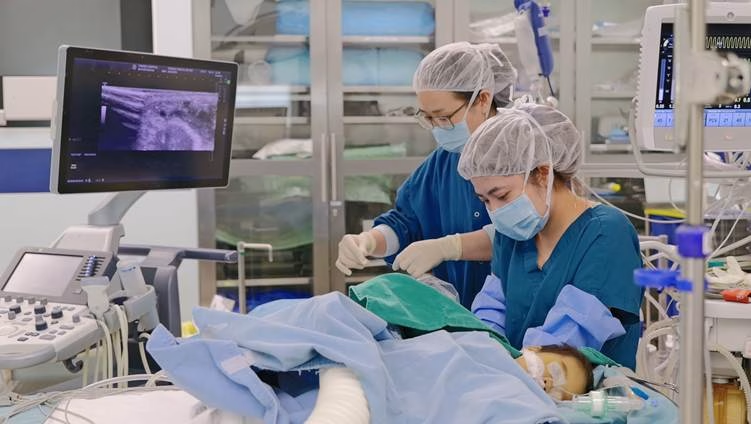
According to Dr. Le Van Binh from the Intensive Care Unit, postoperative care extended far beyond advanced medical equipment. Every injection, medication dose, nutritional intake, and therapeutic adjustment was carefully calibrated to the child’s fragile physiology.
In the days that followed, recovery depended on an intensely individualized care plan. Gradually, the child stabilized, began to breathe more comfortably, and started to gain weight, showing small but significant signs of progress.
From Complex Cases to National Capability
This case underscores the level of clinical capability Vinmec has built through years of treating some of the country’s most challenging transplant patients. That experience has established the system as a national reference center for high-risk pediatric liver transplantation.
At the heart of this capacity is Dr. Le Van Thanh, a pioneer of liver transplantation in Vietnam. Beyond performing many of the nation’s most complex transplant surgeries, he has also led the transfer of advanced techniques and clinical protocols to Vietnam Military Hospital 175 and to transplant centers across Southeast Asia.
Beyond surgical expertise, Vinmec’s success in liver transplantation is anchored in advanced infrastructure and modern technology. The hospital operates cutting-edge laparoscopic systems integrated with ICG fluorescence imaging (Indocyanine Green Imaging), allowing surgeons to clearly visualize biliary anatomy and vascular structures without repeated X-ray exposure. This is supported by modern anesthesia and intensive care platforms that provide real-time monitoring and precise control of vital parameters, enabling timely intervention and a high level of patient safety.
In addition, Vinmec meets a range of the world’s most stringent international standards, including JCI, AABB, UCARE, ADCARE, and CAP, providing a robust foundation for highly accurate and safe organ transplantation practices.
By managing some of the region’s most complex cases, Vinmec is strengthening a patient-centered transplant model aligned with international standards. Increasingly, it is emerging as a credible option for international families seeking liver transplant care.