

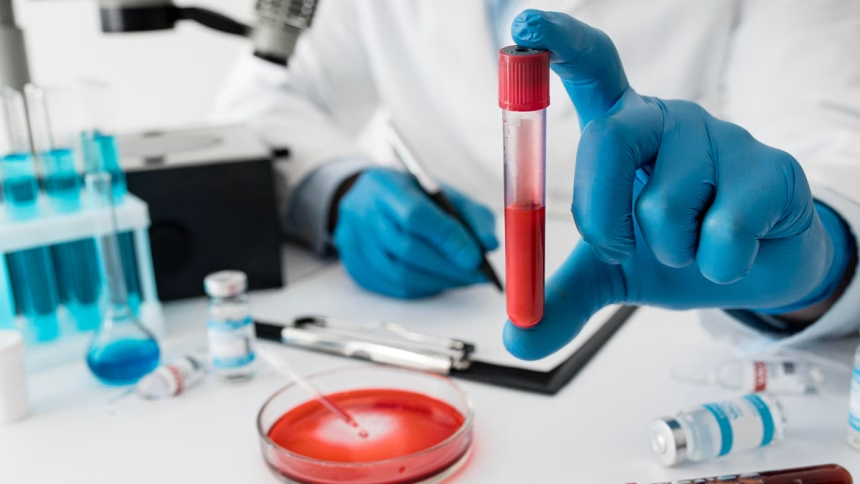

In modern medicine, blood transfusion is one of the most essential and life-saving interventions. Yet, despite global awareness campaigns, the world consistently struggles with blood shortages, especially in low- and middle-income countries, disaster zones, and during emergencies where donor blood is not immediately available. According to the World Health Organization, more than 118 million units of blood are donated globally each year, but demand continues to exceed supply in nearly half of all nations.
This urgent gap has fueled decades of scientific exploration into artificial blood substitutes, engineered solutions capable of transporting oxygen and supporting circulation without relying on human donors. Unlike donated blood, artificial blood can offer a longer shelf life, universal compatibility, and rapid deployment in critical situations such as trauma, surgery, or battlefield medicine.
Also Read: Japan to Begin Clinical Trials for Artificial Blood in 2025
In recent months, research breakthroughs in hemoglobin-based oxygen carriers (HBOCs), perfluorocarbon emulsions (PFCs), and lab-grown red blood cells have brought this vision closer to clinical reality than ever before. Far from science fiction, artificial blood in 2025 is emerging as a practical solution that may reshape the future of transfusion medicine.
What is Artificial Blood?
Artificial blood, often called blood substitutes or oxygen therapeutics, refers to synthetic or bioengineered products designed to mimic the oxygen-carrying function of natural blood. Unlike traditional blood donations, which rely on human or animal sources, artificial blood aims to provide a universal, infection-free alternative for emergencies, surgeries, and chronic conditions like anaemia.
At its core, blood’s primary role is transporting oxygen via red blood cells (RBCs). Artificial blood substitutes replicate this by using molecules that bind and release oxygen efficiently. According to a March 2025 review in The Lancet Haematology, these substitutes could address global blood shortages, especially in regions with limited donor access, potentially saving millions of lives annually.
Click here to join our WhatsApp channel here
Types of Artificial Blood products
1. Hemoglobin-Based Oxygen Carriers (HBOCs)
- Modified hemoglobin molecules extracted from human or animal sources
- Enhanced oxygen-carrying capacity
- Reduced immunogenicity through chemical modifications
2. Perfluorocarbon-Based Solutions (PFCs)
- Synthetic compounds with high oxygen solubility
- Temporary oxygen carriers requiring supplemental oxygen therapy
- Inert and biocompatible properties
3. Laboratory-Grown Red Blood Cells
- Cultured from human stem cells or induced pluripotent stem cells (iPSCs)
- Identical functionality to natural red blood cells
- Unlimited production potential
Key breakthroughs in Artificial Blood
- Hemoglobin-Based Oxygen Carriers (HBOCs)
• Research into HBOCs continues, with newer generations showing promise in reducing side effects such as vasoconstriction that troubled earlier versions.
• One of the most notable candidates, ErythroMer, supported by DARPA, has shown encouraging results in animal studies and is being prepared for early-phase human trials. Its powdered, shelf-stable form could make it useful in emergency and battlefield settings. - Perfluorocarbon Emulsions (PFCs)
• PFCs remain under investigation due to their high oxygen-carrying capacity. While earlier products were discontinued because of safety and efficacy limitations, experimental nano-PFC formulations are being studied to improve stability and oxygen delivery.
• Long-term, these could be valuable in trauma care and disaster medicine, though no widely approved product exists yet. - Stem Cell-Derived Red Blood Cells (lab-grown RBCs)
• In the UK, researchers under the NHS-funded RESTORE trial have successfully transfused small volumes of lab-grown red blood cells into human volunteers. Early findings showed these cells can survive in circulation comparably to donor-derived RBCs.
• While scalability remains a major challenge, this represents a hybrid pathway between donor blood and fully artificial substitutes.
Key challenges and ethical considerations
- Manufacturing Scale: Transforming laboratory breakthroughs into cost-effective, regulated mass production remains a major hurdle.
- Regulatory Approval: Rigorous safety and efficacy trials are underway (notably in Japan), but widespread clinical use is still several years away.
- Complexity: Fully replicating all of blood’s functions, including immune activity and clotting, is still beyond current artificial blood technologies.
- Ethics: The sources of stem cells and the use of reprogramming methods must meet stringent ethical standards.
By 2030, experts believe artificial blood could support traditional donations in hospitals around the world, bringing major changes to trauma care, surgery, and even space missions. With ongoing research and innovation, the future of artificial blood looks bright, with safer, more advanced, and affordable options expected in the years ahead.