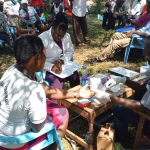



Vaccines have been heralded as one of the most outstanding public health achievements, credited with nearly eradicating devastating diseases such as polio, measles, and rubella. In the modern era, the decision to remain unvaccinated by choice has become a topic of widespread debate, a flashpoint not just during the COVID-19 pandemic, but whenever infectious diseases threaten. As misinformation proliferates and vaccination rates fluctuate, the consequences of these choices for both individuals and society are under greater scrutiny than ever before.
However, is the decision not to vaccinate truly a personal one, bearing consequences solely for the individual, or does it reverberate throughout communities and impact everyone? Scientific evidence and public health experience suggest that unvaccinated individuals do not merely assume personal risk but also put others in harm’s way, especially the most vulnerable.
Risks to the Individual Who Remains Unvaccinated
When individuals choose to forgo vaccines, they expose themselves to an array of dangers that extend well beyond inconvenience.
1. Increased Susceptibility and Severity
Unvaccinated people are highly susceptible to infectious diseases, far more than this risk exists for the vaccinated. For example, during recent measles outbreaks in North America and Europe, nearly all severe cases occurred in those who were unvaccinated by choice (1)(2). The same pattern held for COVID-19: hospitalization and death rates for the unvaccinated were multiple times higher than for their vaccinated counterparts (3). Vaccines do not guarantee absolute protection, but they significantly reduce the risk of contracting and suffering severe consequences from diseases.
‘’Vaccines are not solely a private matter; they are a collective safeguard.’’
2. No Effective Treatments for Many Diseases
For illnesses such as measles, mumps, or polio, there are no cures, only supportive care. Vaccination is often the only proper form of prevention (4)(2). Individuals foregoing vaccines thus must rely purely on luck and their immune systems, both of which are unreliable defenses against aggressive pathogens.
3. Risk of Long-Term Complications
Infectious diseases can inflict lasting harm. Measles can result in brain inflammation and permanent neurological damage, while mumps can cause infertility. For adults, risks are often even greater than for children. Individuals who choose not to vaccinate are, therefore, willingly exposing themselves to the possibility of lifelong disability (4)(2)
Community Impact: The Ripple Effect
It is a misconception that the choice to remain unvaccinated affects only the person who opts out. In reality, this decision has profound effects on the entire community.
1. Threats to Vulnerable Populations
Some of society’s most vulnerable, such as infants, pregnant women, and individuals with compromised immune systems due to illnesses like cancer or HIV, cannot be vaccinated, either due to medical reasons or age (4)(5). These individuals depend on “herd immunity”: when a sufficiently high proportion of the population is immune, transmission chains break down, and outbreaks fade away. When people opt out of vaccination, herd immunity weakens, and these vulnerable groups face increased risk.
2. Amplified Transmission and “Reservoirs”
Unvaccinated individuals can serve as reservoirs for pathogens, harboring and transmitting diseases that could otherwise be kept at bay (6)(7). Studies have shown that unvaccinated people are much more likely to infect those around them than the vaccinated are. During the COVID-19 pandemic, one study found that a person exposed to an unvaccinated carrier was up to twenty times more likely to become infected compared to a vaccinated contact. The implications go beyond COVID-19; this pattern has been observed with measles, pertussis, and influenza as well.
3. Breakthrough Infections Become More Likely
No vaccine is 100% effective. As the number of unvaccinated people in a community rises, so does the exposure of everyone, including those who are fully vaccinated. The more the pathogen circulates, the greater the chance that even those with partial immunity might contract the disease, undermining community health in every direction (6)(9)(2).
Societal Costs: Beyond Health
The impact of individuals who choose not to vaccinate is not limited to physical health; their decisions produce significant societal and economic consequences.
1. Overwhelmed Healthcare Systems
Unvaccinated populations are more likely to require intensive care if infected, putting considerable strain on hospitals (3). During COVID-19 surges, intensive care wards were pushed to the brink, forcing postponements of critical but non-urgent care (such as cancer surgeries). The ripple effects compromised available treatment not just for those with infectious diseases, but for all who needed medical attention.
2. Economic Burden
Treating vaccine-preventable diseases is far more expensive than preventing them. Hospitalizations, long-term rehabilitation, contact tracing, and outbreak control measures cost mount rapidly when vaccination rates fall. Some estimates place the burden in the tens of billions of dollars globally, a tab primarily paid by taxpayers and public health systems(3).
3. The Peril of Variant Evolution
Every time an infectious agent spreads freely, vaccinations are a bulwark against it; it gains opportunities to mutate, potentially resulting in new, more virulent or vaccine-resistant variants. This evolutionary “arms race” puts everyone, vaccinated or not, at risk whenever immunity gaps exist in the community (5).
Re-framing Choice: Ethics and Community Responsibility
Vaccine hesitancy or outright refusal often rests on the assertion of personal liberty, but public health experts caution that this view ignores the substantial communal repercussions. Modern societies are interdependent; our health is intricately linked to that of our neighbors.
Ethics and infectious disease fundamentally intersect. The freedom to opt out of vaccination comes with a corresponding responsibility: to recognize the risk this poses to others, particularly those least able to protect themselves (6)(10). In a shared environment, choosing not to be vaccinated is not a neutral act; it raises the stakes for all.
Click here to join our WhatsApp channel here
The evidence is clear: being unvaccinated by choice is not just a risk to oneself. It is a profound risk to everyone in society. The decision to forgo vaccination elevates personal risk of severe disease and also directly endangers vulnerable populations, supports the ongoing transmission of dangerous pathogens, threatens to overwhelm healthcare systems, and creates financial and scientific hurdles to controlling outbreaks. Honoring the freedoms we cherish includes embracing the responsibilities we owe to one another, particularly when it comes to public health. Vaccines are not solely a private matter; they are a collective safeguard. In making choices about vaccination, the fate of the individual and the welfare of the community cannot and must not be separated (1)(4)(5)(10).
Medical Doctor and Global Health Specialist | Researcher in Vaccines, Infectious Diseases & Migrant Health
References:
- The risks of not getting vaccinated. (2022, January 13). Clinic Barcelona. Retrieved August 2, 2025, from https://www.clinicbarcelona.org/en/assistance/be-healthy/vaccine-1/the-risks-of-not-getting-vaccinated
- Vaccinated vs. Unvaccinated: What Are the Risks? Scripps.org. (2025, January 27). Scripps.org. https://www.scripps.org/news_items/7263-vaccinated-vs-unvaccinated-what-are-the-risks
- Farrenkopf, P. M. (2022, June 30). The cost of ignoring vaccines. https://pmc.ncbi.nlm.nih.gov/articles/PMC9235251/
- Canadian Paediatric Society. (n.d.). When parents choose not to vaccinate: Risks and responsibilities. https://caringforkids.cps.ca/handouts/immunization/when-parents-choose-not-to-vaccinate-risks-and-responsibilities
- The risks of remaining unvaccinated. (n.d.). hwww.ochsnerlsuhs.org. https://www.ochsnerlsuhs.org/content/uploads/OLHS_COVID_Phase-IV_ImpactsOfUnvaccinated_.pdf
- Matt. (2022, May 6). What is the Impact if some of a Population are Not Being Vaccinated on those Who are Vaccinated i.e. The Impact of Population Mixing Between Vaccinated and Unvaccinated Subpopulations on Infectious Disease Dynamics? The London General Practice. https://www.thelondongeneralpractice.com/impact-of-not-being-vaccinated-on-those-who-are-vaccinated/
- Fisman, D. N., Amoako, A., Simmons, A., & Tuite, A. R. (2024). Impact of immune evasion, waning and boosting on dynamics of population mixing between a vaccinated majority and unvaccinated minority. PLoS ONE, 19(4), e0297093. https://doi.org/10.1371/journal.pone.0297093
- Robinson, A., & Baker, C. (n.d.). Your unvaccinated friend is roughly 20 times more likely to give you COVID. The Conversation. https://theconversation.com/your-unvaccinated-friend-is-roughly-20-times-more-likely-to-give-you-covid-170448
- Milman, O., Yelin, I., Aharony, N., Katz, R., Herzel, E., Ben-Tov, A., Kuint, J., Gazit, S., Chodick, G., Patalon, T., & Kishony, R. (2021). Community-level evidence for SARS-CoV-2 vaccine protection of unvaccinated individuals. Nature Medicine, 27(8), 1367–1369. https://doi.org/10.1038/s41591-021-01407-5
- Milman, O., Yelin, I., Aharony, N., Katz, R., Herzel, E., Ben-Tov, A., Kuint, J., Gazit, S., Chodick, G., Patalon, T., & Kishony, R. (2021b). Community-level evidence for SARS-CoV-2 vaccine protection of unvaccinated individuals. Nature Medicine, 27(8), 1367–1369. https://doi.org/10.1038/s41591-021-01407-5