
• Duphat
  • infinia camp
mededge mea logo web MedEdge_Logo_Dark

Public Relations, Top Health Magazine and Healthcare News GCC

  • Newsletters
  • Magazines
  • Subscribe
  • Home
  • News
  • Opinion
  • Interviews
  • Featured
  • Cover Stories
  • Events
  • Health For all
    • Ageing Gracefully
    • Family Health Matters
    • Environment Health
    • Women and Child Health
    • Men’s Health
  • Resource Hub
    • Fresh Perspectives
    • Medical Tourism
    • Medical Education
    • Personnel
    • Research
      • Healthcare Journals & Publishers
    • Healthcare Campaigns
    • Health Tools Hub
    • Dubai Health Centers Directory | Services, Locations & Timings
    • ME Explained
Reading: Suriname Certified Malaria-free by WHO
Share
Notification
  • Duphat
  • infinia camp
mededge mea logo web
  • Magazines
  • Newsletters
  • Profiles
  • Subscribe
Search
  • Home
  • News
  • Opinion
  • Interviews
  • Featured
  • Cover Stories
  • Events
  • Health For all
    • Ageing Gracefully
    • Family Health Matters
    • Environment Health
    • Women and Child Health
    • Men’s Health
  • Resource Hub
    • Fresh Perspectives
    • Medical Tourism
    • Medical Education
    • Personnel
    • Research
    • Healthcare Campaigns
    • Health Tools Hub
    • Dubai Health Centers Directory | Services, Locations & Timings
    • ME Explained
Have an existing account? Sign In
MedEdge MEA > Health For All > Public Health > Suriname Certified Malaria-free by WHO
Public Health

Suriname Certified Malaria-free by WHO

ME Desk
ME Desk
Published: July 1, 2025
Share
4 Min Read
Suriname
SHARE

Suriname became the first country in the Amazon region to receive malaria-free certification from the World Health Organization (WHO). This historic milestone follows nearly 70 years of commitment by the government and people of Suriname to eliminate the disease across its vast rainforests and diverse communities.

“WHO congratulates Suriname on this remarkable achievement,” said Dr Tedros Adhanom Ghebreyesus, WHO Director-General. “This certification is a powerful affirmation of the principle that everyone—regardless of nationality, background, or migration status—deserves universal access to malaria diagnosis and treatment. Suriname’s steadfast commitment to health equity serves as an inspiration to all countries striving for a malaria-free future.”

Also Read: Uganda launches historic malaria vaccine rollout to protect over 1.1 million children

“Suriname did what was needed to eliminate malaria—detecting and treating every case quickly, investigating to prevent spread, and engaging communities,” said Dr Jarbas Barbosa, Director of the Pan American Health Organization (PAHO), WHO’s regional office for the Americas. “This certification reflects years of sustained effort, especially reaching remote areas. It means future generations can grow up free from this potentially deadly disease.”

Certification of malaria elimination is granted by WHO when a country has proven, beyond reasonable doubt, that the chain of indigenous transmission has been interrupted nationwide for at least the previous three consecutive years.

Suriname’s road to elimination

Suriname’s malaria control efforts began in 1950s in the country’s densely-populated coastal areas, relying heavily on indoor spraying with the pesticide DDT and antimalarial treatment. By the 1960s, the coastal areas had become malaria-free and attention turned towards the country’s forested interior, home to diverse indigenous and tribal communities.

Although indoor spraying was successful in coastal areas, its impact was limited in the country’s interior due to the prevalence of traditional open-style homes that offer minimal protection against mosquitoes. In 1974 malaria control in the interior was decentralized to Medische Zending, Suriname’s primary health care service, which recruited and trained healthcare workers from the local communities to provide early diagnosis and treatment.

The surge in mining activities, particularly gold mining which often involves travel between malaria-endemic areas, led to increases in malaria, reaching a peak of more than 15 000 cases in 2001, the highest transmission rates of malaria in the Americas.

Since 2005, with support from the Global Fund to Fight AIDS, Tuberculosis and Malaria, the capacity to provide diagnosis was greatly expanded with both improvements in microscopy and the use of rapid diagnostic tests, particularly among mobile groups. Artemisinin-based treatments with primaquine were introduced in Suriname and neighboring countries through PAHO-led studies under the Amazon Malaria Initiative (AMI-RAVREDA), supported by the United States. Prevention among high-risk groups was also strengthened through the distribution of insecticide-treated nets funded by the Global Fund.

By 2006, malaria had drastically decreased among the indigenous populations, prompting Suriname to shift its focus to high-risk mobile populations in remote mining areas. To reach these groups—many of whom were migrants from neighboring endemic countries—the country established a network of Malaria Service Deliverers, recruited directly from the mining communities. These trained and supervised community workers provide free malaria diagnosis, treatment, and prevention services, playing a vital role in closing access gaps in hard-to-reach regions.

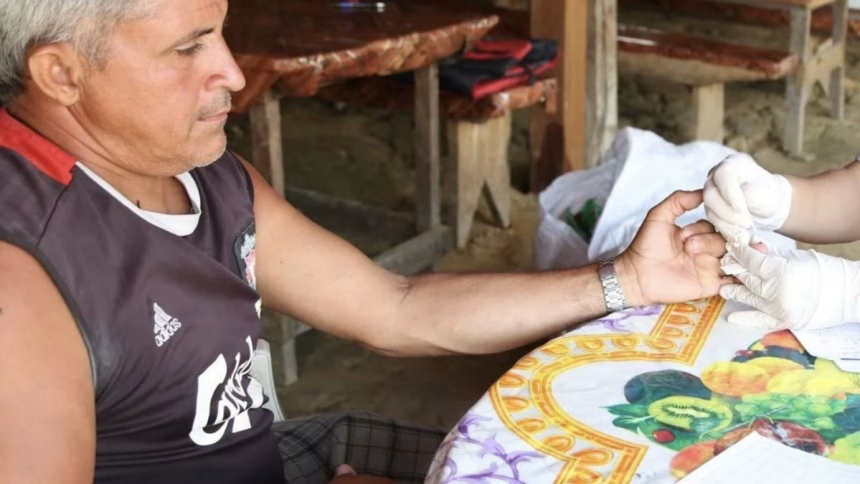
Through ensuring universal access to diagnosis and treatment regardless of legal status, deploying an extensive network of community health workers, and implementing nationwide malaria screening, including at border crossings, Suriname successfully eliminated malaria. The last locally transmitted case of Plasmodium falciparum malaria was recorded in 2018, followed by the final Plasmodium vivax case in 2021.

Share This Article
Facebook Whatsapp Whatsapp LinkedIn Copy Link
Share
Previous Article Martin-Stumpe Danaher Appoints Martin Stumpe as Chief Technology and AI Officer
Next Article Alpert Prize 2025 Warren Alpert Prize Honors Scientists Whose Discoveries Culminated in Novel HIV Treatment

Recent Posts

  • From market access to national ambition, gulf healthcare is playing a longer game
  • New Push for HIV Innovation and Access Aims to Accelerate Progress Toward 2030 Goals
  • WHO Discusses Digital Health and Humanization of Care at Scientific Conference
  • Rising Ebola Cases Deepen Humanitarian Crisis for Children in DR Congo
  • Burjeel holdings secures dual credit ratings and launches USD 1.5 billion sukuk programme
  • duphat
  • MedEdge-Infinia
Two Point Five Logo white
  • About Us
  • Contact Us
  • Medical Disclaimer
  • Privacy Policy
  • Terms and Conditions
  • Cookie Policy (EU)
  • Submit Your Story
  • MediaKit
Reading: Suriname Certified Malaria-free by WHO
Share

Published by Two Point Five Media FZCO

  • About Us
  • Contact Us
  • Medical Disclaimer
  • Privacy Policy
  • Terms and Conditions
  • Cookie Policy (EU)
  • Submit Your Story
  • MediaKit
Reading: Suriname Certified Malaria-free by WHO
Share

Follow US on Social Media

Facebook Instagram Linkedin X-twitter Youtube Whatsapp
Manage Consent
To provide the best experiences, we use technologies like cookies to store and/or access device information. Consenting to these technologies will allow us to process data such as browsing behavior or unique IDs on this site. Not consenting or withdrawing consent, may adversely affect certain features and functions.
Functional Always active
The technical storage or access is strictly necessary for the legitimate purpose of enabling the use of a specific service explicitly requested by the subscriber or user, or for the sole purpose of carrying out the transmission of a communication over an electronic communications network.
Preferences
The technical storage or access is necessary for the legitimate purpose of storing preferences that are not requested by the subscriber or user.
Statistics
The technical storage or access that is used exclusively for statistical purposes. The technical storage or access that is used exclusively for anonymous statistical purposes. Without a subpoena, voluntary compliance on the part of your Internet Service Provider, or additional records from a third party, information stored or retrieved for this purpose alone cannot usually be used to identify you.
Marketing
The technical storage or access is required to create user profiles to send advertising, or to track the user on a website or across several websites for similar marketing purposes.
  • Manage options
  • Manage services
  • Manage {vendor_count} vendors
  • Read more about these purposes
View preferences
  • {title}
  • {title}
  • {title}

WhatsApp us

Logo of Medede mea
Welcome Back!

Sign in to your account

Username or Email Address
Password

Lost your password?