


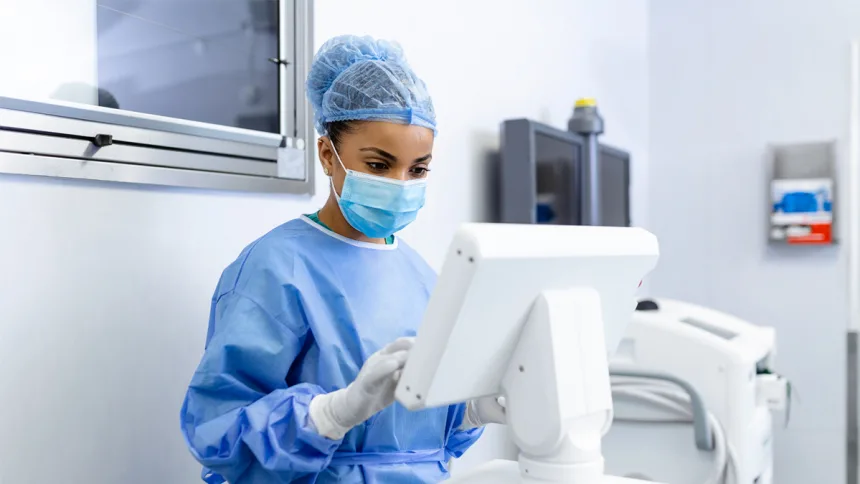
Modern medicine is on the cusp of a seismic shift: artificial intelligence (AI) and advanced computing increasingly appear in the operating room, offering solutions like real-time analytics, algorithmic decision-making, and robotics. Nevertheless, for all this innovation, one vital question remains: Who ultimately controls the operating room of the future—the surgeon or the machine? A meaningful exploration of this question requires us to examine the nature of AI in surgical settings, the evolving role of human expertise, and the potential pitfalls of ceding too much power to data-driven systems.
The rise of AI in the operating room
In its broadest sense, AI promises to deliver better accuracy, enhanced decision-making support, and improved workflows. Proponents envision that machine learning models—trained on vast repositories of patient data, surgical videos, and imaging—can guide surgeons with unprecedented specificity. They point to potential applications like:
- Procedure Scheduling: Optimising OR usage and anticipating complications.
- Intraoperative Guidance: This involves identifying tissue boundaries or recommending the next step in a procedure, particularly in challenging surgeries.
- Postoperative Analysis: Comparing tangible outcomes vs. predicted results, providing data-driven feedback loops for surgeons. In the abstract, these capabilities offer an attractive vision: safer surgeries, fewer errors, and personalised care. Yet, many procedures involve unique anatomical or pathological variations—and every surgeon typically tailors their technique to individual patient needs. As a result, purely data-focused methods may falter with less common conditions or real-time tissue shifts that deviate from “typical” AI training examples, underscoring the need for a more adaptive approach.
The problem with AI reliance
A common criticism of current AI models in healthcare is that they are only as strong as their training data. The model’s guidance could be flawed if the datasets are incomplete, unrepresentative, or biased. In an operating room, a single misstep can mean life or death. Surgeons trust what they can observe, measure, or confirm through reliable protocols—a sense of control built through years of rigorous training. Many remain wary of ceding authority to an algorithm that is essentially a “black box,” meaning it can provide output without transparent rationale.
Also Read : Cleveland Clinic Abu Dhabi Performs First Simultaneous Kidney Transplant Using One Robot
Consider the phenomenon of brain shift in neurosurgery. In this scenario, the brain moves due to fluid drainage, anaesthesia protocol, or the natural elasticity of tissue, causing the patient’s anatomy to deviate from the preoperative scans. AI models that rely on static preoperative images may find themselves at a loss the moment actual patient conditions differ from learned patterns. This mismatch can leave surgeons in limbo, either left with outdated information or forced to pause the procedure to gather additional data.
Surgeons vs. AI: A false dichotomy?
It is tempting to paint this as an either/or scenario: Will intelligent systems eventually supplant surgeons? However, the more nuanced reality is that future operating rooms will likely require a profound synergy between human expertise and intelligent machines. Surgeons have an irreplaceable, intuitive understanding of how tissues behave, where anomalies might hide, and how different patient contexts can alter procedural steps. Machines can offer rapid data processing, pattern recognition, and real-time alerts in ways the human brain cannot match at scale.
Rather than framing it strictly as “surgeon vs. AI,” a more constructive view is to discuss how we can harness computational methods without losing sight of clinical judgment. Surgeons are best placed to define the parameters an algorithm can operate safely.
Real algorithm, real-time
One emerging example of surgeon-machine collaboration uses a MedTech approach that foregoes data-heavy AI models, favouring a physics-based, real-time navigation system. Instead of “training” on vast data sets, this platform relies on deterministic modelling, creating dynamic simulations that can adapt to patient-specific factors and rapid tissue changes—such as brain shifts—during surgery. This method sidesteps many pitfalls associated with black-box AI in the operating room by tracking real-time tissue movement through physical principles rather than extrapolating from historical datasets.
Key benefits include:
- Continuous Adaptation: As the brain shifts, the algorithm updates the patient’s 3D anatomy using deterministic calculations, maintaining surgical accuracy without requiring repeated intra-operative imaging.
- Enhanced Surgeon Control: The platform provides real-time feedback without dictating procedural steps, keeping the surgeon firmly in command.
- Minimal Data Dependency: By using physical modelling, its avoids overfitting or bias risks and offers better transparency, which are essential factors in building surgeon trust.
This approach exemplifies the philosophy that advanced technology should support, not replace, clinical expertise. A system anchored by physical truths, not just probability distributions, can offer greater reliability in critical edge cases—where purely data-driven models might otherwise falter.
Training the Surgeon, Not Just the System
An overlooked aspect of future surgical technology is the educational dimension. As automation grows, surgeons risk losing specific skills if they become overly reliant on AI-driven prompts. For instance, if an intelligent system always identifies blood vessels or anatomical landmarks, do trainees still learn to detect them manually under challenging conditions?
Surgeons are best placed to define the parameters an algorithm can operate safely.
Anas Obeidat, Co-founder and CEO of EVAnatomy
State-of-the-art systems will facilitate surgery at hand and train surgeons to become even better. Ideally, the machine’s real-time insights can highlight areas of caution or show how slight adjustments might improve an outcome. Real-time insights and replayable data form a feedback loop—ensuring the technology elevates skill levels rather than merely automating tasks.
So, who will control the operating room in the future?
In truth, the future OR will be co-piloted. Surgeons must remain decision-makers, wielding judgment, surgical finesse, and the ability to respond to the unexpected. Machines—AI-based or physically modelled systems—will support those decisions with real-time calculations, continuous guidance, and data- based insights. The operative word is collaboration, not replacement.
Effective collaboration relies on transparent, robust technology and a continuous dialogue among innovators, surgeons, and regulators assuring that powerful tools like AI or physics-based models enhance, rather than override, clinical expertise.


