
• Duphat
  • infinia camp
mededge mea logo web MedEdge_Logo_Dark

Public Relations, Top Health Magazine and Healthcare News GCC

  • Newsletters
  • Magazines
  • Subscribe
  • Home
  • News
  • Opinion
  • Interviews
  • Featured
  • Cover Stories
  • Events
  • Health For all
    • Ageing Gracefully
    • Family Health Matters
    • Environment Health
    • Women and Child Health
    • Men’s Health
  • Resource Hub
    • Fresh Perspectives
    • Medical Tourism
    • Medical Education
    • Personnel
    • Research
      • Healthcare Journals & Publishers
    • Healthcare Campaigns
    • Health Tools Hub
    • Dubai Health Centers Directory | Services, Locations & Timings
    • ME Explained
Reading: Study Links Female Sex Hormones to Progression of Eye Disease
Share
Notification
  • Duphat
  • infinia camp
mededge mea logo web
  • Magazines
  • Newsletters
  • Profiles
  • Subscribe
Search
  • Home
  • News
  • Opinion
  • Interviews
  • Featured
  • Cover Stories
  • Events
  • Health For all
    • Ageing Gracefully
    • Family Health Matters
    • Environment Health
    • Women and Child Health
    • Men’s Health
  • Resource Hub
    • Fresh Perspectives
    • Medical Tourism
    • Medical Education
    • Personnel
    • Research
    • Healthcare Campaigns
    • Health Tools Hub
    • Dubai Health Centers Directory | Services, Locations & Timings
    • ME Explained
Have an existing account? Sign In
MedEdge MEA > Health For All > Women and Child Health > Study Links Female Sex Hormones to Progression of Eye Disease
Women and Child Health

Study Links Female Sex Hormones to Progression of Eye Disease

ME Desk
ME Desk
Published: July 9, 2025
Share
3 Min Read
Eye Disease
SHARE

Female sex hormones can significantly enhance the progression of the rare neurodegenerative eye disease retinitis pigmentosa (RP), according to a preclinical study by researchers at UTย Southwestern Medical Center. The findings, published inย Science Advances, may lead to therapeutics to slow progression of the disease and help clinicians assess the risk of hormone therapies for female patients with genetic markers for the disease.ย 

โ€œRetinitis pigmentosa is a commonly inherited form of vision loss that was previously thought to be unaffected by biological sex,โ€ explainedย Katherine Wert, Ph.D., Assistant Professor ofย Ophthalmologyย at UTย Southwestern. โ€œWe discovered we can actually slow disease progression in female mice if we deplete their sex hormones.โ€

Also Read: WHO issues first global guideline to improve pregnancy care for women with sickle cell disease

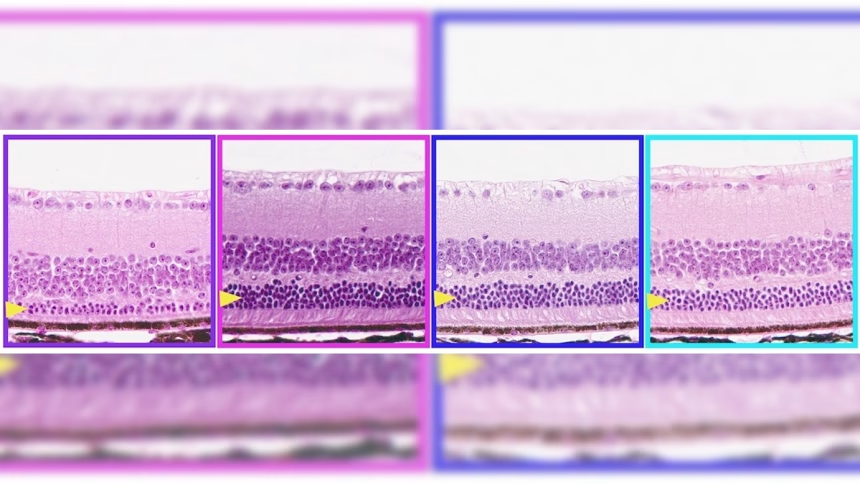
The researchers studied male and female mice with a mutation in rhodopsin (RHO P23H) โ€“ a key light-sensing protein in the retina โ€“ that causes the development of retinitis pigmentosa. At 2 months of age, they found the layer of photoreceptors in the femalesโ€™ retinas had significantly worse function than in males, indicating faster vision loss and a sex-related difference in disease progression.

In females spayed to reduce sex hormone levels, Dr. Wert said the team was surprised to see reduced RP progression, to the point that their vision was comparable to that of males. Neutered males showed no change in visual function compared to intact males. Similarly, artificially increasing sex hormone levels in neutered mice by implanting estradiol under their skin had no effect on males but resulted in increased loss of function in the photoreceptors of females.  

In contrast, the vision of healthy mice without the RHO P23H mutation remained unchanged after they received female sex hormones, indicating an interaction between the rhodopsin mutation and sex hormones, causing higher levels of inflammation and cell death in females. 

Ashley Rowe, the studyโ€™s lead author and a doctoral student in Dr. Wertโ€™s laboratory, noted that the teamโ€™s research warrants further investigation regarding the potential impact of hormonal therapy in women with related retinal conditions. The authors emphasized that there is currently no evidence that birth control and hormone replacement therapy adversely affect vision in women without genetic mutations associated with retinitis pigmentosa.

โ€œWeโ€™re not advocating for depleting womenโ€™s hormones,โ€ Ms. Rowe said. โ€œBut this discovery opens exciting opportunities to understand the underlying mechanisms leading to worsened disease outcomes in women, which could lead to transformative future therapeutic strategies for both women and men living with RP.โ€ 

Other UTSW researchers who contributed to the study are Jeffrey McDonald, Ph.D., Professor ofย Molecular Genetics; Mauricio Velasquez, B.S., a Senior Analytical Chemist in theย Center for Human Nutritionย and the McDonald Lab; andย Wert Labย members Jacob Aumeier, medical student, and Tiffany Yee and Emily Nettesheim, Ophthalmology doctoral students.


Share This Article
Facebook Whatsapp Whatsapp LinkedIn Copy Link
Share
Previous Article UV-Blocking Why Wearing UV-Blocking Sunglasses Is Essential for Eye Health
Next Article Maie-St.-John Maie St. John Named Director of Department of Otolaryngologyโ€“Head and Neck Surgery for the Johns Hopkins University School of Medicine

Recent Posts

  • From market access to national ambition, gulf healthcare is playing a longer game
  • New Push for HIV Innovation and Access Aims to Accelerate Progress Toward 2030 Goals
  • WHO Discusses Digital Health and Humanization of Care at Scientific Conference
  • Rising Ebola Cases Deepen Humanitarian Crisis for Children in DR Congo
  • Burjeel holdings secures dual credit ratings and launches USD 1.5 billion sukuk programme
  • duphat
  • MedEdge-Infinia
Two Point Five Logo white
  • About Us
  • Contact Us
  • Medical Disclaimer
  • Privacy Policy
  • Terms and Conditions
  • Cookie Policy (EU)
  • Submit Your Story
  • MediaKit
Reading: Study Links Female Sex Hormones to Progression of Eye Disease
Share

Published by Two Point Five Media FZCO

  • About Us
  • Contact Us
  • Medical Disclaimer
  • Privacy Policy
  • Terms and Conditions
  • Cookie Policy (EU)
  • Submit Your Story
  • MediaKit
Reading: Study Links Female Sex Hormones to Progression of Eye Disease
Share

Follow US on Social Media

Facebook Instagram Linkedin X-twitter Youtube Whatsapp
Manage Consent
To provide the best experiences, we use technologies like cookies to store and/or access device information. Consenting to these technologies will allow us to process data such as browsing behavior or unique IDs on this site. Not consenting or withdrawing consent, may adversely affect certain features and functions.
Functional Always active
The technical storage or access is strictly necessary for the legitimate purpose of enabling the use of a specific service explicitly requested by the subscriber or user, or for the sole purpose of carrying out the transmission of a communication over an electronic communications network.
Preferences
The technical storage or access is necessary for the legitimate purpose of storing preferences that are not requested by the subscriber or user.
Statistics
The technical storage or access that is used exclusively for statistical purposes. The technical storage or access that is used exclusively for anonymous statistical purposes. Without a subpoena, voluntary compliance on the part of your Internet Service Provider, or additional records from a third party, information stored or retrieved for this purpose alone cannot usually be used to identify you.
Marketing
The technical storage or access is required to create user profiles to send advertising, or to track the user on a website or across several websites for similar marketing purposes.
  • Manage options
  • Manage services
  • Manage {vendor_count} vendors
  • Read more about these purposes
View preferences
  • {title}
  • {title}
  • {title}

WhatsApp us

Logo of Medede mea
Welcome Back!

Sign in to your account

Username or Email Address
Password

Lost your password?