

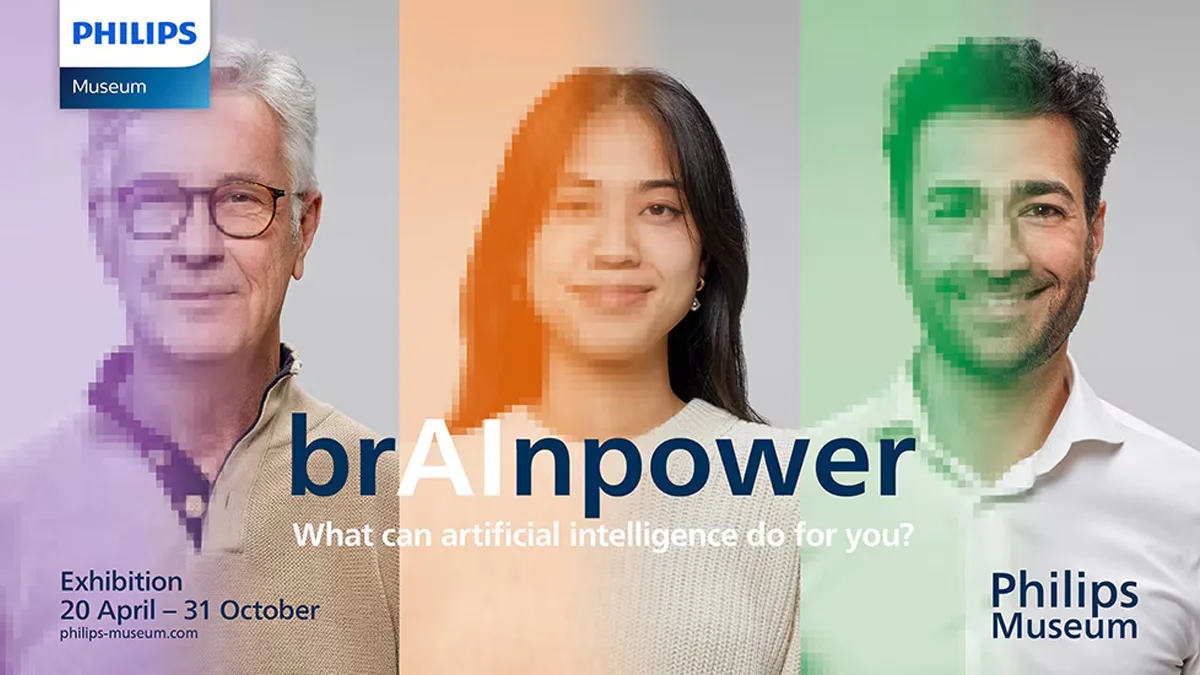

EINDHOVEN, the Netherlands- 19 April 2024- On Saturday 20 April, the Philips Museum, located in the heart of Eindhoven, the Netherlands, will open its doors to the public with a new exhibition: ‘brAInpower’. This exhibition revolves around artificial intelligence (AI), a development Philips has been working on for a long time, now specifically in healthcare. Visitors to the interactive exhibition can experience AI for themselves.
AI is an revolution with unprecedented opportunities. At the same time, as an emerging technology it is unfamiliar and that can create uncertainty. That’s why the Philips Museum is taking the opportunity to help the public to explore AI for themselves. Interactive additions, rare collection pieces and informative videos show how AI affects everyday life. In this way, the museum aims to appeal to a wide audience.
AI can help free up time carers
The collaboration of humans and AI is the focus of the exhibition: the unique ‘brain’ qualities of humans combined with AI: Brain + AI = Power. This leads to innovations on many fronts, including in healthcare. “This is necessary because medical care is under pressure worldwide,” said Shez Partovi, Chief Innovation & Strategy Officer at Philips. “AI can help ease workload. Already, AI supports disease detection, diagnosis, treatment and monitoring. Using AI to analyze medical images can support radiologists, cardiologists and other specialists to make faster and even better diagnoses. AI also helps monitor patients for vital signs which can contribute to a lower risk of readmission to hospital. This helps improve efficiency, allowing healthcare providers to focus on their patients.” At the exhibition, visitors can see and experience several examples of this.
AI evolution
Upon entering, visitors are introduced to a ‘deepfake’ of Philips’ founding fathers Gerard and Anton. They make the connection between the emergence of electricity and the rise of AI. A comprehensive timeline shows the development of AI and Philips’ contributions. Philips’ history with AI goes back to the development of the electron tube. This tube evolved from the light bulb and was a step towards the development of the transistor and microchips. These innovations were crucial to today’s computing power and data storage, making them part of the AI revolution. At the same time, Philips innovated a lot in digital medical imaging. Thus, Philips is often at the forefront of applying AI to improve healthcare.
(Un)conscious AI use
The exhibition also looks to today and the future impact of AI. Many people – often unconsciously – are already using AI. For example, brushing with an electric toothbrush with smart sensors can contribute to better oral health. This highlights what AI can already do today.
Also Read: Philips Introduces AI-enabled Diagnostic Innovations for Patient Care at ECR 2024
Others are already working with programs such as ChatGPT and Midjourney. Visitors can work in the exhibition themselves to discover what AI can mean in practice. For example, they can build a Lego house and have AI translate it into a design of a dream house. Or step into a designer’s shoes with AI to create original images. Visitors can also experience being guided by
AI with Precise Position to lie down correctly in the CT scanner. This is another Philips’ innovation already being used in healthcare.