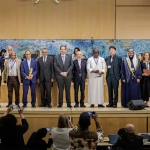


The Government of the Democratic Republic of the Congo (DRC) and the World Health Organization (WHO) have issued a joint statement reaffirming their strong partnership to contain the Bundibugyo Ebola outbreak affecting parts of the country, including Ituri, North Kivu, and South Kivu provinces.
Following a high-level mission to Bunia led by DRC Minister of Health Dr Samuel Roger Kamba, Minister of Communication and Media Mr. Patrick Muyaya Katembwe, and WHO Director-General Dr Tedros Adhanom Ghebreyesus, authorities emphasized urgent coordination to strengthen outbreak control measures.
The Ministry of Health reports a rapidly evolving situation, with confirmed Ebola cases and deaths across multiple health zones. In response, the DRC government supported by WHO and international partners is intensifying disease surveillance, laboratory testing, contact tracing, and patient care to quickly break the chain of transmission.
The DRC government continues to lead a comprehensive national response, working closely with provincial authorities and global health partners. WHO, along with the United Nations system, is providing technical and operational support to ensure timely delivery of life-saving interventions to affected communities.
A central focus of the response is community engagement, with health authorities working alongside local leaders, women’s groups, youth representatives, and religious organizations to build trust, address concerns, and promote culturally appropriate health measures.
Although the Bundibugyo strain of Ebola presents significant challenges, including the absence of a licensed vaccine or specific treatment, public health experts confirm that proven interventions such as early detection, isolation, infection prevention, and safe burials remain highly effective in controlling spread.
Health authorities and WHO are also exploring clinical trials for candidate vaccines and treatments to support future outbreak control efforts.
The statement highlights ongoing challenges, including rapid case detection, safe isolation, effective contact tracing, and strengthened infection prevention and control in health facilities. Communities are urged to adopt protective measures such as regular handwashing, early medical consultation, and reliance on verified health information.
The DRC, with its extensive experience in managing previous Ebola outbreaks, continues to play a leading role in outbreak containment. Strong political leadership and international solidarity are seen as key factors in controlling the current situation.
Authorities also stressed the importance of maintaining essential healthcare services while responding to the outbreak, ensuring that long-term health system resilience is strengthened through investments in laboratories, surveillance systems, and healthcare workers.
The DRC, WHO, Africa CDC, and other partners continue to coordinate efforts to mobilize resources and ensure rapid, equitable delivery of emergency health interventions. International partners are urged to maintain support to help bring the outbreak under control and protect vulnerable populations.
The Government of the Democratic Republic of the Congo (DRC) and the World Health Organization (WHO) reaffirm their strong partnership and shared commitment to protect the health and well-being of the people of Ituri Province and the nation at large, following the joint mission to Bunia led by Dr Samuel Roger Kamba, Minister of Health, Mr. Patrick Muyaya Katembwe, Minister of Communication and Medias, and the visit of WHO Director-General Dr Tedros Adhanom Ghebreyesus.
This high-level visit comes at a challenging time, as the country responds to an outbreak of Ebola disease caused by the Bundibugyo virus. The Ministry of Health reports a rapidly evolving situation, with cases and deaths notified in several health zones of Ituri, North Kivu and South Kivu. The Government, with support from WHO and partners, is intensifying surveillance, laboratory testing and patient care to interrupt transmission as quickly as possible.
Also Read: WHO Director-General Honours Four Global Health Leaders at World Health Assembly
The Government of the DRC is firmly leading a comprehensive national response, working closely with provincial authorities in Ituri and neighbouring provinces. WHO, alongside the broader United Nations system and health and humanitarian partners, is fully committed to supporting these efforts. Together, DRC authorities, WHO and partners are working to strengthen coordination, mobilize additional resources, and ensure that life-saving interventions reach affected communities quickly and equitably.
Central to this response is the recognition that communities are at the heart of the solution. Success will depend on the trust, engagement and leadership of local communities. National and provincial authorities, with support from WHO and partners, are intensifying dialogue with community leaders, women’s groups, youth representatives, religious leaders and the private sector to better understand local concerns and co-develop solutions that are culturally appropriate and effective.
While the Bundibugyo strain presents additional challenges, including the absence of a licensed vaccine or specific treatment, proven public health measures remain effective in slowing transmission and potential full recovery. The Ministry of Health, WHO and partners are working to rapidly undertake randomized control trials on candidate vaccines and treatments.
Persistent challenges include early detection and isolation of cases, contact tracing, safe and dignified burials, robust infection prevention and control in health facilities, and strong community awareness. The Government and WHO call on all communities to continue adopting protective behaviors, including regular hand hygiene, early care seeking in health facilities, and sharing accurate information.
The DRC brings unparalleled experience to this response, having successfully contained multiple previous Ebola outbreaks. This experience, combined with strong political leadership at the highest level of the State and renewed international solidarity, provides a firm foundation for bringing the current outbreak under control.
Both parties emphasize that outbreak response must maintain primary health care and essential services and strengthen long-term health system resilience. Investments made today in laboratories, health workers, surveillance systems and essential services will leave a legacy for the people of Ituri and the DRC as a whole.
Together, DRC authorities, WHO, Africa CDC and partners are working to strengthen coordination, mobilize additional resources, and ensure that life-saving interventions reach affected communities quickly and equitably.