

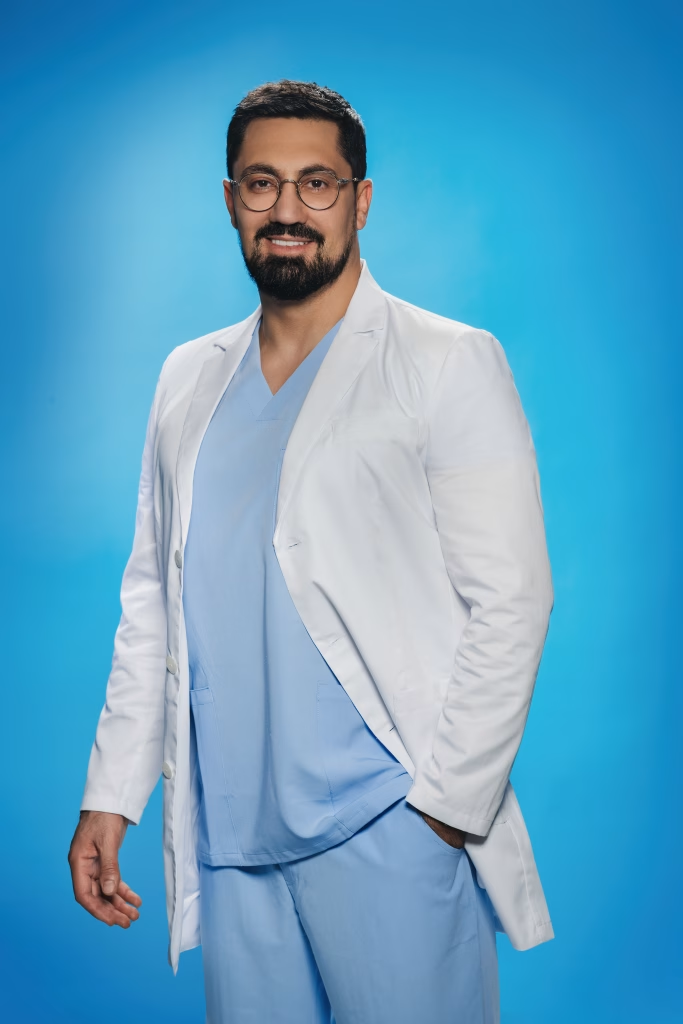
Renowned for his exclusive Ultra-Thin Seam™ Technique, Dr. Vardan Khachatrian, a visionary specialist and celebrity doctor, whose methods are increasingly shaping expectations across high-end patient segments not only in MENA region, but also globally.
To explore these trends, MedEdge MEA sat down for an exclusive conversation with Dr. Vardan Khachatrian, the Head of the Department of Plastic Surgery at Valiant Clinic & Hospital in Dubai, UAE. In this conversation, the celebrity doctor discusses the psychology behind modern patients, the rise of transparency in cosmetic procedures, and why the future of aesthetic surgery lies in discipline, not trends. Read the full interview to discover more.
MedEdge: You often say aesthetic surgery is moving toward “precision ethics”. What does that mean in practice?
Dr. Vardan Khachatrian: It means that capability is no longer the benchmark; judgment is. We are at a stage where surgical technology, tools, and techniques allow us to do far more than before. However, the question is no longer how much can be done; it is what is justified to do for this particular patient, in this particular anatomy, with this long-term horizon.
Precision ethics is about understanding consequences in advance, not only the visual outcome, but how the tissue will behave under gravity, how scars will mature, how the result will age over five, ten, fifteen years.
It also requires restraint. Many of the best surgical decisions are the ones where you deliberately choose not to overcorrect, not to over-tighten, not to overfill. I believe in modern surgery, restraint is expertise. The most refined result is often the least excessive one.
MedEdge: We are seeing celebrities and Hollywood people openly discussing their procedures done. How do you interpret this trend?
Dr. Vardan Khachatrian: It reflects a broader cultural transition from secrecy to openness. Patients today are more comfortable acknowledging that aesthetic medicine is part of their self-care or self-investment. That transparency can be positive because it removes stigma and allows for more informed conversations. However, it also introduces a risk, the simplification of something that is inherently complex.
When procedures are presented as quick, easy, or lifestyle choices without context, it creates unrealistic expectations. Surgery is a medical intervention with structural and biological consequences. The more aesthetic surgery becomes visible, the more responsibility we carry to keep it grounded in medicine, not entertainment.
MedEdge: Your practice is heavily focused on revision surgery. What do these cases teach you?
Dr. Vardan Khachatrian: They teach you to think in layers, both anatomically and historically. Every revision case is a record of previous decisions. You see how tissue has been handled, how tension was distributed, how healing evolved. Sometimes the issue is not what was done, but how aggressively it was done, or how little attention was paid to long-term stability.
Revision surgery requires you to work with compromised conditions, thinner tissue, altered blood supply, existing scar patterns. You cannot approach it with the same logic as a primary procedure. It requires patience, sequencing, and often staged strategies. The body remembers every intervention. Revision surgery is a dialogue with that memory; and it requires respect.
MedEdge: Can you share a case that stayed with you?
Dr. Vardan Khachatrian: Without going into specifics, a patient had undergone multiple surgeries in different countries. Technically, each procedure may have been considered acceptable on its own, but cumulatively, the structure had lost coherence. The challenge was not to impose a new design, but to restore stability gradually. We approached it in stages, prioritizing function and support before aesthetics.
What stayed with me was not the visual transformation, but the psychological shift. The patient moved from frustration to calm, from constantly thinking about the body to simply living in it. The best outcomes are not the most dramatic; they are the ones that restore normality.
Also read: American University of Ras Al Khaimah hosts inaugural Biotechnology Conference
MedEdge: Let’s talk about your Ultra-Thin Seam™ technique. How did it originate?
Dr. Vardan Khachatrian: It started with a simple question: why do scars differ so significantly between patients and even between procedures on the same patient? When you analyze it, you realize that the scar is the visible endpoint of a deeper process. It depends on how tension is managed, how blood supply is preserved, how tissues are stabilized internally.
I began refining closure techniques to reduce surface stress and redistribute load into deeper, more stable layers. Over time, this became a structured system, not just a way of closing the skin, but a way of planning the entire surgical interaction with tissue. A refined ultra-thin scar is not created at the skin level. It is engineered beneath it through control, stability, and respect for biology.
MedEdge: What trends in aesthetic medicine do you believe have long-term value?
Dr. Vardan Khachatrian: There is a clear movement toward quality over immediacy. Patients are increasingly interested in outcomes that remain stable, rather than those that simply look good in the first months. That shifts the focus toward structural support, balanced proportions, and controlled healing.
Another important trend is patient education. People are asking more questions that are precise about techniques, about recovery, about long-term implications. This elevates the entire field. I am deeply convinced that the future of aesthetic medicine belongs to results that age well.
MedEdge: And what trends concern you?
Dr. Vardan Khachatrian: Acceleration. There is pressure, both from marketing and from social media, to make procedures appear fast, easy, and highly transformative at once. In reality, those variables rarely align safely. When complexity is simplified, risk is underestimated. In addition, when risk is underestimated, outcomes become less predictable.
If a procedure is presented as effortless, it usually means the complexity has been hidden, not removed.
Click here to join our WhatsApp channel here
MedEdge: Dubai is now a global destination for aesthetic procedures. What defines this market?
Dr. Vardan Khachatrian: It is one of the most structured environments I have worked in. The regulatory system is clear, the standards are high, and there is strong alignment between clinics, authorities, and patient expectations. This creates stability essential for high-quality medicine.
There is also a distinct cultural dimension. In the Gulf, aesthetic preferences tend to favor refinement over transformation. Patients want to look better, not different. The best result is the one that integrates seamlessly into the person’s identity.
MedEdge: Finally, what does success look like for you today?
Dr. Vardan Khachatrian: Consistency at a high level. Not one exceptional result but a standard that can be maintained across every case and every patient, regardless of complexity. Success in surgery is not a moment. It is the ability to sustainably reproduce refinement, it is an excellence system.
As aesthetic medicine continues to intersect with healthcare, performance, and patient psychology, authority voices like Dr. Vardan Khachatrian’s signal a clear direction from visibility to responsibility. Moreover, in that shift, the definition of excellence is being redefined with intent.