
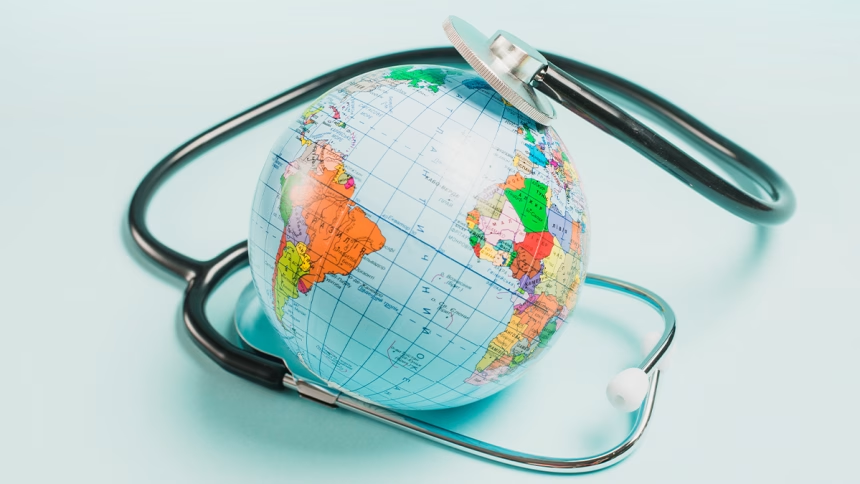
In recent years, international medical travel has evolved from a niche phenomenon into a powerful force quietly reshaping the global health care landscape. While traditionally associated with patients crossing borders for elective procedures or cost savings, the reality today is far more complex, and far more impactful. What’s emerging is a broader ecosystem of international healthcare services exports, encompassing not only patient care but also education, training, research, and system strengthening. At the heart of this transformation are academic medical centers, which are increasingly serving as hubs for global collaboration and innovation.
A broader definition of global health engagement
The term “medical tourism” has often been used as a catch-all for international patient care, but it fails to capture the full scope of what’s happening. Strictly speaking, medical tourism refers to patients traveling abroad for care, often for affordability or access to specific procedures. But what’s unfolding now is a more expansive model: one that includes international patient programs, academic partnerships, capacity building, and cross-border research. Academic medical centers in the United States and elsewhere are no longer just destinations for care, they’re becoming strategic partners in global health. These institutions bring together clinical excellence, cutting-edge research, and a commitment to education, making them uniquely positioned to support health system development and foster long-term, sustainable improvements in care.
International patient programs: More than a visit
Patients from around the world are increasingly seeking care at academic institutions not just for treatment, but for access to multidisciplinary expertise and advanced technologies unavailable in their home countries. These international patient programs are designed to offer culturally sensitive care, streamlined logistics, and long-term follow-up, often in collaboration with embassies, ministries of health, and referring physicians. But the impact goes beyond the individual patient. These programs serve as entry points for broader engagement, opening doors to clinical trials, research participation, and shared learning. Patients in many regions may encounter cultural, regulatory, or logistical barriers to participating in clinical research within their home countries. International programs help bridge that gap by providing access to advanced clinical trials and therapies, contributing to improved outcomes and shaping global standards of care.
Research without borders
One of the most transformative aspects of international healthcare services is the globalization of research. When patients travel across borders for care, they bring with them diverse genetic backgrounds, environmental exposures, and disease presentations. This diversity enriches clinical research and helps institutions develop more inclusive and effective treatments. Academic centers are leveraging these opportunities to conduct multinational studies, validate new therapies, and explore innovative care models. Collaborations with international partners allow for larger patient cohorts, faster data collection, and broader applicability of findings. These efforts are especially critical for diseases that disproportionately affect certain regions, such as sickle cell disease, infectious diseases, or rare cancers, where domestic research agendas may fall short.
Academic collaboration: A two-way street
Global partnerships are not one-sided. Leading medical centers are engaging with hospitals and universities around the world to share expertise, co-develop treatment protocols, and train the next generation of health professionals. These relationships offer U.S. institutions the opportunity to learn from the unique challenges and innovations emerging in other health systems, whether it’s community-based care models, novel approaches to resource management, or culturally tailored public health strategies. Joint research initiatives, virtual consultations, and exchange programs allow clinicians and researchers to work side-by-side across borders. These efforts contribute to a shared understanding of disease patterns, treatment efficacy, and public health strategies, ultimately improving outcomes for patients everywhere.
Building capacity, not just treating patients
International medical travel is no longer just about flying in for surgery and flying out with a discharge summary. Increasingly, it’s about building capacity within local health systems. Academic medical centers are helping partner institutions develop specialized programs, implement evidence-based practices, and establish centers of excellence. Through global health initiatives and partnerships these institutions support infrastructure development, workforce training, and policy advising. The goal is not only to deliver care but to empower local clinicians and researchers to lead advancements in their own communities. This approach ensures that improvements are sustainable and locally driven, rather than dependent on external intervention.
Exporting expertise
Education is one of the most powerful exports of academic medicine. Through fellowships, online courses, and in-person training programs, institutions are helping build the next generation of global health leaders. These programs are often tailored to the needs of partner countries, focusing on areas such as oncology, cardiology, emergency medicine, and public health. By investing in education, academic centers are not only sharing knowledge, they’re fostering long-term relationships and creating a global community of practice. These efforts help standardize care, reduce disparities, and promote innovation across borders.
A new model of global partnership
The evolution of international healthcare services is prompting a shift in how institutions view global engagement. Global health partnerships are increasingly seen as strategic alliances that benefit all parties. Academic medical centers are recognizing that collaboration is essential not only for improving global health but for advancing their own missions in research, education, and innovation. These partnerships are built on mutual respect, shared goals, and long-term commitment. Whether through joint conferences, collaborative publications, or integrated care pathways, they foster a global ecosystem of innovation and equity.
Learning from global peers
One of the most underappreciated aspects of international collaboration is the opportunity it provides for institutions to learn from their global peers. Health systems in other countries often develop creative solutions to resource constraints, cultural barriers, and public health challenges. By engaging in meaningful collaboration, academic centers can adopt and adapt these innovations to improve care at home. For example, telemedicine platforms developed in rural regions may offer insights into reaching underserved populations in urban settings. Similarly, community-based screening programs abroad could inform outreach strategies in domestic health systems. These lessons are invaluable, and they underscore the importance of humility and openness in global health partnerships.
A shared future
As international healthcare services continue to evolve, their impact on global health care will only deepen. The next frontier lies in creating integrated networks of care, research, and education that span continents and cultures. Academic medical centers are uniquely positioned to lead this transformation. By embracing international medical travel not just as a clinical service but as a catalyst for global collaboration, these institutions are helping to build a more connected, equitable, and innovative health care system. They are proving that the pursuit of better health outcomes is a shared endeavor, one that transcends geography and ideology. In the quiet corridors of academic hospitals and the bustling streets of international cities, a new model of global health is taking shape. And in doing so, it’s reminding us that health care, at its best, is a global conversation.