

• Duphat
  • infinia camp
mededge mea logo web MedEdge_Logo_Dark

Public Relations, Top Health Magazine and Healthcare News GCC

  • Newsletters
  • Magazines
  • Subscribe
  • Home
  • News
  • Opinion
  • Interviews
  • Featured
  • Cover Stories
  • Events
  • Health For all
    • Ageing Gracefully
    • Family Health Matters
    • Environment Health
    • Women and Child Health
    • Men’s Health
  • Resource Hub
    • Fresh Perspectives
    • Medical Tourism
    • Medical Education
    • Personnel
    • Research
      • Healthcare Journals & Publishers
    • Healthcare Campaigns
    • Health Tools Hub
    • Dubai Health Centers Directory | Services, Locations & Timings
    • ME Explained
Reading: Does keeping your room Wi-Fi on at night damage your brain health?
Share
Notification
  • Duphat
  • infinia camp
mededge mea logo web
  • Magazines
  • Newsletters
  • Profiles
  • Subscribe
Search
  • Home
  • News
  • Opinion
  • Interviews
  • Featured
  • Cover Stories
  • Events
  • Health For all
    • Ageing Gracefully
    • Family Health Matters
    • Environment Health
    • Women and Child Health
    • Men’s Health
  • Resource Hub
    • Fresh Perspectives
    • Medical Tourism
    • Medical Education
    • Personnel
    • Research
    • Healthcare Campaigns
    • Health Tools Hub
    • Dubai Health Centers Directory | Services, Locations & Timings
    • ME Explained
Have an existing account? Sign In
MedEdge MEA > ME Explained > Does keeping your room Wi-Fi on at night damage your brain health?
ME Explained

Does keeping your room Wi-Fi on at night damage your brain health?

Harshad Hussain B
Harshad Hussain B
Published: September 10, 2025
Share
6 Min Read
Wi-Fi on at night damage
SHARE

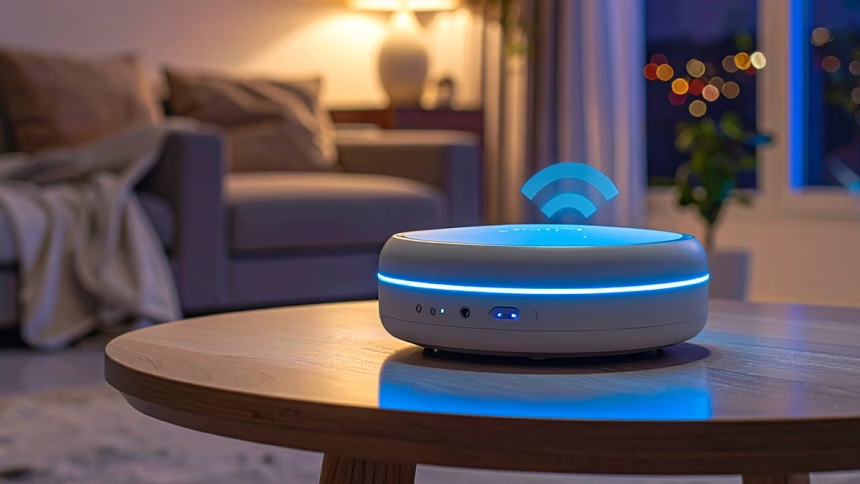
With Wi-Fi being a constant presence in our homes, many wonder if leaving it on during the night might harm brain health. This concern comes from the fact that Wi-Fi devices emit radiofrequency electromagnetic fields (RF-EMF), and prolonged exposure to RF radiation has raised questions about its possible effects on the nervous system, particularly the brain. This article presents an evidence-based overview to help you understand whether keeping Wi-Fi on at night could potentially damage your brain.

Contents
  • What is Wi-Fi radiation?
  • Animal studies suggest possible brain effects
  • What does human research show?
  • Should you turn off Wi-Fi at night?
  • Practical recommendations for brain health and Wi-Fi use

What is Wi-Fi radiation?

Wi-Fi transmits data using RF-EMF, typically at 2.4 GHz or 5 GHz frequencies. This radiation is non-ionizing, meaning it does not carry enough energy to break chemical bonds or directly damage DNA as ionizing radiation (like X-rays) does. Because of this, Wi-Fi radiation is generally considered lower risk compared to ionizing radiation. However, attention has turned to whether long-term, low-level exposure might have subtle biological effects, especially in brain tissue.

Also Read: How Does Diet Influence Mental Well-Being, and What Foods Support Brain Health?

Animal studies suggest possible brain effects

Animal research provides some insights into potential risks, although the direct application to humans remains uncertain:

  • A study exposing rats to 2.4 GHz Wi-Fi radiation found significant biochemical changes in brain tissue, such as altered expression of microRNA and genes related to neurodegenerative diseases. This suggests long-term exposure might increase risk factors linked to brain disorders.
  • Rats exposed to Wi-Fi frequencies experienced increased anxiety levels and impaired motor function. Brain examinations showed changes indicating neurobehavioral alterations possibly linked to damage or stress responses. The researchers suggested potential pathways that could lead to neurodegeneration after continued exposure.
  • Other studies on rodents found increased oxidative stress markers, such as elevated malondialdehyde (MDA) and reduced antioxidant enzyme activities (superoxide dismutase [SOD], catalase [CAT]). These changes are associated with memory deficits and anxiety-related behaviors in exposed animals.
  • Additional research reported neuronal damage and increased apoptosis (programmed cell death) in critical brain areas like the hippocampus, responsible for memory and learning, particularly when animals were exposed for long periods (weeks to months).

These findings reinforce that high or prolonged exposure to Wi-Fi frequency radiation can induce measurable biochemical and functional changes in animal brains. Yet, stressing that these effects occurred at controlled exposures often much higher or longer than typical human everyday exposure levels.

What does human research show?

Human studies on Wi-Fi exposure and brain health are more limited and less conclusive:

  • Epidemiological studies have not demonstrated a clear link between Wi-Fi or similar RF-EMF exposure and serious brain diseases such as tumors, cognitive decline, or neurodegeneration.
  • Some controlled experiments suggest brief exposure to Wi-Fi frequencies does not significantly alter brain function or cognitive ability in healthy adults. However, subtle changes in brain electrical activity during sleep have been noted in recent studies, indicating a possibility of mild biological effects with continuous exposure.
  • The strongest scientific consensus today is that RF-EMF exposure from Wi-Fi routers is markedly below safety thresholds set by health authorities, which are designed to prevent known harmful effects.

Individuals reporting sensitivity to electromagnetic fields (electromagnetic hypersensitivity or EHS) note symptoms like headaches and concentration issues around wireless devices. Yet, scientific validation of this condition remains elusive, and the cause-effect relationship is unclear.

Click here to join our WhatsApp channel here

Should you turn off Wi-Fi at night?

There is no conclusive proof that leaving your Wi-Fi on overnight causes direct, significant brain damage in humans. Typical household Wi-Fi signal strengths are low and within regulatory safety limits. Nonetheless, some animal studies showing brain changes suggest that chronic, high-intensity exposure could raise risks, especially with cumulative effects over time.

The precautionary principle recommends minimizing unnecessary RF exposure where possible. Turning Wi-Fi routers off at night is a practical, simple step that incurs no significant inconvenience and may further reduce any theoretical risks.

Additionally, reducing Wi-Fi exposure in the bedroom can help improve sleep quality by removing other potential electromagnetic distractions.

Practical recommendations for brain health and Wi-Fi use

  • Turn off Wi-Fi at night or when not actively using it to reduce continuous exposure.
  • Keep Wi-Fi routers away from sleeping areas or bedrooms to lessen direct RF exposure during rest.
  • Use wired internet connections where feasible, eliminating wireless signals near you.
  • Maintain a healthy lifestyle with good nutrition, antioxidants, and sufficient sleep to support brain resilience against environmental stressors.

Share This Article
Facebook Whatsapp Whatsapp LinkedIn Copy Link
Share
Harshad Hussain B
ByHarshad Hussain B
Follow:
[email protected]
Previous Article TERN Group TERN Group raises $33 million to transform GCC healthcare with the worldโ€™s first clinical AI workforce platform
Next Article Aster DM Healthcare Nominations for fifth edition of Aster Guardians Global Nursing Award 2026 worth USD 250,000 now Open

Recent Posts

  • UAE Trade Minister Tours Ajman Medical Campus to Advance Healthcare Innovation and Knowledge Economy Goals
  • Novel Drug Therapy Offers Hope for Children With Brain-Injury-Related Obesity, Study Finds
  • Dignity in Dying: UAE Strengthens Palliative Care for Patients With Life-Limiting Conditions
  • Leica Biosystems Expands AI Powered Digital Pathology Solution Across EMEA
  • Abu Dhabi Laboratory Joins WHO Global Network for Measles and Rubella Surveillance
  • duphat
  • MedEdge-Infinia
Two Point Five Logo white
  • About Us
  • Contact Us
  • Medical Disclaimer
  • Privacy Policy
  • Terms and Conditions
  • Cookie Policy (EU)
  • Submit Your Story
  • MediaKit
Reading: Does keeping your room Wi-Fi on at night damage your brain health?
Share

Published by Two Point Five Media FZCO

  • About Us
  • Contact Us
  • Medical Disclaimer
  • Privacy Policy
  • Terms and Conditions
  • Cookie Policy (EU)
  • Submit Your Story
  • MediaKit
Reading: Does keeping your room Wi-Fi on at night damage your brain health?
Share

Follow US on Social Media

Facebook Instagram Linkedin X-twitter Youtube Whatsapp
Manage Consent
To provide the best experiences, we use technologies like cookies to store and/or access device information. Consenting to these technologies will allow us to process data such as browsing behavior or unique IDs on this site. Not consenting or withdrawing consent, may adversely affect certain features and functions.
Functional Always active
The technical storage or access is strictly necessary for the legitimate purpose of enabling the use of a specific service explicitly requested by the subscriber or user, or for the sole purpose of carrying out the transmission of a communication over an electronic communications network.
Preferences
The technical storage or access is necessary for the legitimate purpose of storing preferences that are not requested by the subscriber or user.
Statistics
The technical storage or access that is used exclusively for statistical purposes. The technical storage or access that is used exclusively for anonymous statistical purposes. Without a subpoena, voluntary compliance on the part of your Internet Service Provider, or additional records from a third party, information stored or retrieved for this purpose alone cannot usually be used to identify you.
Marketing
The technical storage or access is required to create user profiles to send advertising, or to track the user on a website or across several websites for similar marketing purposes.
  • Manage options
  • Manage services
  • Manage {vendor_count} vendors
  • Read more about these purposes
View preferences
  • {title}
  • {title}
  • {title}

WhatsApp us

Logo of Medede mea
Welcome Back!

Sign in to your account

Username or Email Address
Password

Lost your password?