


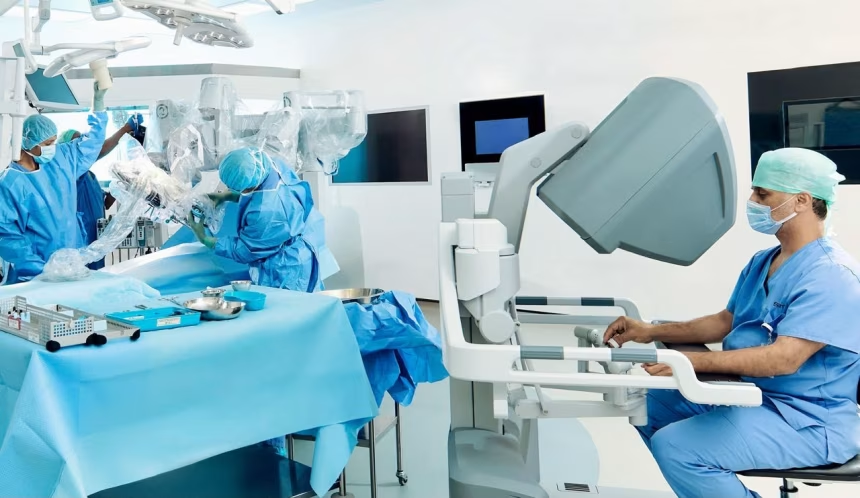
Dr Salem Al Harthi chair of the department of surgery and consultant general surgeon at Sheikh Shakhbout Medical City (SSMC) explains thyroid warning signs, how robotic thyroidectomy through the armpit works, who qualifies, when open surgery is safer, and what patients should expect afterwards.
ME: What does the thyroid do, and which common conditions and warning signs should readers know about?
SA: The thyroid is a small, butterfly-shaped gland at the front of the neck. Its hormones control how quickly the body uses energy, affecting heart rate, weight, temperature, mood and digestion.
Hypothyroidism means too little hormone, leaving people tired, cold, constipated and low in mood, often with weight gain. Hyperthyroidism means too much, causing anxiety, a racing heart, weight loss, heat intolerance and tremor. Goitre and nodules appear as lumps or swelling in the neck.
Readers should seek advice for a new neck lump, hoarseness lasting more than two weeks, difficulty swallowing or breathing, or unexplained weight change with palpitations or extreme fatigue.
ME: How common are thyroid nodules, does finding one mean cancer, and how are they assessed before surgery is considered?
SA: They are extremely common. If we scanned 100 adults, about half would have a nodule, yet only about five in 100 nodules are cancerous. Finding one does not mean cancer, and most are harmless cysts or simple overgrowth.
Assessment involves an ultrasound to check how suspicious the nodule looks, a fine needle aspiration cytology (FNAC) test that collects cells with a needle as thin as one used for blood tests, and blood tests to check thyroid function.
Click here to join our WhatsApp channel here
ME: When should a patient consider surgery, and is it reasonable to choose an operation over a daily tablet?
SA: We consider surgery for confirmed or highly suspected cancer, a large nodule causing choking, swallowing difficulty or visible swelling, an overactive nodule that medication cannot control, or a goitre growing into the chest.
Choosing surgery over lifelong tablets is also reasonable if hyperthyroidism keeps returning, tablets cause side effects, or a patient does not want medication for decades. For many benign conditions both options are safe, and the choice is personal once risks are discussed. For cancer, surgery is the main treatment.
ME: How does the robotic approach through the armpit work, and what happens inside the body after the small incisions are made?
SA: We make a small incision in a natural skin crease of the armpit, then create a narrow tunnel under the skin, over the chest muscle and up to the neck. A little gas inflates it to create space, and the robot, which has four thin arms, passes through. Inside, the operation is the same as in conventional surgery: we remove the thyroid lobe. The scar stays hidden when the arm is down, and the neck has no scar.
ME: What do the magnified 3D view and tremor filtration change in theatre, and why does that matter for voice and calcium balance?
SA: The thyroid sits over two delicate structures: the recurrent laryngeal nerve, which controls the voice, and the parathyroid glands, each about the size of a grain of rice, which control calcium.
In open surgery we see them with the naked eye. With the robot, I see them in 10x magnified, high-definition 3D, like moving from standard television to 3D cinema. Tremor filtration removes natural hand shake, and the instruments bend like a human wrist.
Also read: Personalised Care Advances Treatment of Complex Blood Disorders
This helps me identify and preserve the voice nerve and the parathyroids’ blood supply, lowering the risk of hoarseness and of tingling from low calcium after surgery.
ME: What makes someone a good candidate for robotic thyroidectomy, and when does conventional neck surgery remain safer?
SA: Good candidates are typically younger patients worried about a neck scar or prone to keloids, motivated by a cosmetic result, with a nodule or cancer under 3 to 4cm on one side, a thin to average build and no previous neck surgery.
Open surgery remains the gold standard for cancers larger than 4cm, cancers growing outside the thyroid, bulky neck lymph nodes, very large goitres, Graves’ disease, previous neck surgery or radiation, and obese patients needing a total thyroidectomy on both sides.

ME: What should patients expect after surgery, will they need medication, and what risks should they weigh against the cosmetic benefit?
SA: Patients go home the next day. The chest and armpit feel sore or bruised for about a week, more like a workout ache than neck pain. Most return to office work in 7 to 10 days and the gym in two to three weeks, with no neck numbness.
If half the thyroid is removed (a lobectomy), about 70 per cent of patients need no daily tablet. After a total thyroidectomy, one small thyroxine tablet every morning for life is needed, identical to the natural hormone.
Risks match open surgery, a 1 to 2 per cent chance of temporary hoarseness and 2 to 3 per cent of temporary low calcium, felt as finger tingling. Robotic surgery adds more chest wall soreness and a possible small fluid collection under the skin. Patients trade a visible neck scar for a hidden armpit scar and slightly more chest wall discomfort.

