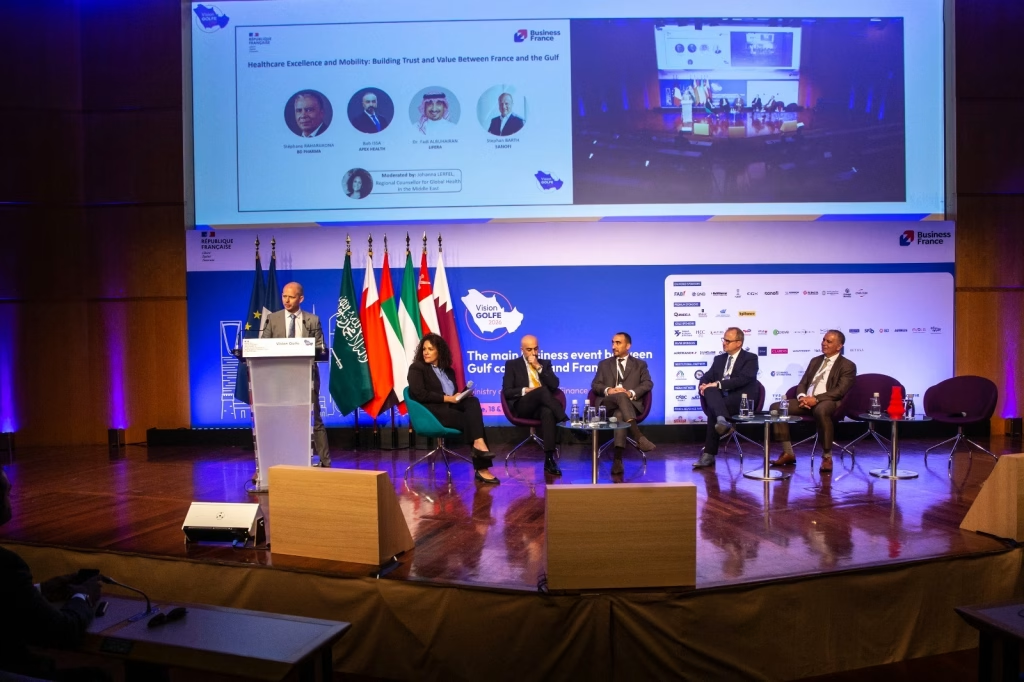
Four voices spanning biopharma, vaccines, hospital infrastructure, and injectable devices gathered at Vision Golfe, convened at the Ministry of Economy in Paris under the patronage of President Emmanuel Macron, and reached the same verdict: the Gulf has stopped weighing international partners by their ability to enter the market. What counts now is what they build once they are inside it.
The panel on France-Gulf healthcare corperation focused less on selling into a market than on the conditions under which lasting partnerships take shape. The four practitioners spent the better part of an hour setting out what it actually takes to operate meaningfully in one of the world’s fastest-growing healthcare economies.
The answer, across all four contributions, pointed to the same thing: trust, built through commitment, capability development, and alignment on long-term national ambition.
The session, moderated by Johanna Lerfel, Regional Counselor for Health in the Middle East for the French Ministry of Foreign Affairs, opened with a picture of the Saudi healthcare landscape as it stands today. Dr. Fadi Albuhairan, Chief Executive of LIFERA, was direct about where the opportunity lies. Market access, he argued, is not the challenge. Any international company can enter Saudi Arabia and find a route to market. The more consequential question is what they do once they are there.
Also read: Daman highlights eye health as a priority area for early detection and preventive care
LIFERA’s own agenda is structured around three verticals: the localisation of biologics, beginning with insulin; genomic sequencing and the downstream application of the data it generates; and gene therapy, which the company intends to initiate in 2027. Across all three, Albuhairan’s emphasis fell on leapfrogging the ability for Saudi partners to build not from scratch but from an existing foundation, absorbing international expertise to advance the sector rather than simply replicate it. “It’s not about localising only,” he said. “It’s about advancing the agenda.”
What five decades in the gulf actually teaches you
Stephan Barth, Global Franchise Head at Sanofi for its pneumococcal, meningococcal, and travel vaccine portfolio, brought a perspective rooted in five decades of regional presence. Sanofi was the first multinational to localise manufacturing in the Gulf, a fact Barth referenced not as historical trivia but as evidence of a different kind of commitment, one that runs through the entire value chain, from research and development to production. The company signed a further memorandum of understanding with Saudi Arabia’s Public Investment Fund and the Ministry of Health and Industry at the end of 2024, with the chairman of Sanofi’s board present at the signing.
For Barth, that level of seniority signals how seriously the organisation is prioritising the relationship. He returned more than once to a point that framed the panel’s broader theme: the bilateral relationship between France and the Gulf is a genuine competitive advantage for French companies, and one they should actively leverage rather than take for granted.
Click here to join our WhatsApp channel here
Bob Issa, Chief Marketing Officer of APEX Health, approached the question from the infrastructure side. The Qatari-based company has expanded from zero to eight hospitals across four countries in three years, with two to three additional markets targeted before year end. His formulation of what makes a partnership sustainable rather than extractive was the most resonant of the session: you build with the market, not for the market. A 300-bed hospital opening in Algeria within the year will, from its first day, draw its supply chain and talent locally. The logic is not philanthropic, it is strategic. Build capacity faster than you develop local capability and you create dependency, which eventually undermines competitive advantage. Build capability without the infrastructure to sustain it and the advantage is forfeit before it matures. The two must rise together.
Gulf market and the rewritten rules of localization
Stéphane Raharijaona of BD, the pharmaceutical systems company whose glass pre-fillable syringes are a core component of the injectable drug delivery chain, offered a fifteen-year view of how the regional market has shifted. When BD first began engaging the Gulf, one or two companies were producing injectables locally. Today there are many. More striking than the volume shift, Raharijaona observed, is the ambition driving it. Gulf companies are not starting with simple molecules and working up. They are entering the market targeting monoclonal antibodies, peptides, and treatments for chronic conditions such as obesity and diabetes, the complex therapies that define the current frontier of pharmaceutical manufacturing. The opening question in every commercial discussion, he said, is no longer about price or access. It is about quality.
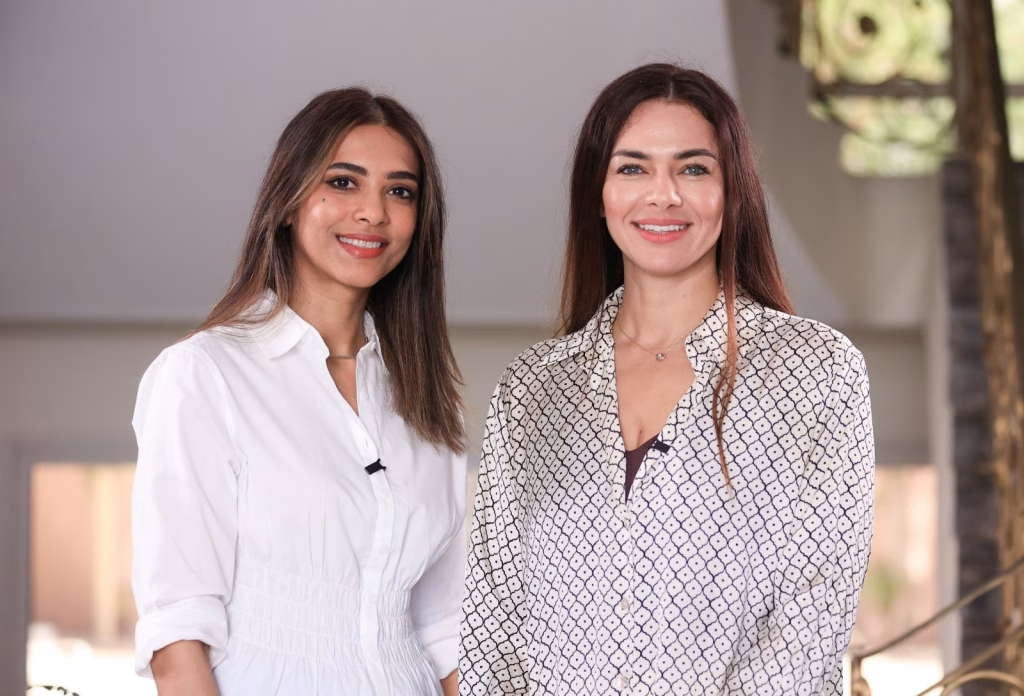
Across the four contributions, what emerged was a portrait of a market in genuine transition one where the parameters of partnership have shifted. The Gulf does not lack capital, ambition, or a young population ready to develop capability. Saudi Arabia’s largest demographic cohort is under 32, a fact Albuhairan cited as one of the most compelling indicators of long-term potential. What the market increasingly requires from international partners is alignment: on regulatory standards that are moving quickly, on a willingness to invest in capability transfer rather than product placement, and on a genuinely shared vision of where the sector is heading.
A new intelligence framework for the KSA healthcare market
It was against this backdrop that Oscar Wendel, Chairman of Global Health Stratalogues, announced at Vision Golfe a strategic partnership between Global Health Stratalogues, the Global Health Exhibition, and Business France. The partnership establishes Global Health Stratalogues as the Global Health Exhibition’s official Intelligence Partner, with the three organisations working together to help international companies navigate one of the region’s most complex and fast-moving healthcare markets. The flagship output is a market intelligence report, Roadmap to Entering the KSA Healthcare Market: A Strategic Guide for International Companies, produced with MedEdge MEA as Media Partner. The report will be formally distributed at the ninth edition of the Global Health Exhibition in Riyadh from 26 to 29 October, where it will reach more than 130,000 healthcare professionals and over 2,200 exhibiting brands. An invitation-only Global Stratalogues Roundtable, curated with Business France, will bring senior leaders, policymakers, and innovators together for a working dialogue on the Kingdom’s health future.
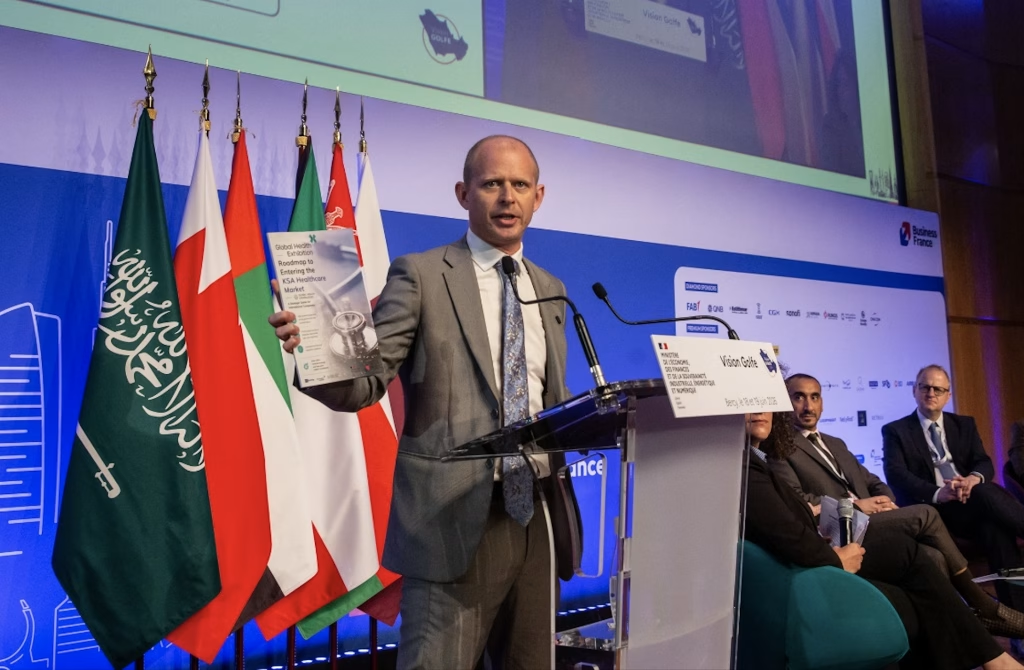
The logic of the partnership is structural. “Our partnerships create an integrated system across three layers,” said Sunita Khatri, Show Director of the Global Health Exhibition. “Business France provides the institutional channel into Saudi Arabia, the GCC’s largest healthcare market. The Global Health Exhibition provides the audience and a deal-making environment. And Global Health Stratalogues with MedEdge MEA provide the media layer that sustains and amplifies those conversations year-round.”
The panel made the case for that report more effectively than any product launch could have. The Saudi healthcare market is not short of opportunity. What international companies consistently underestimate is the sophistication of what is now required to operate there well the regulatory intelligence, the localisation expectations, the pace of ambition. The France-Gulf health relationship is entering a phase defined less by market entry and more by the architecture of what comes next.