

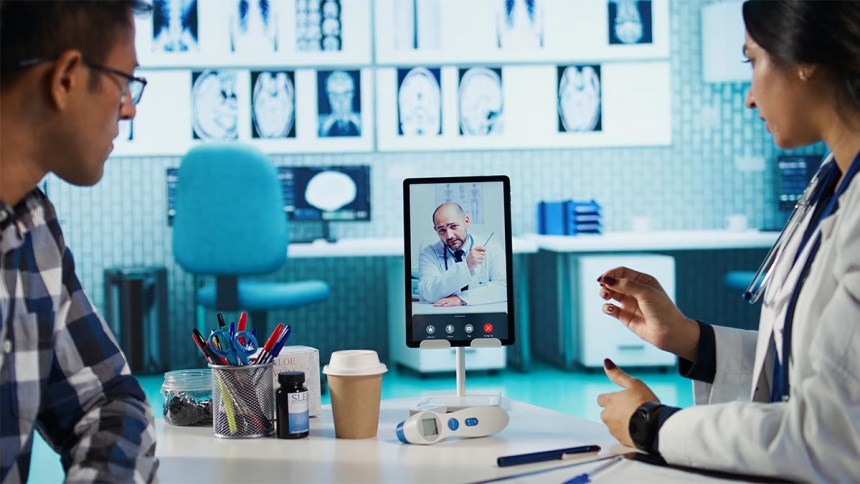

Artificial intelligence (AI) is rapidly transforming modern healthcare, combining technologies that improve diagnosis, treatment, research, and healthcare operations. From detecting diseases in medical scans to streamlining hospital workflows, AI is increasingly helping clinicians make faster and more data-driven decisions. Once viewed as a futuristic concept, today many AI-powered tools are already becoming part of everyday medical practice. In the Middle East region, it is no different.
Modern AI in medicine combines technologies such as machine learning, computer vision, natural language processing, and generative AI to support both clinical care and healthcare operations. In the GCC region, research has shown that the AI market was valued at USD $503 million in 2024 and is expected to grow to $5.81 billion by 2035.
When it comes to digital health markets in the region, two sof its biggest countries are projected to have big impact. The UAE’s market was estimated at $619.3 million in 2023 but in the next four years, that figure could increase substantially to $2.65 billion in 2030. Meanwhile, the Kingdom of Saudi Arabia is expected to reach $11.07 billion by 2033.
As healthcare systems become increasingly technology-enabled, future physicians will need to develop clinical expertise alongside the ability to work with data-driven healthcare tools and digital care ecosystems.
Click here to join our WhatsApp channel here
AI in medical imaging and diagnostics
One of the clearest examples of AI’s success in healthcare has emerged in medical imaging. AI-powered computer vision systems are increasingly being used to help clinicians detect abnormalities in radiology scans with greater speed and accuracy. Breast cancer screening has become one of the most studied use cases.
According to a Saudi Arabia-based study conducted across government hospitals in Jeddah, AI-powered breast cancer detection systems demonstrated 92.3 per cent diagnostic accuracy, with sensitivity and specificity rates exceeding 91 per cent, highlighting the technology’s potential to support earlier and more reliable cancer detection.
These tools have seen relatively smoother adoption because they are designed for narrow, measurable tasks. Their performance can be validated against standardized clinical benchmarks such as sensitivity, specificity, and detection rates. Importantly, these systems are intended to support physicians rather than replace them, functioning as a second layer of review that helps reduce workload while improving diagnostic confidence.
Also read: UAQ Chamber and Thumbay University Hospital Partner to Expand Healthcare Access
Personalized medicine and the role of AI
Another major area of interest has been personalized medicine, where treatments are tailored to an individual’s genetic profile. Since the Human Genome Project in the 1990s, researchers have hoped that advances in genomics and computational medicine would enable highly individualized therapies. While significant progress has been made, especially in oncology biomarker testing, many AI-driven applications in drug discovery and precision medicine still remain at the research or pre-clinical stage.
AI has nevertheless accelerated parts of the research process. Tools such as protein-structure prediction models and machine learning systems are helping researchers identify potential drug targets more efficiently than before. However, translating computational discoveries into approved clinical therapies still requires years of testing, validation, and regulatory review. As a result, personalized medicine continues to evolve gradually rather than transforming healthcare overnight.
Generative AI in healthcare
Generative AI has emerged as one of the most discussed technologies in medicine over the last few years. Much of its real-world adoption currently remains concentrated around administrative and operational workflows rather than direct clinical decision-making. AI tools are increasingly being used for functions such as claims coding, prior-authorization reviews, clinical documentation, and patient record summarization, helping healthcare systems improve efficiency and reduce administrative burden.
Although generative AI systems can process medical information and respond effectively to standardized medical questions, patient care still depends heavily on contextual understanding, ethical judgment, communication, and decision-making in uncertain situations. Concerns around transparency and explainability also continue to limit AI’s role in high-stakes clinical environments. As a result, AI is unlikely to replace physicians in critical diagnostic or therapeutic decisions in the near future. Instead, it is expected to remain a supportive tool that enhances efficiency while clinicians retain final responsibility for patient care.
The future of healthcare lies in human-AI collaboration
The future of healthcare is unlikely to involve AI replacing doctors entirely. Instead, AI is expected to increasingly manage repetitive, structured, and data-heavy tasks, while clinicians continue to lead areas requiring empathy, communication, contextual reasoning, and complex judgment.
Core clinical skills such as patient interaction, history-taking, physical examination, and ethical decision-making will remain central to medical practice. At the same time, healthcare professionals will increasingly need to understand the strengths and limitations of AI tools, critically evaluate AI-generated outputs, and identify potential errors or bias.
As healthcare continues to evolve, physicians who can effectively combine clinical expertise with technological understanding will likely be best positioned to lead the next generation of patient care.