

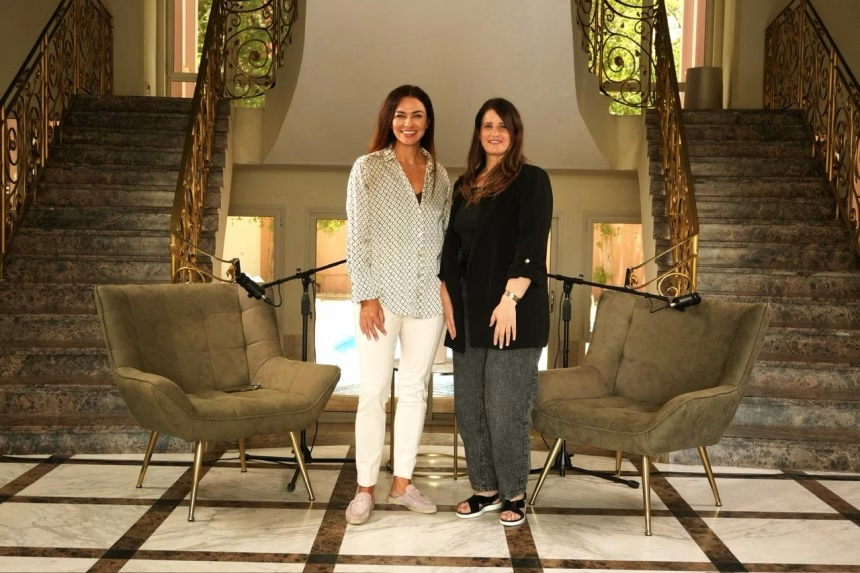

Every year, hundreds of companies descend on the Gulf chasing deals, partnerships, and a piece of its trillion-dollar transformation. Most leave empty-handed. Miryem Oukas, who has spent 14 years on the ground in Dubai with Business France, knows exactly why and what the ones who stay get right.
The first error most companies make, Oukas explains, is treating the Gulf as a single, uniform market. It is not. The regulatory environment in Saudi Arabia is fundamentally different from that of the UAE. The procurement culture in Qatar diverges from Kuwait’s. The sectoral priorities of each country shift with its own national strategies. A product pitch or market-entry plan calibrated for one capital will often fall flat in another.
“We will help them to craft their own strategy, depending on the sector and on the market,” Oukas says. Business France maintains offices across the GCC (in the UAE, Saudi Arabia, Qatar, and Kuwait) precisely because a Dubai-based team cannot fully interpret Riyadh’s dynamics, and vice versa. Companies that skip this localisation step often discover the hard lesson after an expensive false start.
Opportunity without presence is just tourism
The Gulf’s bold economic visions, including Saudi Arabia’s Vision 2030 and the UAE’s various national strategies, communicate ambition on a scale that can make the region seem like a growth market where almost anything can succeed. Liquidity is real. The appetite for innovation is genuine. But Oukas is direct about what that does not mean.
“You cannot handle a French-UAE or a French-Saudi relationship with business trips from Paris from time to time,” she says. “You have to invest in this relationship. You have to be grounded. You have to get teams locally present.”
Gulf decision-makers, whether in government ministries or private sector boardrooms, build trust through sustained presence and consistent engagement. A company that shows up for a major exhibition and then goes quiet for six months sends a clear signal: it is not serious about the market. That signal, once sent, is hard to walk back.
Also read: Everest Medicines Secures LNZ100 Deal in Greater China
Business France addresses this through its VIE program (Volontariat International eEnterprise), which allows French companies to deploy young talent on structured international missions. It is more affordable than a full expatriate contract and more capable than a standard internship, offering a practical way for smaller firms to establish a credible local footprint without overextending their resources.
The difference between being talked to and talked with
One of the sharpest illustrations of what sustained community-building looks like in practice came during the Iran crisis earlier this year. When geopolitical tension spiked, and French companies operating across the GCC needed fast, reliable guidance, Business France convened an emergency webinar. More than 2,000 companies registered.
What made the session effective, Oukas recalls, was the deliberate decision not to panic. The team assembled a panel of diplomats, French Embassy economists, and logistics specialists to provide a grounded, factual read of the situation: where France stood diplomatically, what the economic indicators were showing, and what practical steps companies could take.
The result was a community that felt informed rather than managed. That distinction, between being talked to and being talked with, is at the heart of how long-term trust is built in this region.
2,000 meetings two Days and one roof
For Oukas, the annual Vision Golfe summit in Paris is the culmination of this philosophy in event form. Now in its fourth edition, the two-day gathering brings together French and Gulf ministers, sovereign entities, industrial leaders, and policy-makers at landmark venues including the French Ministry of Economy. Last year, it facilitated more than 2,000 business-to-business and business-to-government meetings within a single two-day window.
What sets the format apart is not the prestige of the venues but the architecture of the program. Institutional panel sessions, sectoral conferences, and one-on-one business meetings happen simultaneously, under one roof. Gulf delegations arrive with a dual agenda: to advance their commercial relations with French counterparts and to reconnect with one another. Kuwaiti, Qatari, and Emirati executives use the event as a forum to rebuild and deepen ties across the GCC itself, a dynamic that has made Vision Golfe something more than a bilateral trade event.
This year’s programme was substantially revised just six weeks before the event to reflect the current context. New sessions on infrastructure security and food security were added. Confirmed speakers include representatives from Saudi Aramco, Sanofi, and Saudi Arabia’s Industrial Development Program, alongside partners such as DMCC from the UAE, Qatar National Bank, and First Abu Dhabi Bank, institutions that have been with the event since its first edition.
Click here to join our WhatsApp channel here
Patience is not a soft skill, it’s a strategy
There is a broader lesson in all of this that extends well beyond the France-Gulf relationship. In a world of constant geopolitical flux and rapid market shifts, the instinct of many companies is to move faster, to capture opportunity before conditions change. But Oukas’s experience suggests the opposite approach is often the wiser one.
The companies that have built durable positions in the Gulf are those that committed before the returns were obvious, that invested in local teams before they were strictly necessary, and that showed up consistently even when there was no deal on the table. They treated relationship-building not as a precursor to business but as business itself.
Cultural intelligence, local presence, and long-term commitment are not soft differentiators. In the GCC, they are hard competitive advantages, and they cannot be replicated by a last-minute strategy pivot or an extra round of business-class flights.
The Gulf is watching. The question is whether companies are willing to stay long enough to be seen.