


• Duphat
  • infinia camp
  • Emirates Digestive Diseases
MedEdge MEA MedEdge_Logo_Dark

Public Relations, Top Health Magazine and Healthcare News GCC

  • Newsletters
  • Magazines
  • Subscribe
  • Home
  • News
  • Opinion
  • Interviews
  • Featured
  • Cover Stories
  • Events
  • Health For all
    • Ageing Gracefully
    • Family Health Matters
    • Environment Health
    • Women and Child Health
    • Men’s Health
  • Resource Hub
    • Fresh Perspectives
    • Medical Tourism
    • Medical Education
    • Personnel
    • Research
      • Healthcare Journals & Publishers
    • Healthcare Campaigns
    • Health Tools Hub
    • Dubai Health Centers Directory | Services, Locations & Timings
    • ME Explained
Reading: What is the flesh-eating Screwworm making headlines in the U.S.?
Share
Notification
  • Duphat
  • infinia camp
  • Emirates Digestive Diseases
MedEdge MEA
  • Magazines
  • Newsletters
  • Profiles
  • Subscribe
Search
  • Home
  • News
  • Opinion
  • Interviews
  • Featured
  • Cover Stories
  • Events
  • Health For all
    • Ageing Gracefully
    • Family Health Matters
    • Environment Health
    • Women and Child Health
    • Men’s Health
  • Resource Hub
    • Fresh Perspectives
    • Medical Tourism
    • Medical Education
    • Personnel
    • Research
    • Healthcare Campaigns
    • Health Tools Hub
    • Dubai Health Centers Directory | Services, Locations & Timings
    • ME Explained
Have an existing account? Sign In
MedEdge MEA > ME Explained > What is the flesh-eating Screwworm making headlines in the U.S.?
ME Explained

What is the flesh-eating Screwworm making headlines in the U.S.?

Harshad Hussain B
Harshad Hussain B
Published: August 28, 2025
Share
5 Min Read
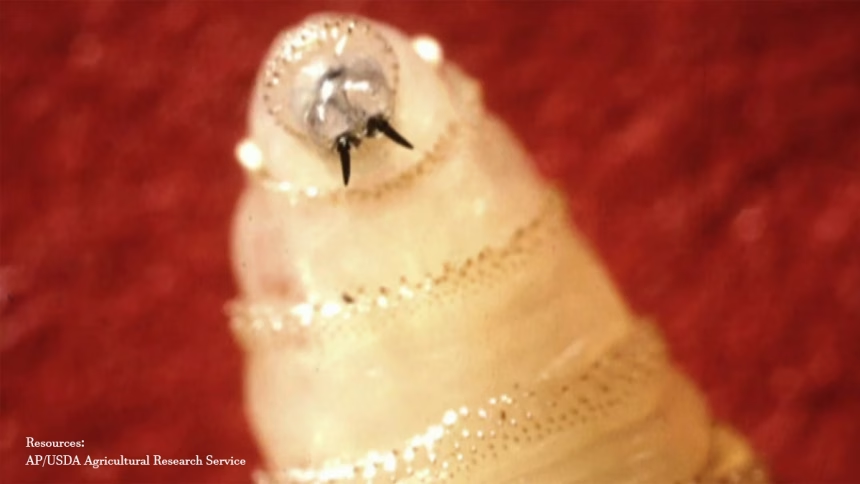
Screwworm Parasite
SHARE

The latest news of the first human case of a flesh-eating screwworm parasite in the United States has understandably caused some concern. While this type of parasitic infection is rare in the US, itโ€™s important to understand the facts about this condition and what it means for public health.

Contents
  • What is the Screwworm Parasite?
  • History and why this matters
  • What are the risks and symptoms of screwworm infections?
  • How can screwworm infections be prevented and treated?
  • Climate change and global health

What is the Screwworm Parasite?

The New World screwworm (Cochliomyia hominivorax) is the larva of a fly species found primarily in tropical and subtropical regions of the Americas. Unlike common maggots that feed on dead tissue, screwworm larvae invade living flesh, including that of humans and animals, causing severe tissue damage, secondary infections, and even death if untreated.

Also Read: Why giving kids smartphones before 13 can harm their Mental Health, Global study warns

The flies are attracted to open wounds, mucous membranes (like the nose or ears), or sometimes intact skin. They lay eggs in these areas, and within hours, the larvae hatch and begin burrowing into tissue, feeding on living matter. This results in painful lesions, swelling, and a distinct foul odor.

History and why this matters

The United States once faced screwworm outbreaks and worked to control them aggressively. A landmark public health effort used the sterile insect technique (SIT): releasing large numbers of sterile male flies to mate with wild females, which produced no offspring. Over time, this dramatically reduced and then eliminated screwworms from the U.S. and much of Central America.

Click here to join our WhatsApp channel here

The U.S. was declared free of screwworms in the early 1980s. Since then, the screwworm has persisted in some parts of the Americas, especially in warmer, tropical regions. That means travelers, workers, or animals moving from endemic areas can reintroduce the parasite if wounds are exposed.

A confirmed human case in the U.S. would be considered a rare reintroduction event and would trigger public health tracking and prevention measures.

What are the risks and symptoms of screwworm infections?

While screwworm infections are rare in the US, they can pose serious health risks if not properly identified and treated. The larvae can burrow deeply into the skin, muscle, and even internal organs, causing severe tissue damage, secondary infections, and potentially life-threatening complications.

Common symptoms of a screwworm infection include:

  • A small, itchy sore or wound that gradually expands
  • Visible movement of the larvae within the wound
  • Foul odor from the infected area
  • Pain, swelling, and redness around the wound
  • Fever, chills, and other signs of systemic infection

Anyone who develops an unexplained, expanding wound should seek immediate medical attention, especially if they have recently traveled to areas where screwworm is known to be present.

How can screwworm infections be prevented and treated?

The best way to prevent screwworm infections is to avoid open wounds, especially while traveling in tropical or subtropical regions. Properly cleaning and covering any cuts or abrasions can help deter flies from laying eggs.

If an infection is suspected, prompt medical treatment is crucial. Doctors will typically prescribe antiparasitic medications to kill the larvae, along with antibiotics to treat any secondary bacterial infections. In severe cases, surgical debridement (removal of damaged tissue) may be necessary.

Itโ€™s also important to report any suspected screwworm cases to local health authorities, as this can help track the spread of the parasite and implement public health measures to contain it.

Climate change and global health

The appearance of a screwworm case in the U.S. is a reminder of how interconnected our world is, and how climate shifts are expanding the habitats of tropical diseases. Warmer temperatures allow disease vectors to survive in regions previously considered low-risk.

Public health systems are adapting through enhanced surveillance, public education, and research into emerging pathogens. Travel medicine is also becoming increasingly important.

While the confirmation of a human screwworm case in the U.S. is concerning, it is not a cause for panic. Awareness, prevention, and early treatment are highly effective. Stay informed, take sensible precautions during travel, and consult a healthcare professional if you notice unusual symptoms.

Health authorities continue to monitor the situation closely. For now, this case serves as a timely reminder: in a warming, traveling world, vigilance is our best defense.


Share This Article
Facebook Whatsapp Whatsapp LinkedIn Copy Link
Share
Harshad Hussain B
ByHarshad Hussain B
Follow:
[email protected]
Previous Article smartphones before 13 Why giving kids smartphones before 13 can harm their Mental Health, Global study warns
Next Article CTW Global 2025 CTW Global 2025 to Drive Strategic Trade, Innovation, and Cross-Sector Growth in Dubai

Recent Posts

  • What’s happening inside your head and why you shouldn’t ignore the Signs
  • Everest Medicines Secures LNZ100 Deal in Greater China
  • Science&Humans Partners with Segic to Expand Access to Specialized Hormone Health Benefits
  • Africa CDC and WHO launch joint continental Ebola response plan
  • PureHealth performs GCCโ€™s first separation of craniopagus twinsโ€™ procedure in Abu Dhabi
  • duphat
  • MedEdge-Infinia
Two Point Five Logo white
  • About Us
  • Contact Us
  • Medical Disclaimer
  • Privacy Policy
  • Terms and Conditions
  • Cookie Policy (EU)
  • Submit Your Story
  • MediaKit
Reading: What is the flesh-eating Screwworm making headlines in the U.S.?
Share

Published by Two Point Five Media FZCO

  • About Us
  • Contact Us
  • Medical Disclaimer
  • Privacy Policy
  • Terms and Conditions
  • Cookie Policy (EU)
  • Submit Your Story
  • MediaKit
Reading: What is the flesh-eating Screwworm making headlines in the U.S.?
Share

Follow US on Social Media

Facebook Instagram Linkedin X-twitter Youtube Whatsapp
Manage Consent
To provide the best experiences, we use technologies like cookies to store and/or access device information. Consenting to these technologies will allow us to process data such as browsing behavior or unique IDs on this site. Not consenting or withdrawing consent, may adversely affect certain features and functions.
Functional Always active
The technical storage or access is strictly necessary for the legitimate purpose of enabling the use of a specific service explicitly requested by the subscriber or user, or for the sole purpose of carrying out the transmission of a communication over an electronic communications network.
Preferences
The technical storage or access is necessary for the legitimate purpose of storing preferences that are not requested by the subscriber or user.
Statistics
The technical storage or access that is used exclusively for statistical purposes. The technical storage or access that is used exclusively for anonymous statistical purposes. Without a subpoena, voluntary compliance on the part of your Internet Service Provider, or additional records from a third party, information stored or retrieved for this purpose alone cannot usually be used to identify you.
Marketing
The technical storage or access is required to create user profiles to send advertising, or to track the user on a website or across several websites for similar marketing purposes.
  • Manage options
  • Manage services
  • Manage {vendor_count} vendors
  • Read more about these purposes
View preferences
  • {title}
  • {title}
  • {title}

WhatsApp us

Logo of Medede mea
Welcome Back!

Sign in to your account

Username or Email Address
Password

Lost your password?