


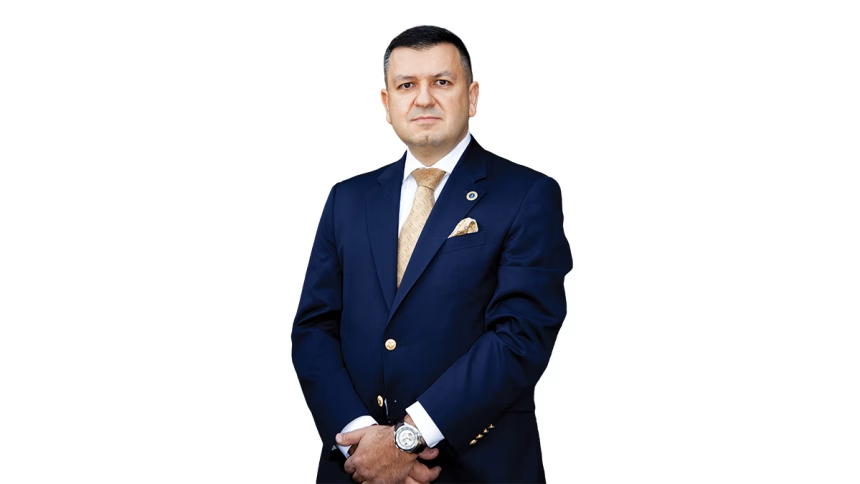
What if you could identify the threats to your health before they become issues? Can everyone benefit from preventive care instead of it being a luxury for a select few? Ali Tinazli, CEO of lifespin, was recently interviewed by MedEdge MEA to see how AI-driven health assessments are transforming prevention. He discusses how context, data, and technology are influencing healthcare in this open discussion, as well as the milestones that will be reached in 2026.
MedEdge MEA: How has your perspective on preventive medicine evolved since the early days of lifespin (2017-2020)?
Ali Tinazli: When lifespin started in 2017, preventive medicine largely lived in the world of VIP concierge care: highly personalized, expensive, and accessible to very few. It was elegant, but structurally fragile – more a privilege than a system.
What has changed since then is not the underlying biology, but the urgency to act at scale. Non-communicable diseases continue to rise globally, while healthcare systems face mounting pressure from aging populations, workforce shortages, and escalating costs. Prevention has therefore shifted from a lifestyle aspiration to an economic and societal necessity.
At the same time, expectations have matured. Providers, payers, and policymakers now demand preventive solutions that are measurable, clinically credible, and operationally scalable. Good intentions are no longer enough. This evolution has fundamentally shaped our approach at lifespin, how we design technology, how we generate evidence, and how we think about deployment in real-world healthcare settings.
ME: How will lifespin’s AI-powered health assessment platform transform preventive healthcare, and what milestones can we expect in 2026?
Tinazli: Prevention loses relevance when it remains abstract. Our focus is therefore on making it concrete –turning complex biological data into interpretable insights that support decisions and can be tracked over time. When people can see risk trajectories and responses to intervention, prevention moves from intention to routine.
In 2026, three developments stand out. First, we are launching a pharmacy-based channel in Germany, combining our platform with professional consultation at the point of access – where prevention can scale responsibly. Second, we are progressing toward CE marking for our metabolomics-based platform, which will accelerate adoption and broaden clinical use across Europe. Third, we are introducing dedicated software for insulin resistance assessment, designed to support earlier risk identification and longitudinal monitoring in type 2 diabetes prevention.
Together, these milestones move preventive care closer to everyday clinical and consumer reality, without compromising scientific rigor.
ME: What have you learned from international partnerships, and how will they help expand lifespin’s global footprint?
Tinazli: Healthcare challenges are remarkably similar across regions, aging populations, rising chronic disease burden, and cost pressure – but implementation is intensely local. Regulation, reimbursement, clinical workflows, and institutional decision-making vary widely.
International partnerships teach you humility and precision. What travels well are not slogans, but solutions that are scientifically defensible, operationally simple, and economically rational. Strong partners help translate these principles into local reality – whether by aligning with clinical expectations, adapting logistics, or building institutional trust.
ME: Can you share examples where MetaboPRO has directly influenced patient care or lifestyle changes compared with traditional lab tests?
Tinazli: Since the international rollout of MetaboPRO in 2025, a consistent pattern has emerged: the most meaningful impact often comes from improved clarity rather than dramatic findings.
In several cases, clinicians have used the platform to confirm that interventions – such as metabolic or lipid-management strategies – were producing coherent, system-wide improvements rather than isolated marker changes. That context matters when decisions need to be sustained over time.
In another instance, the analysis revealed a persistently atypical pattern across renal function and inflammatory markers over several months, which prompted closer clinical evaluation. While the platform is not diagnostic, this longitudinal signal led to the identification and resolution of a more serious systemic condition through appropriate follow-up clinical procedures.
The difference between our test compared to traditional laboratory tests lies not in frequency, but in context. Traditional check-ups based on legacy technologies typically report a limited panel of around 20 to 30 parameters, most of which are interpreted in isolation. While useful, this approach often misses subtle but meaningful patterns that emerge only when markers are viewed in relation to one another.
Most legacy health testing models assess biomarkers in isolation. We operate at the level of patterns – enabling risk to be evaluated systemically, over time.
In our workflow, we obtain approximately 250 biomarkers from a standard serum sample. Crucially, we do not merely quantify these markers; we analyze their relationships, ratios, and internal consistency across metabolic pathways. This contextual, multi-dimensional view allows the system to detect very subtle metabolic shifts that may indicate early dysfunction – well before they would become apparent in conventional testing.
ME: Where do you see lifespin in 2030, and what new innovations do you hope it will bring?
Tinazli: Healthcare rewards realism. Rather than predicting outcomes with certainty, we focus on building toward a clear direction: a comprehensive, evidence-based health assessment system that supports prevention across the lifespan while remaining clinically grounded and economically viable.
Today, our models address core domains such as glycemic control, liver and kidney function, inflammation, and cardiovascular risk. By 2030, we aim to expand meaningfully into additional areas, including thyroid function, energy metabolism, and muscle health – domains that are central to healthspan but often underrepresented in routine care.
If we succeed, the real innovation will not be a new buzzword. It will be a new default: making proactive health management routine rather than exceptional, with earlier signals, clearer decisions, and fewer people entering care too late for prevention to matter.