



• GHE Riyadh 2026 MedEdge
MedEdge MEA

Public Relations, Top Health Magazine and Healthcare News GCC

  • Newsletters
  • Magazines
  • Subscribe
  • Home
  • News
  • Opinion
  • Interviews
  • Featured
  • Cover Stories
  • Events
  • Health For all
    • Ageing Gracefully
    • Family Health Matters
    • Environment Health
    • Women and Child Health
    • Men’s Health
  • Resource Hub
    • Fresh Perspectives
    • Medical Tourism
    • Medical Education
    • Personnel
    • Research
      • Healthcare Journals & Publishers
    • Healthcare Campaigns
    • Health Tools Hub
    • Dubai Health Centers Directory | Services, Locations & Timings
    • ME Explained
  • Her Health
Reading: Is Your Child Afraid of the Dentist? You Might Be Part of the Problem
Share
Notification
  • GHE Riyadh 2026 MedEdge
MedEdge MEA logo full
  • Magazines
  • Newsletters
  • Profiles
  • Subscribe
Search
  • Home
  • News
  • Opinion
  • Interviews
  • Featured
  • Cover Stories
  • Events
  • Health For all
    • Ageing Gracefully
    • Family Health Matters
    • Environment Health
    • Women and Child Health
    • Men’s Health
  • Resource Hub
    • Fresh Perspectives
    • Medical Tourism
    • Medical Education
    • Personnel
    • Research
    • Healthcare Campaigns
    • Health Tools Hub
    • Dubai Health Centers Directory | Services, Locations & Timings
    • ME Explained
  • Her Health
Have an existing account? Sign In

Home - Lead - Is Your Child Afraid of the Dentist? You Might Be Part of the Problem

What Doctors Say

Is Your Child Afraid of the Dentist? You Might Be Part of the Problem

Sumayya Parveen. A
Sumayya Parveen. A
Published: September 16, 2026
Share
7 Min Read
Is Your Child Afraid of the Dentist You Might Be Part of the Problem
SHARE
google_preferred_source_badge_light_en@2x

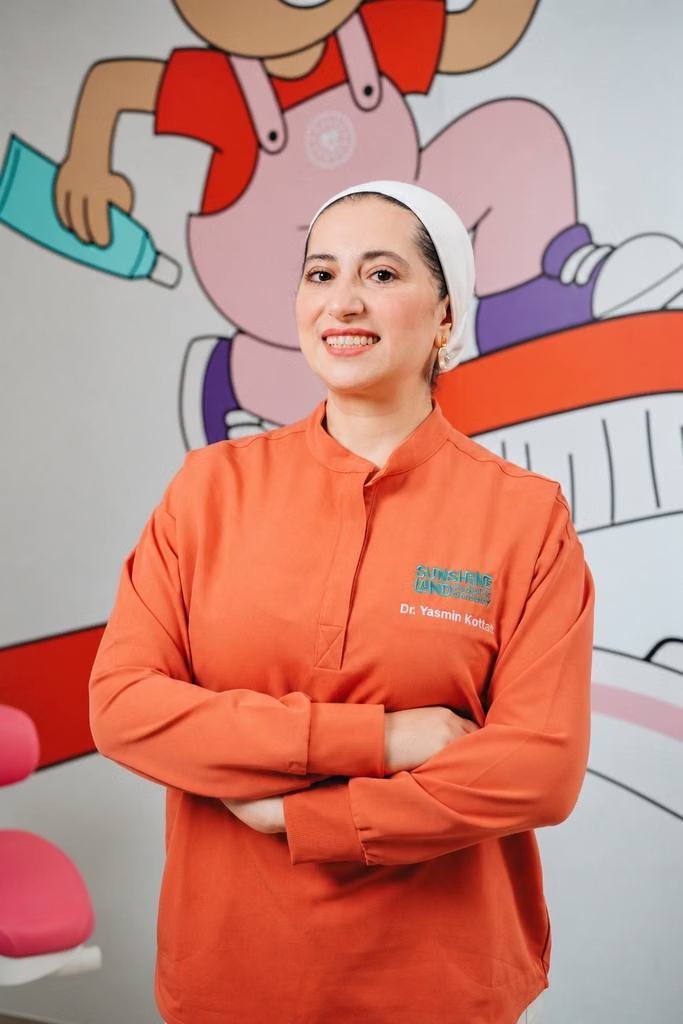
Dr Yasmin Kottait, founder of Sunshine Land Pediatric Dentistry in Dubai, says most childhood dental fear has less to do with the dentist and more to do with what happens before the appointment. From casual threats to skipped waiting room time, she walks through the everyday parenting habits that quietly shape whether a child walks into the clinic calm or already on edge.

In your experience, is dental fear in children usually learned, or does it show up on its own?

Fear itself is innate; we are all born with it. A child does not need to have had a bad experience to feel afraid of a stranger, of an unfamiliar situation, or of not being in control. Those are normal responses that can appear in any child, in any setting, without any prior sensitisation.

The dental visit tends to touch on several of those triggers at the same time. The dentist is someone the child has never met. The room brings unfamiliar sounds, sights and smells. The child has little say in what happens next. Add to that the parent’s own anxiety, energy and past experiences, plus whatever preparation the child was or was not given, and the honest fact that dentistry can involve some discomfort, and you have a lot working against the child before the appointment even starts. Children are not uniquely wired to fear the dentist. The visit itself brings together nearly every fear a child already carries.

What do parents say or do before a visit that they think is reassuring, but actually increases a child’s fear?

The phrase I hear most often is some version of: if you do not listen, if you do not sit still, the dentist will give you an injection. I always ask parents why they would say that. Are they on my side, or not? That one sentence can undo everything I am trying to build with a child before I have even said hello, and once that anxiety sets in, it takes a long time to work back out.

Click here to join our WhatsApp channel here

My main rule for parents is simple. Do not threaten. Do not use the dentist, or anything that happens in the chair, as a punishment or a consequence. Doing so plants a fear that did not need to exist.

Is there a difference between how fear shows up in a first-time visitor versus a child who has had a bad experience before?

Yes, and the distinction matters. A first-time visitor usually shows a general, diffuse nervousness about the unknown, nothing specific yet. A child who has already had a bad experience is dealing with something different: anxiety, or in some cases phobia. It is sharper and more specific, and harder to work through, because the child is no longer afraid of the unknown. They are afraid of something they already know.
WhatsApp Image 2026 09 16 at 2.50.39 PM
Dr Yasmin Kottait, founder of Sunshine Land Pediatric Dentistry

Are there specific words or phrases you would tell parents to avoid using with their child before an appointment?

Beyond not threatening, I tell parents to be honest without over-explaining or over-preparing, and to avoid negative intonation. Then leave the framing to us. We are trained to talk to children in language that keeps them calm and curious rather than on edge, things like “I’m going to tickle your teeth” or “we’re going to use the buzzing bee” or “we’re going to make the germs go away.” It helps if parents let the dental team choose those words.

How much of a child’s dental anxiety comes from the parent’s own anxiety about dentists? What is the most common mistake you see well-meaning parents make in the waiting room itself?

I would put it at around 80 percent. The parent’s energy, history and approach going into the visit is the single biggest factor in how the child responds.

Also read: Healthcare Workforce Survey Highlights Gap Between Leaders and Frontline Workers

Most children’s dental clinics, ours included, design the waiting area deliberately to be playful and inviting. What I see most often is a parent not letting the child actually use it. The child wants to explore and play, and the parent sits them down right beside them instead. That waiting room is often the child’s first chance to feel safe in the space before anything clinical begins, and letting them explore it does real work.

Once a child is genuinely afraid, how long does it typically take to rebuild trust, and what does that process look like?

That depends entirely on the child, their history and what needs to be addressed; there is no fixed number of visits. But the process itself follows a consistent shape. We always begin with a no-treatment visit, a simple clean and fluoride and nothing more. The point of that visit is not the dental work, it is trust. Once that trust is established, we move on to actual treatment. We do not skip that step, even if it means more visits than a parent expects.

 Trust has to come back before the smile can.

Share This Article
Facebook Whatsapp Whatsapp LinkedIn Copy Link
Share
Previous Article WhatsApp Image 2026 09 16 at 1.27.22 PM Carrefour Stores to Expand Smart Recycling Initiative Across the UAE

Recent Posts

  • Is Your Child Afraid of the Dentist? You Might Be Part of the Problem
  • Carrefour Stores to Expand Smart Recycling Initiative Across the UAE
  • Gaza Hospitals Face Critical Shortages as Premature Births Rise
  • Healthcare Workforce Survey Highlights Gap Between Leaders and Frontline Workers
  • Cancer Patient Preserves Future Fertility Before Starting Chemotherapy
  • Global Health Riyadh 2026 MedEdge MEA
Two Point Five Logo white
  • About Us
  • Contact Us
  • Medical Disclaimer
  • Privacy Policy
  • Terms and Conditions
  • Cookie Policy (EU)
  • Submit Your Story
  • MediaKit
Reading: Is Your Child Afraid of the Dentist? You Might Be Part of the Problem
Share

Published by Two Point Five Media FZCO

  • About Us
  • Contact Us
  • Medical Disclaimer
  • Privacy Policy
  • Terms and Conditions
  • Cookie Policy (EU)
  • Submit Your Story
  • MediaKit
Reading: Is Your Child Afraid of the Dentist? You Might Be Part of the Problem
Share

Follow US on Social Media

Facebook Instagram Linkedin X-twitter Youtube Whatsapp
Manage Consent
To provide the best experiences, we use technologies like cookies to store and/or access device information. Consenting to these technologies will allow us to process data such as browsing behavior or unique IDs on this site. Not consenting or withdrawing consent, may adversely affect certain features and functions.
Functional Always active
The technical storage or access is strictly necessary for the legitimate purpose of enabling the use of a specific service explicitly requested by the subscriber or user, or for the sole purpose of carrying out the transmission of a communication over an electronic communications network.
Preferences
The technical storage or access is necessary for the legitimate purpose of storing preferences that are not requested by the subscriber or user.
Statistics
The technical storage or access that is used exclusively for statistical purposes. The technical storage or access that is used exclusively for anonymous statistical purposes. Without a subpoena, voluntary compliance on the part of your Internet Service Provider, or additional records from a third party, information stored or retrieved for this purpose alone cannot usually be used to identify you.
Marketing
The technical storage or access is required to create user profiles to send advertising, or to track the user on a website or across several websites for similar marketing purposes.
  • Manage options
  • Manage services
  • Manage {vendor_count} vendors
  • Read more about these purposes
View preferences
  • {title}
  • {title}
  • {title}

WhatsApp us

Logo of Medede mea
Welcome Back!

Sign in to your account

Username or Email Address
Password

Lost your password?