
• Duphat
  • infinia camp
  • Emirates Digestive Diseases
MedEdge MEA MedEdge_Logo_Dark

Public Relations, Top Health Magazine and Healthcare News GCC

  • Newsletters
  • Magazines
  • Subscribe
  • Home
  • News
  • Opinion
  • Interviews
  • Featured
  • Cover Stories
  • Events
  • Health For all
    • Ageing Gracefully
    • Family Health Matters
    • Environment Health
    • Women and Child Health
    • Men’s Health
  • Resource Hub
    • Fresh Perspectives
    • Medical Tourism
    • Medical Education
    • Personnel
    • Research
      • Healthcare Journals & Publishers
    • Healthcare Campaigns
    • Health Tools Hub
    • Dubai Health Centers Directory | Services, Locations & Timings
    • ME Explained
Reading: Cincinnati Children’s researchers collaborate with colleagues in Uganda where the disease burden is highest.
Share
Notification
  • Duphat
  • infinia camp
  • Emirates Digestive Diseases
MedEdge MEA
  • Magazines
  • Newsletters
  • Profiles
  • Subscribe
Search
  • Home
  • News
  • Opinion
  • Interviews
  • Featured
  • Cover Stories
  • Events
  • Health For all
    • Ageing Gracefully
    • Family Health Matters
    • Environment Health
    • Women and Child Health
    • Men’s Health
  • Resource Hub
    • Fresh Perspectives
    • Medical Tourism
    • Medical Education
    • Personnel
    • Research
    • Healthcare Campaigns
    • Health Tools Hub
    • Dubai Health Centers Directory | Services, Locations & Timings
    • ME Explained
Have an existing account? Sign In
MedEdge MEA > News > Collaborations > Cincinnati Children’s researchers collaborate with colleagues in Uganda where the disease burden is highest.
Collaborations

Cincinnati Children’s researchers collaborate with colleagues in Uganda where the disease burden is highest.

ME Desk
ME Desk
Published: June 4, 2026
Share
3 Min Read
SHARE

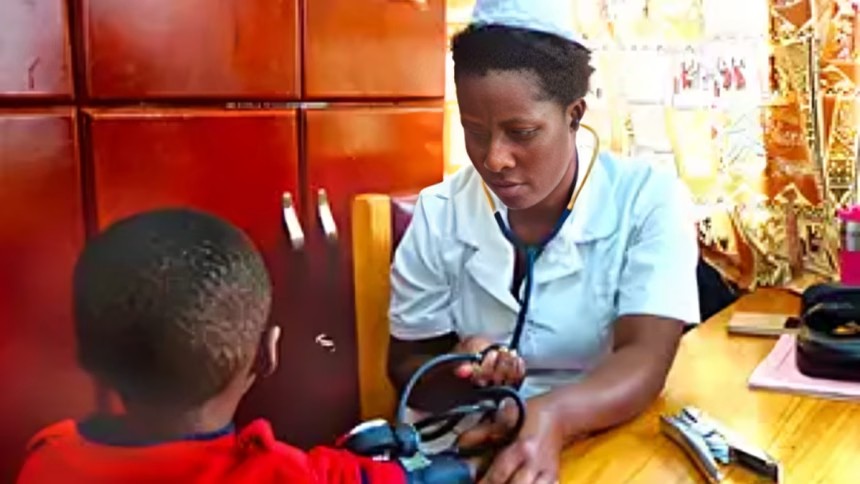
Fewer serious complications. Fewer hospitalizations and blood transfusions. Better growth and development. And a markedly lower risk of death from the complications of sickle cell anemia.

These are the benefits documented from 10 years of continuous hydroxyurea treatment provided in the NOHARM trial to a group of young children in Uganda, which has one of the world’s largest number of people living with the painful disorder known for causing sickle-shaped red blood cells. These improved outcomes were highlighted May 27, 2026, in a report published by The New England Journal of Medicine.

Russell Ware, MD, PhD, director of the Division of Hematology and the Global Health Center at Cincinnati Children’s, was the lead author of the report. He has been working for years with researchers and clinicians across sub-Saharan Africa to demonstrate the safety and effectiveness of low-cost hydroxyurea treatments.

Also Read: King Faisal Hospital Ranks 12th Globally in Brand Finance 2026

“In a low-resource environment like sub-Saharan Africa where about 50% of children with sickle cell anemia will die by age 10 years, we have reduced the death rate to about 1-2% per year. That’s at least an 80% improvement over the natural history of this condition in this region,” Ware says.

In sub-Saharan Africa, an estimated 300,000 to 400,000 babies are born with sickle cell disease. Far fewer infants are born with sickle cell disease in the United States, but their life expectancy now exceeds 50 years of age. That’s because the U.S. offers widespread mandatory newborn screenings, and children have access to multiple forms of treatment, including penicillin provided early in life, hydroxyurea, regular blood transfusions and other forms of care to manage organ damage. In recent years, new and expensive gene therapies have offered cures to some people with the disease.

Hydroxyurea – an older medication initially used to treat cancer and HIV is available in Africa for anywhere from 10 cents to $1 per capsule. The drug prompts the body to produce fetal hemoglobin (HbF), which helps prevent red blood cells from sickling. Regular use of the drug reduces the frequency of painful crises, episodes of acute chest syndrome, and the need for blood transfusions.

In the new NEJM report, Ware and colleagues add that providing the “maximum tolerated dose” is notably more effective than smaller doses and still pose no major long-term safety concerns. The researchers found that many patients can tolerate doses as high as 30 mg/kg/day versus initial “fixed” doses of 15-20 mg/kg/day used earlier in their studies.

“These findings matter globally because they show that a proven sickle cell therapy can work safely and effectively even in settings complicated by malaria, malnutrition, and limited access to care,” Ware says.

Click here to join our WhatsApp channel here

Share This Article
Facebook Whatsapp Whatsapp LinkedIn Copy Link
Share
Previous Article Unsafe food causes illnesses and deaths annually, young children at highest risk
Next Article New IAEA Project to Advance Terbium-Based Radiopharmaceuticals for Improved Theranostics

Recent Posts

  • Cabaletta Bio Reports Promising Rese-cel Data at EULAR 2026
  • HHS Unveils Sweeping Plan to Combat Lyme Disease and Advance Treatment
  • New IAEA Project to Advance Terbium-Based Radiopharmaceuticals for Improved Theranostics
  • Cincinnati Children’s researchers collaborate with colleagues in Uganda where the disease burden is highest.
  • Unsafe food causes illnesses and deaths annually, young children at highest risk
  • duphat
  • MedEdge-Infinia
Two Point Five Logo white
  • About Us
  • Contact Us
  • Medical Disclaimer
  • Privacy Policy
  • Terms and Conditions
  • Cookie Policy (EU)
  • Submit Your Story
  • MediaKit
Reading: Cincinnati Children’s researchers collaborate with colleagues in Uganda where the disease burden is highest.
Share

Published by Two Point Five Media FZCO

  • About Us
  • Contact Us
  • Medical Disclaimer
  • Privacy Policy
  • Terms and Conditions
  • Cookie Policy (EU)
  • Submit Your Story
  • MediaKit
Reading: Cincinnati Children’s researchers collaborate with colleagues in Uganda where the disease burden is highest.
Share

Follow US on Social Media

Facebook Instagram Linkedin X-twitter Youtube Whatsapp
Manage Consent
To provide the best experiences, we use technologies like cookies to store and/or access device information. Consenting to these technologies will allow us to process data such as browsing behavior or unique IDs on this site. Not consenting or withdrawing consent, may adversely affect certain features and functions.
Functional Always active
The technical storage or access is strictly necessary for the legitimate purpose of enabling the use of a specific service explicitly requested by the subscriber or user, or for the sole purpose of carrying out the transmission of a communication over an electronic communications network.
Preferences
The technical storage or access is necessary for the legitimate purpose of storing preferences that are not requested by the subscriber or user.
Statistics
The technical storage or access that is used exclusively for statistical purposes. The technical storage or access that is used exclusively for anonymous statistical purposes. Without a subpoena, voluntary compliance on the part of your Internet Service Provider, or additional records from a third party, information stored or retrieved for this purpose alone cannot usually be used to identify you.
Marketing
The technical storage or access is required to create user profiles to send advertising, or to track the user on a website or across several websites for similar marketing purposes.
  • Manage options
  • Manage services
  • Manage {vendor_count} vendors
  • Read more about these purposes
View preferences
  • {title}
  • {title}
  • {title}

WhatsApp us

Logo of Medede mea
Welcome Back!

Sign in to your account

Username or Email Address
Password

Lost your password?