

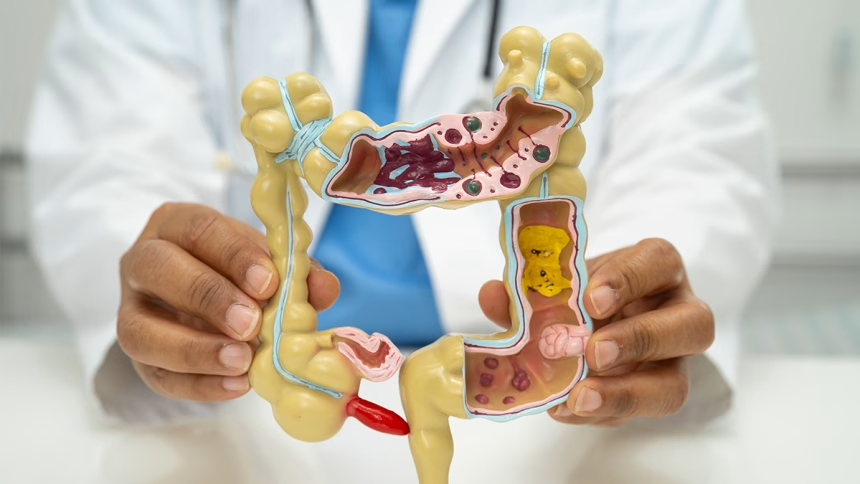

For decades, Inflammatory Bowel Disease (IBD), principally comprising Crohn’s disease and ulcerative colitis, was viewed largely as a condition of the West. It was the disease of Europe and North America, something we read about in medical textbooks but rarely encountered in our clinics here in the Middle East. Today, that narrative has shifted dramatically. We are no longer just reading about it. We are on the front lines of a silent epidemic that is reshaping the digestive health landscape of our region.
In the UAE, we are witnessing a startling trend. Recent data indicates a nearly 13-fold increase in new IBD diagnoses over the past two decades. This represents a fundamental shift in the health profile of our nation. What is perhaps more concerning is the nature of the disease we are seeing in our clinics across the country. Unlike the classic Western presentation, our patients are younger and often present with a far more aggressive phenotype. A significant proportion of our Crohn’s disease patients arrive with complex complications like strictures, fistulas, or perianal disease at the very onset of their diagnosis.
The “Why”: Unlocking the Exposome
Why is this happening now? The rapid urbanization and industrialization of the UAE have brought immense benefits to our quality of life, but they have also dramatically altered our environment. We call this the “exposome.” The shift towards Westernized diets, increased antibiotic use, and changes in our living environments are interacting with our biology in ways we are only just beginning to understand.
Also Read: Shreyas Iyer Hospitalized with Rib Cage Injury: What You Need to Know
This is where our collective work in the UAE goes beyond standard clinical care. Supported by a major grant from the Department of Health in Abu Dhabi, the UAE Epi-IBD Study is a pioneering national initiative. We are not just counting cases. We are hunting for causes. We are meticulously mapping the environmental exposures of our patients and using multi-omics technology to understand how these external factors are rewriting our internal biology. Building on this foundation, our upcoming research will dive even deeper into epigenetics. We believe that the environment acts as a switch, turning specific genes on or off through chemical modifications like DNA methylation. By deciphering these switches, we hope to explain why IBD in the UAE is rising so fast and why it hits our population so hard. This understanding is the first step toward true prevention.
Bridging the Gap in Care
Understanding the disease is only half the battle. Treating it effectively is the other. We are fortunate to have a robust healthcare infrastructure in the UAE, yet ensuring equitable access to the latest advanced therapies remains a priority. The high cost of biologics and small molecule therapies means that continuous efforts are needed to streamline access pathways for all patients.
This is why generating local data is crucial. We cannot simply rely on clinical trials from Europe or the United States to justify treatments for our population. We need our own evidence to prove what works here. The UAE IBD community has embarked on generating Real-World Evidence (RWE) to support our clinical decisions. Recent collaborative work has demonstrated that newer agents are highly effective in our specific, complex patient population. We have shown that moving to these targeted therapies earlier can prevent the irreversible bowel damage that leads to surgery.
To further standardize care and ensure every patient gets the right treatment at the right time, regardless of where they are seen, the UAE expert community recently came together to publish UAE-wide expert consensus guidance. This document serves as a blueprint for clinicians, payers, and policymakers alike. It ensures that care delivery in the UAE meets the highest international standards while pragmatically addressing our local realities.
A Global Hub for Research & Academic Excellence
In the UAE, our vision for IBD care extends beyond the clinic walls. We have established a vibrant academic ecosystem, driving a robust portfolio of research that places us on the global stage. The UAE is currently leading multiple investigator-initiated studies, such as the region’s first device study for flare detection. Our centers, including SSMC, act as key sites for major industry-sponsored clinical trials, including head-to-head studies with active comparators and investigations into novel mechanisms of action such as TL1A inhibitors. This gives our patients access to cutting-edge therapies long before they are widely available. With numerous collaborative clinical and basic science studies along with disease registries fuelling ongoing discovery, the UAE is setting the benchmark for academic excellence in the Middle East.
Click here to join our WhatsApp channel here
Looking Forward
While our primary focus remains on understanding the environmental drivers of this disease, we are also continuously exploring the genetic underpinnings unique to our population. Though still in early stages, our work on identifying distinct (monogenic) forms of IBD and developing local risk scores represents a profound opportunity to further refine our approach in the future. The rise of IBD in the UAE is a significant challenge, but it is one we need to meet with rigorous science and compassionate care. We are moving from a reactive model that treats complications as they arise to a proactive era of precision medicine. Our goal is not just to manage this disease but to understand its origins in our unique environment and, ultimately, to turn the tide.

Consultant Gastroenterologist & Director of the IBD Center,
Sheikh Shakhbout Medical City (SSMC)
References
- Ahmed HA, Alzaabi MN, Swaid TK, et al. Evolving clinical burden of inflammatory bowel disease in the United Arab Emirates: a two-decade analysis of diagnoses and disease severity. Frontline Gastroenterol. 2025; doi:10.1136/flgastro-2025-103345.
- Alzaabi MN, Swaid TK, Ahmed HA, et al. Real-World Effectiveness of Risankizumab in Crohn’s Disease: Outcome Data for an IL-23 Inhibitor from the Middle East. Crohns & Colitis 360. 2025; doi:10.1093/crocol/otaf062.
- Al Awadhi S, Al Hassani A, El Ouali S, et al. Second United Arab Emirates consensus guidance on the diagnosis and management of inflammatory bowel disease. World J Gastroenterol. 2025;31(35):109882. doi:10.3748/wjg.v31.i35.109882.